The Burgundy-Beamed House Beneath the Forest Canopy
Hidden along a narrow residential lane surrounded by dense woodland, this abandoned Stick Style Victorian house remains a striking reminder of nineteenth-century craftsmanship and changing seasons. The three-story family residence sits quietly among spruce, birch, and maple trees, where moss-covered stones, ferns, and climbing ivy have slowly reclaimed the edges of the property.
The exterior is defined by a layered combination of white-painted timber, deep burgundy-red decorative beams, pale grey stone foundations, and a weathered copper roof that has aged into a muted green patina. The contrasting materials create a strong Victorian character, with the exposed structural patterns giving the façade a handcrafted and architectural presence.
The Stick Style details remain visible despite decades of abandonment.
Ornate wooden brackets decorate the upper sections of the home, carved porch columns support the curved entry area, and narrow bay windows create vertical accents along the façade. The steep asymmetrical gables rise unevenly above the structure, adding to the expressive silhouette of the residence.
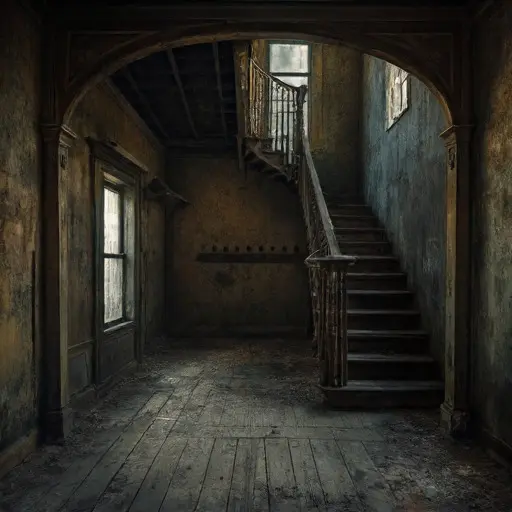
Time has gently reshaped the house rather than destroying it. The walls bow subtly outward, the central gable has developed a slight crooked angle, and the windows sit with uneven spacing that reflects years of gradual settling. The imperfections give the building a natural, lived-in appearance, as though the structure has adapted slowly to its environment.
The wraparound porch curves naturally around the side of the house, following the softened shape of the building. Its wooden details show traces of fading paint and weather exposure, while sections of the railing and support elements appear worn but still recognizable. The porch creates a transition between the abandoned home and the surrounding forest, now partially covered by creeping vegetation.
The muted green copper roof adds another layer of character to the residence. Its aged surface catches the diffused overcast daylight, revealing subtle changes in texture and color. The steep roof sections and irregular gables create a dynamic profile that rises above the surrounding trees.
Around the property, nature has gradually taken over the forgotten garden. Moss-covered rocks sit among tall ferns, ivy climbs along old fences, and abandoned planting beds have merged with the woodland floor. The forest feels close and quiet, surrounding the house with a sense of isolation.
Beneath an old tree near the yard, a faded wooden swing set remains in place. Its worn structure stands among tall grass and fallen leaves, preserving a small trace of the family life that once surrounded the home. Nearby, a rusted iron gate hangs open beside a cracked stone pathway leading toward the entrance.
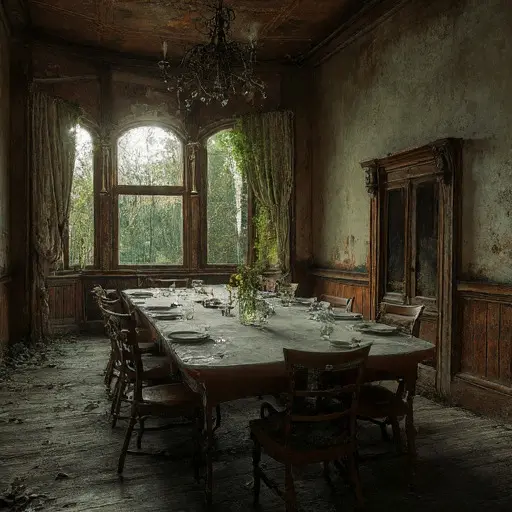
Inside, the house holds a quiet atmosphere of forgotten elegance. The exposed timber construction continues into the interior, where wooden beams, aged floors, and handcrafted details reveal the skill of the original builders. Empty rooms retain their historic character, with layers of dust and weathered surfaces showing the passage of time.
The narrow windows allow soft grey daylight to enter, illuminating faded textures and worn materials without changing the abandoned mood of the spaces. The absence of modern alterations leaves the original Victorian craftsmanship as the defining feature of the interior.
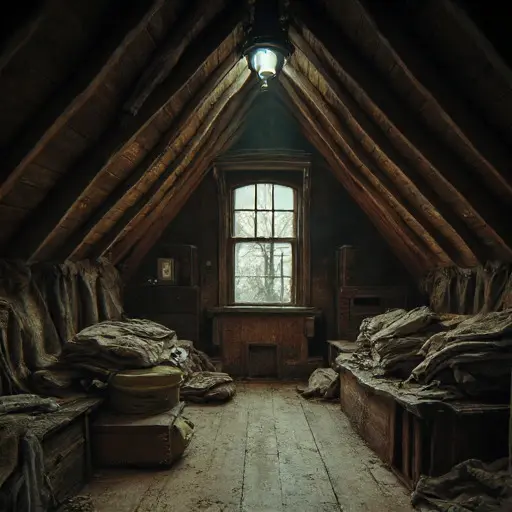
The Burgundy-Beamed House Beneath the Forest Canopy remains a quiet architectural relic surrounded by woodland. Its white timber walls, deep red beams, moss-covered foundations, and aged copper roof tell the story of a home slowly returning to nature.
Though empty and forgotten, the residence still carries the character of its original design. Every uneven window, curved porch detail, and weathered wooden element reflects the passage of time while preserving the charm of a remarkable Stick Style Victorian home.