The Brinewatch House and the Quiet Dissolution of a Cliff Accounting Estate
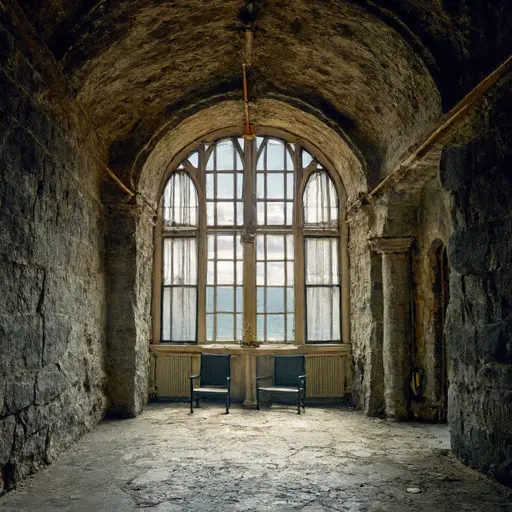
The Brinewatch House was completed in 1890 for Charles Edwin Brinewatch, born 1842 in Cornwall, a coastal infrastructure surveyor and maritime land auditor specializing in cliff stability mapping, harbor adjacency valuation, and erosion-based property assessment. His wealth derived from government contracts establishing standardized systems for evaluating coastal land risk, allowing insurance underwriters and port authorities to quantify structural exposure along unstable shorelines. The house was built directly into the cliff above a gray ocean inlet to serve as both residence and observation site for long-term coastal measurement records.
He lived there with his wife Edith Marlowe Brinewatch and their son Thomas, who later assisted in maintaining erosion ledgers and structural drift documentation tied to regional coastal planning offices.
The decline began in 1906 after discrepancies emerged between cliff stability measurements and recorded land valuation updates, caused by accelerating erosion patterns that invalidated earlier structural risk models. Coastal authorities challenged multiple insurance classifications as shoreline regression outpaced projected modeling intervals, producing persistent inconsistencies between measured and forecasted cliff positions. Brinewatch had personally guaranteed portions of the coastal assessment framework, expecting long-term stabilization through refined geological sampling, but wave-driven undercutting introduced nonlinear shifts that could not be reconciled within the original system. By 1912, regional planning boards began restructuring coastal valuation standards, and correspondence shifted from routine survey summaries to formal disputes over methodological validity. Thomas’s involvement in structural documentation ceased after a final audit identified unresolved inconsistencies across multiple cliffside assessment layers.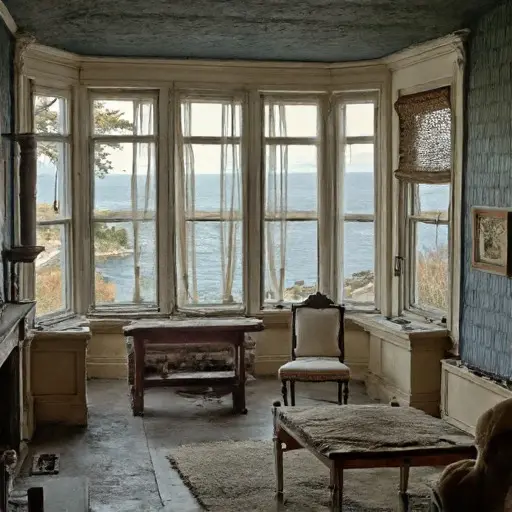
By 1914, Charles Brinewatch had taken a position within a regional coastal planning office to resolve ongoing disputes in erosion-based valuation methodology, leaving the house under only intermittent caretaker oversight. Edith’s correspondence ceased shortly afterward, and Thomas’s name appears once more in a final institutional file concerning contested cliff stability standards. The Brinewatch House remained fully furnished but unmanaged, its coastal ledgers locked in the study and its cliff-facing rooms left untouched. No sale was completed, no family returned, and the property was recorded as vacant, standing intact above the inlet while quietly continuing to follow its own softened and slightly misaligned logic of space, stone, and sea.