The Brindleharp House Letters and the Hearth of Dust
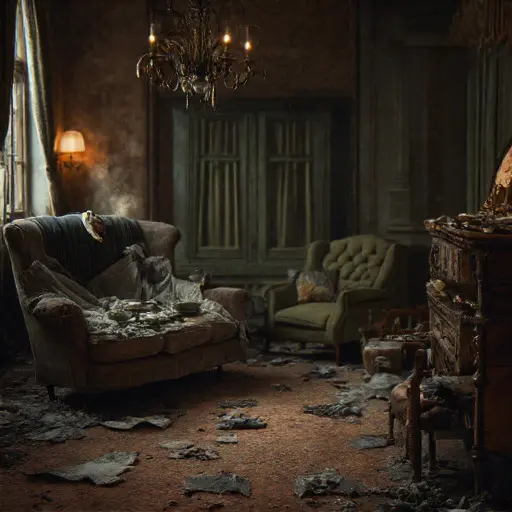
The parlour’s air is dense, unmoving, scented faintly with the mineral tang of old plaster and the sweetened dryness of rotted upholstery. Each step is muffled by carpeting that has long since surrendered its spring. Brindleharp House does not feel deserted by haste; rather, it feels paused—objects retained in postures of use, tasks awaiting completion, domestic rhythms arrested mid-breath.
The Measured Existence of Bernard Ellison Brindle
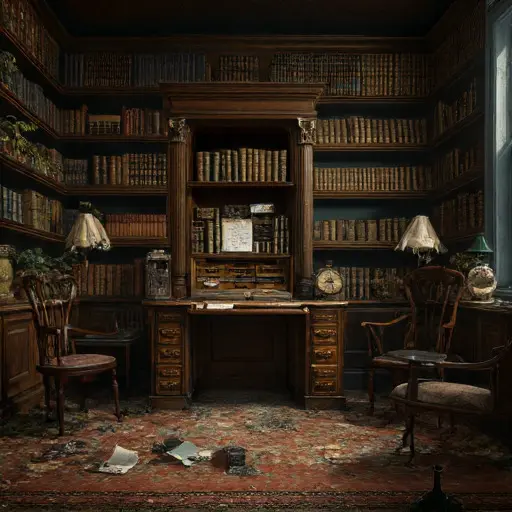
Bernard Ellison Brindle, a railway timetabling clerk of methodical temperament, lived here with his wife, Henrietta, and their son, Alden. Bernard’s days revolved around punctuality: ledgers updated with unwavering neatness, mealtimes held with clockwork regularity, and correspondence arranged in narrow pigeonholes crafted into the desk he commissioned for the Library Room. His handwriting, preserved in scattered documents, is steady and looping, though slight tremors appear in his later notes—subtle hints of fatigue he rarely admitted.
Henrietta managed the household quietly but thoroughly, leaving traces in every room: neatly folded linens awaiting mending, recipe cards annotated in crisp ink, and pressed flowers tucked into volumes of poetry. Alden’s belongings—school primers, a half-finished watercolor of a mantel clock, and a wooden puzzle missing only one piece—suggest a childhood sustained even as the house’s finances dipped into uncertainty.
When Bernard’s schedule division was reorganized, his responsibilities doubled overnight. His ledger entries grow cramped and darker, ink pooling in places where he paused too long. Missed meals, unsorted letters, and receipts left unfiled betray a shift from control to slow erosion. Henrietta’s passing deepened this unraveling. Work consumed him; domestic care diminished; Alden was sent to live with an aunt. No single event emptied the home—the house simply quieted as Bernard withdrew from it, each room settling into stillness.
A Corridor That Records the Family’s Slow Departure
The upper corridor reveals a gradual retreat rather than an exodus. The runner is bunched into uneven folds where feet once avoided warped boards. A hall table holds a tumble of gloves, a broken teacup handle, and visiting cards never sorted. On the wall, faint squares in the wallpaper show where portraits once hung, removed slowly over years as items were passed along to distant relatives.
Domestic Work Left Mid-Breath in the Mending Room
In the Mending Room, Henrietta’s final tasks remain exactly as she left them. A treadle machine holds a half-hemmed petticoat beneath its presser foot. Pin-cushions bloom with rusted needles. Ribbons, lace scraps, and basted seams lie arranged in deliberate piles, now stiffened from long disuse. Nothing here suggests haste—only interrupted continuity.
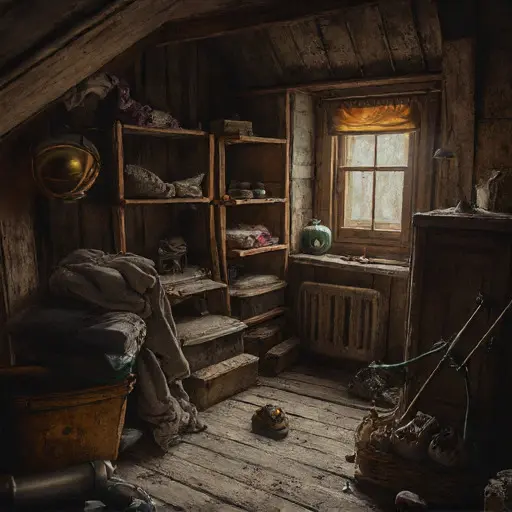
Behind a crate lies a folded sheet in Bernard’s hand, listing “chores postponed until next week.” There is no date, no concluding note—only the faint expectation of return. It rests there still, and Brindleharp House remains abandoned, its rooms holding the quiet weight of tasks that waited too long.
