The Briarcrest Castle House Where Conversations Were Never Finished
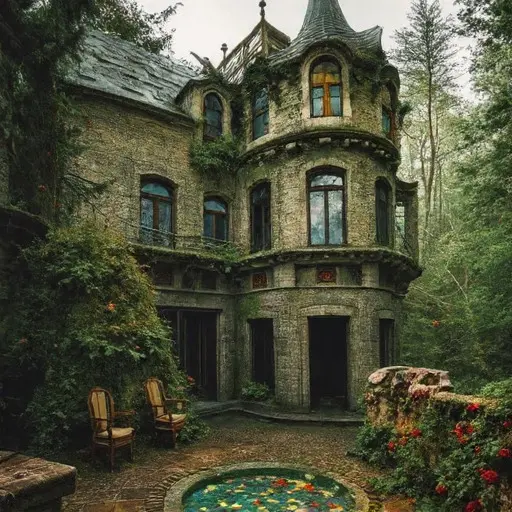
Briarcrest Castle stood in a forest clearing where wind moved differently around stone than it did through trees. Built as a compact Victorian interpretation of a castle residence, it balanced defensive formality with domestic softness, its silhouette rising in uneven layers that avoided strict symmetry in favor of lived adaptation.
It was commissioned by Edmund Harrow and his sister Lillian, who inherited the land after a distant branch of their family line dissolved into legal obscurity.
Edmund, fascinated by medieval masonry, insisted on a central tower that would anchor the house both visually and emotionally. Lillian, more attuned to gardens than fortifications, softened his design with curved turrets, open terraces, and winding circulation paths that allowed the structure to remain porous to the forest around it.
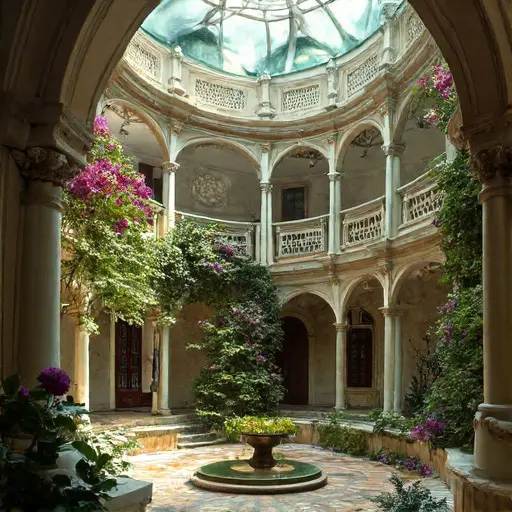
Life within Briarcrest was structured but never rigid. Mornings began in the tower’s upper rooms where light entered through ruby-framed windows, shifting across stone floors as correspondence was sorted and household plans were drafted. Afternoons often dissolved into the courtyard, where gardening, reading, and quiet conversation blurred together without strict separation between task and leisure.
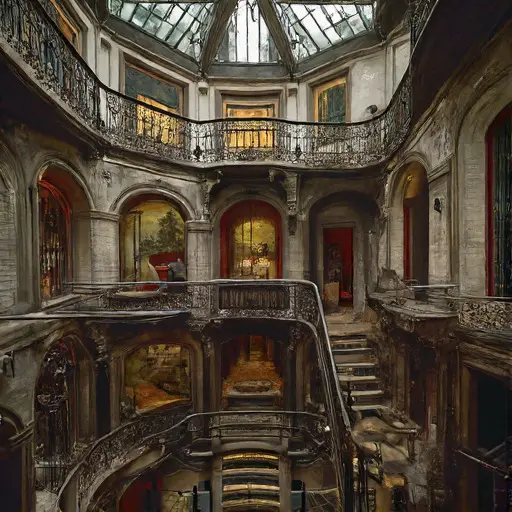
The decline began without a single defining moment. Maintenance demands grew as the structure expanded into its layered complexity. Roof sections required constant attention due to alternating slate pitches and terrace exposure. Edmund attempted to oversee repairs personally, but increasing costs and logistical difficulty slowed progress.
After Lillian’s prolonged illness, the gardens became less actively managed. What had once been carefully guided growth began to spread independently, with roses and wisteria overtaking architectural boundaries. The courtyard remained accessible, but pathways gradually narrowed as vegetation reclaimed circulation routes.
Edmund continued to occupy the tower longer than any other part of the house. He preferred its height, where he could observe both the forest and the slow transformation of his own creation. Letters sent from the castle became less frequent, then eventually ceased entirely.
By 1950, Briarcrest Castle was fully abandoned. Edmund never returned after his final departure, and Lillian’s estate remained legally unresolved due to incomplete succession records. No restoration effort followed, as the structure’s layered complexity and forest integration made intervention impractical.
The house remains standing within the clearing, not as a ruin but as a softened extension of the landscape. Ivy binds its towers, roses climb its balconies, and the courtyard continues to fill and empty with the seasons. Nothing within it suggests a sudden end—only a long, uninterrupted fading into the rhythm of the forest.