The Brackenridge Hillside Manor Abandoned Into the Slope
The Brackenridge Hillside Manor was completed in 1907 for mining engineer Edward Brackenridge, who chose a steep forested slope to isolate his household from nearby industrial settlements. Built as a compact, fortress-like residence, the manor housed Edward, his wife Caroline, and their son Thomas, along with a small staff responsible for managing geological surveys and mining records. The structure was intentionally embedded into the hillside, reflecting Brackenridge’s belief in permanence and defense against both environmental instability and economic uncertainty. In its early years, the house functioned as both residence and field headquarters, where excavation data and land assessments were compiled in a tightly controlled environment.
<img src=”https://beyondvisit.
com/wp-content/imagecontent/uploads/abandoned victorian house 56167620.webp” alt=”” />
The study reflected the disciplined mindset of Edward Brackenridge, but by the late 1910s, mining yields in the surrounding region began to decline. Excavation operations were reduced, and several survey routes were abandoned entirely. Financial returns weakened, forcing reductions in household staff and delaying structural maintenance on the already heavily reinforced estate. Small fissures appeared in the retaining buttresses, and moisture began seeping through the lower basalt courses where hillside pressure increased with seasonal rainfall. Although the manor remained occupied, its operational intensity steadily diminished.
Structural Strain and Withdrawal
By the mid-1920s, Edward Brackenridge’s health deteriorated alongside his business interests. Mining ventures collapsed under rising costs and depleted deposits, leaving the estate increasingly dependent on dwindling reserves. Sections of the manor embedded into the slope became difficult to access due to shifting soil and partial blockage of interior passages. The collapsed stone stairway leading to the entrance was never repaired, and entry was restricted to narrow side corridors reinforced with temporary timber supports. Over time, entire sections of the lower levels were sealed to prevent further structural compromise.
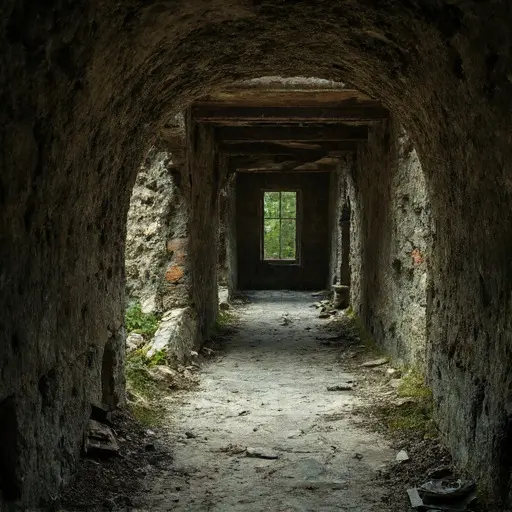
After Caroline Brackenridge’s death in 1930, inheritance disputes divided ownership among distant relatives and financial trustees, none of whom agreed on restoration or continued residence. Legal proceedings tied the property in prolonged uncertainty, preventing sale or intervention. With no unified oversight, maintenance ceased entirely. Vegetation began forcing its way through masonry joints, particularly along the lower hillside-facing walls where root systems destabilized already weakened stonework. Upper levels remained exposed to wind and seasonal erosion, accelerating the fragmentation of slate roofing and metal cladding.
Final Abandonment Into the Hillside
By the early 1940s, the Brackenridge Hillside Manor had been fully abandoned. No heirs returned, and no authority assumed responsibility for stabilization or repair. Soil pressure from the hillside increased gradually, causing additional displacement of retaining buttresses and widening structural cracks along load-bearing walls. Interior spaces became inaccessible as passages collapsed or filled with debris. Moisture, vegetation, and gravity collectively reshaped the structure into a partially absorbed extension of the slope, blurring the boundary between architecture and terrain.
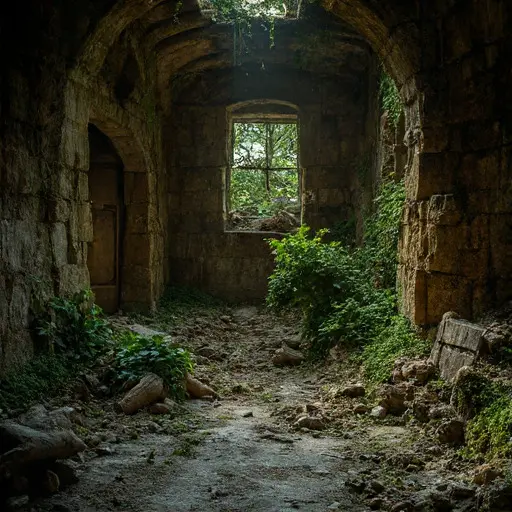
No restoration efforts were ever made, and no legal resolution brought the estate back into use. The Brackenridge Hillside Manor remains embedded in the forest slope, slowly deteriorating under constant geological pressure and vegetation growth. Its interior spaces are permanently abandoned, with no remaining signs of habitation, repair, or future recovery.