The Blue Brick Silence of the Curved Tower Estate
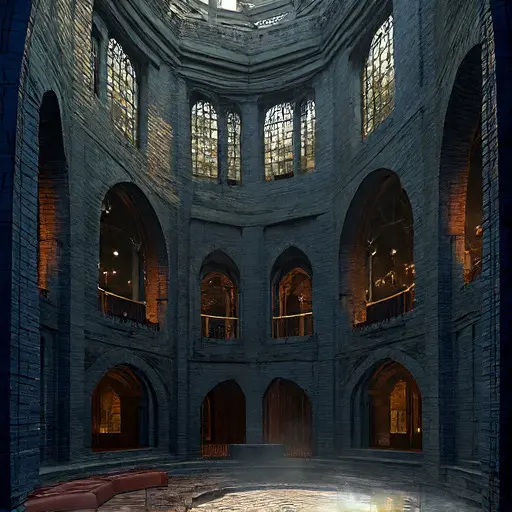
In a quiet forest clearing, a Neo-Gothic Victorian three-story family estate rises as a structure defined by curvature rather than strict vertical order. Its construction of deep cobalt-blue brick is interwoven with pale sandstone ribs that sweep across the façade in flowing structural arcs. These elements replace traditional straight lines, giving the entire building a sense of restrained motion, as if it were shaped by gradual pressure over time rather than fixed construction.
The silhouette is subtly dynamic. One wing projects forward in a slow, bending curve, while the opposite side recedes into the forest edge. A tapered corner tower leans slightly inward, its posture suggesting long-term settlement rather than instability. The roof above is composed of staggered slate planes and muted copper ridges, forming broken yet elegant peaks that vary gently in height across the structure.
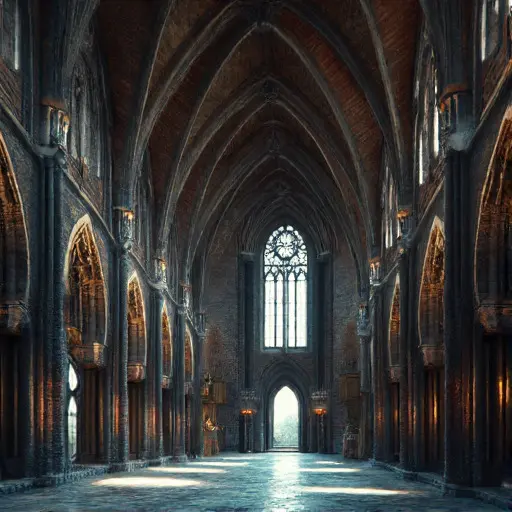
Window design across the estate is richly varied and intentionally irregular. Tall pointed arches stand beside elongated hexagons and soft circular openings, each placed in a non-repeating rhythm that still maintains overall harmony. Despite their variation, the façade avoids chaos through the repetition of material logic—brick, sandstone, and copper maintaining continuity across all elevations. Every interior behind these windows is completely dark and unlit, with no visible glow or artificial illumination.
The surrounding forest reinforces the estate’s composed presence. Evenly spaced fir and birch trees form a soft, natural grid around the clearing, while a mossy ground layer absorbs the diffused daylight. A gently curved gravel path leads toward the entrance, guiding movement in a slow arc that mirrors the building’s structural language.
At the approach, a carved stone reflecting basin sits partially covered in faint lichen patterns, its surface still and unbroken. Nearby, a slightly ajar wrought-iron gate marks the threshold between forest and architecture. The entire scene feels suspended in quiet equilibrium—an estate defined by controlled asymmetry, where every curve suggests time, pressure, and permanence rather than collapse.