The Bloom That Forgot to Close
A Flower Built From Steel and Memory
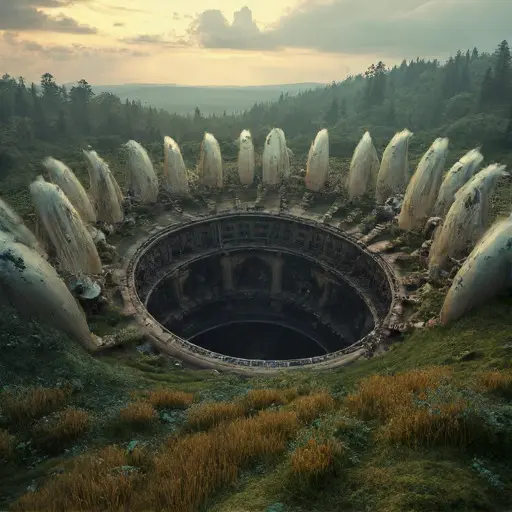
The mansion rises from the meadow crater like a bloom that reached its perfect moment of opening and then simply stopped. It does not decay in the usual sense. Instead, it holds its posture with uncanny precision, as though the concept of time was briefly paused mid-gesture and never resumed.
Each petal is formed from curved ivory-steel architecture, layered with deliberate mechanical elegance. Along their surfaces, iridescent sapphire and ember enamel veins trace pathways that feel almost biological, as if the structure once pulsed with a rhythm it has since forgotten.
At its center lies a circular courtyard—the heart of the bloom—open to the sky and completely silent.
The surrounding meadow bends outward in soft radial currents, like pollen reacting to a breath that never ends.
Petals That Became Rooms
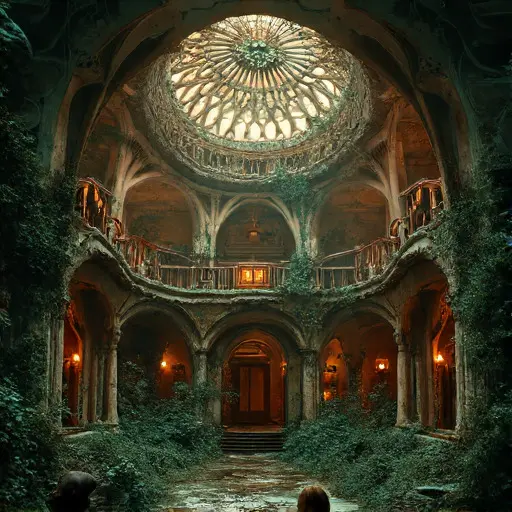
Inside the petals, the mansion becomes an anatomy of architecture.
Each curved segment opens into a habitable chamber, yet none feel truly enclosed. The walls arch outward like botanical ribs, supporting terraces that once may have been filled with movement, observation, and cultivation.
Now, they remain empty.
Hollow petal-window cavities line the outer edges—dark, unlit, and receptive only to wind. These openings do not function as windows in the traditional sense; they behave more like missing memory.
Brass botanical hinges and exposed mechanical joints still hold the structure together. They are softened by rust and moss, yet retain the delicate intelligence of their original design.
Nothing here is collapsing.
It is simply no longer continuing.
The Broken Observatory of Pollen and Glass
At the base of the structure lies a fractured botanical observatory dome. Its shattered glass arcs rest among wildflower beds like the remains of a scientific dream interrupted mid-discovery. Broken pollen chambers—once used to study seasonal cycles or artificial bloom patterns—are scattered nearby, their transparent fragments catching no light at all.
Beyond the mansion, a distant pine forest encircles a still, dark lake. The water does not reflect the structure so much as acknowledge its presence with muted indifference.
The meadow grass around the bloom leans outward in perfect radial symmetry, as though even the land remembers the moment of opening.
A Bloom Held at Its Peak Forever
From a macro-wide cinematic perspective, the mansion feels simultaneously engineered and organic—an impossible hybrid of Victorian craft and biomechanical imagination. Every petal-corridor curves with intention, every seam suggests both growth and construction.
The sky above transitions from dusk-coral into a muted teal horizon, casting a soft, matte illumination across the entire scene. There is no glare, no artificial brightness—only environmental stillness rendered into color.
The flower does not wilt.
It does not close.
It does not move.
It simply remains open, indefinitely, as if waiting for a pollination that will never arrive.
And as wind passes through the hollow petals and across the cratered meadow, the mansion exhales like a dethroned emperor remembering the garden it was once built to bloom within.
“`