The Blackshore Turret House That Never Turned Inland Again
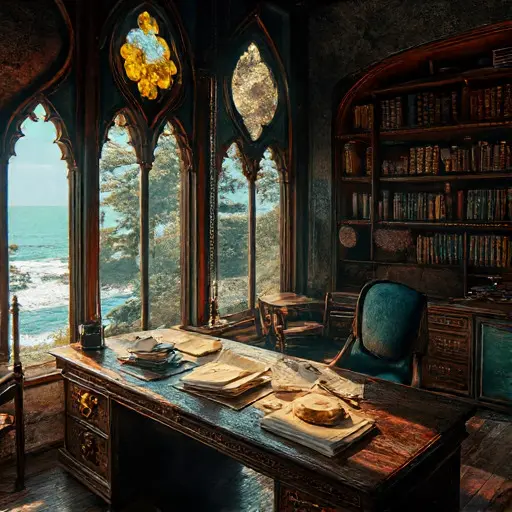
Blackshore House clung to the edge of the coastal cliffs like something built to observe the horizon rather than resist it. Its vertical silhouette rose in fractured Gothic layers—turrets uneven in height, rooflines broken into jagged ridges, and a cantilevered study projecting outward as if the house itself leaned toward the sea to listen more closely.
It was built for the Harrow siblings, Elias and Marianne, who arrived in the late 1890s after inheriting the land from a distant relative lost at sea.
Elias, a cartographer, believed coastlines were never fixed but always rewriting themselves. Marianne, a botanist, documented cliffside flora that survived salt winds and seasonal collapse. Together they shaped the house as both observatory and refuge.
Daily life moved through narrow rhythms: Elias working in the upper study tracking shifting maritime charts while Marianne catalogued plants along the cliffs below. They often communicated through notes left in stairwells or pressed beneath stones on shared terraces, preferring silence over interruption. The house absorbed these quiet exchanges, its stacked volumes behaving like pages in a slow, architectural correspondence.
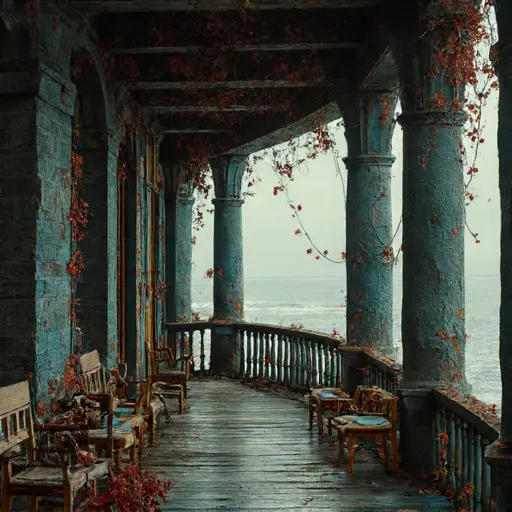
As the years advanced, the harshness of the cliff environment began to reshape the house. Salt winds corroded metal fittings, moisture weakened timber supports, and sections of the lower terraces became unstable. Elias attempted repairs, but the cost of maintaining such a precarious structure exceeded what the siblings could sustain.
Marianne’s health declined first, and her fieldwork stopped entirely. Her notebooks remained open in the lower rooms, documenting plants she could no longer reach. Elias continued his mapping alone, though his charts increasingly reflected erosion patterns rather than navigation routes. The house, once a shared instrument of observation, became quieter with each passing season.
Eventually, parts of the residence were closed off for safety. The cantilevered study remained accessible the longest, as Elias refused to abandon it even as the structure weakened around him. But after his final departure, no one returned to stabilize or reclaim the estate.
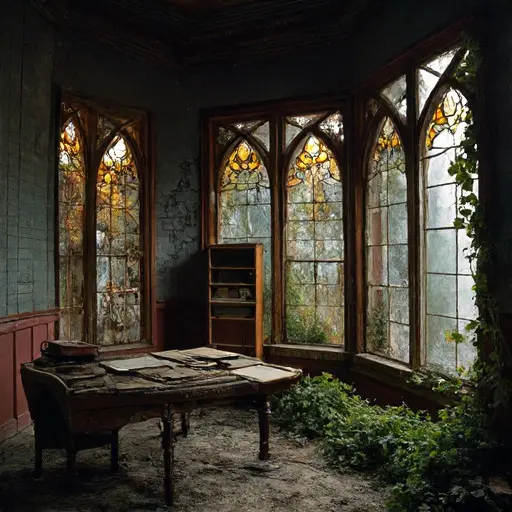
By 1951, Blackshore House was fully abandoned. Elias never returned after leaving for the mainland, and Marianne’s belongings remained untouched in the lower rooms. No inheritance disputes revived interest in the property, and no restoration was attempted due to its unstable coastal position.
The structure remained intact but no longer inhabited, slowly merging with the cliff environment that had always threatened to reclaim it. Vines threaded through every turret and terrace, and the sound of the sea replaced all memory of footsteps. The house endures, not as ruin, but as a quiet extension of the shoreline itself—waiting, unchanged, for no one in particular.