The Blackmere Quarry House Left Vacant After Cliff Recession
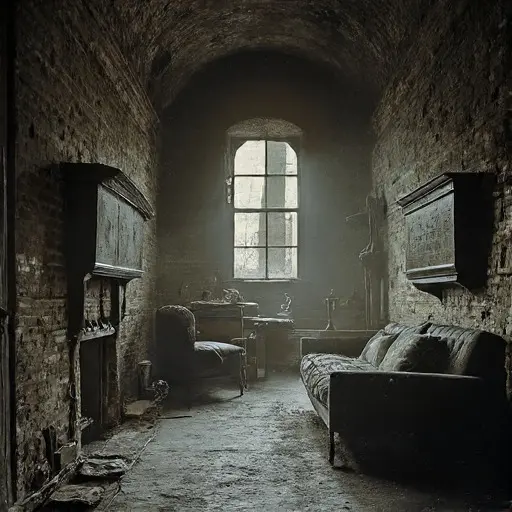
The Blackmere Quarry House was constructed in 1889 along the edge of a working coastal chalk quarry, commissioned by the Harrowgate family who oversaw mineral extraction and shipping operations. Unlike conventional townhouses, the structure was built directly against the sheer quarry wall, with its narrow five-story form embedded into layers of pale stratified rock. Over time, natural erosion and quarry expansion caused the lower level to become partially buried in scree and chalk debris, giving the impression that the house was slowly sinking into the cliff face.
The façade was composed of soot-darkened London stock brick, once softened with subtle stucco ornamentation that has since been worn smooth by wind-driven mineral dust. Rising vertically, the structure followed a strict but uneven rhythm dictated by the geological strata behind it. Tall, narrow windows punctuated the exterior in irregular intervals, some deeply recessed into the wall like cave openings, others projecting slightly outward on fragile iron brackets.
A steep external iron stairway ran diagonally across the façade, functioning as a structural spine connecting staggered entrances on different floors. Each landing was enclosed by delicate cast-iron railings, their Victorian patterns still visible but softened by corrosion into lace-like silhouettes. The stair itself became the primary circulation route as interior passages shifted and adapted to the quarry’s gradual encroachment.
Inside, the Harrowgate household maintained a disciplined rhythm shaped by industrial oversight. Edwin Harrowgate managed quarry output records and shipping schedules, while his wife Lillian coordinated correspondence with merchants and regional contractors. Rooms were narrow but efficiently organized, stacked vertically according to function, with offices, living quarters, and storage spaces distributed across floors that mirrored the building’s exterior ascent.
Early financial strain
By the late 1920s, demand for chalk and lime products fluctuated due to changes in industrial supply chains and the decline of smaller coastal extraction operations. Larger inland quarries began to dominate production, reducing the Blackmere site’s economic relevance. As profits declined, maintenance of both quarry infrastructure and residential structure was reduced. Wind-driven erosion intensified wear on exposed brickwork, while chalk dust accumulated more rapidly within interior spaces.
Gradual decline within the cliff-embedded structure
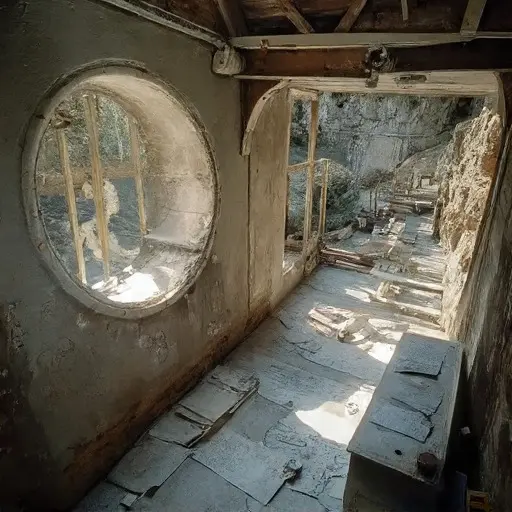
As financial strain increased, sections of the house were gradually abandoned. Lower floors, increasingly buried by quarry debris, became inaccessible. Interior circulation shifted upward, relying more heavily on the external iron stairway as internal corridors degraded. Entire wings were sealed off to reduce maintenance costs, while ventilation became inconsistent due to blocked quarry-facing openings.
Occupancy diminished steadily. Members of the Harrowgate family relocated to coastal towns or industrial centers as quarry operations wound down. By the early 1940s, only minimal occupancy remained, with intermittent visits for legal and administrative oversight.
Final abandonment phase
By 1947, Blackmere Quarry House was no longer fully inhabited. Utility services ceased following prolonged financial arrears, and structural maintenance stopped entirely. Chalk and mineral dust continued to infiltrate the building through open windows and stair landings. The quarry wall itself began to encroach visually and physically, blurring the boundary between architecture and geology.
The house absorbed into the quarry
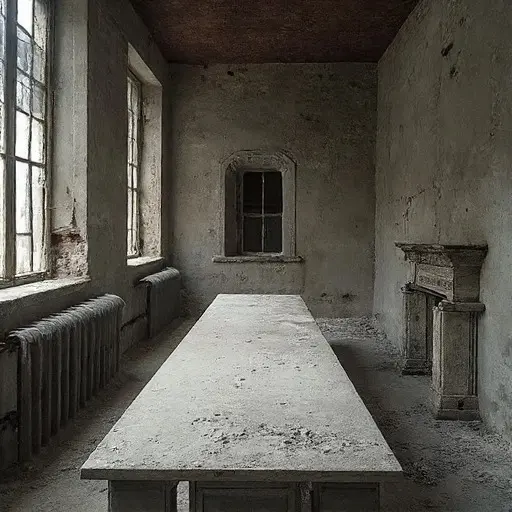
By the late 1940s, no formal ownership or maintenance of Blackmere Quarry House remained. Legal notices were repeatedly returned undelivered, and no heirs reestablished control of the property. No restoration was attempted, and no intervention was made against ongoing geological encroachment. The house remains embedded in the chalk cliff face, slowly eroding under wind, dust, and gravity, its vertical structure gradually dissolving into the stratified quarry wall.