The Beaumont Provincial House Left Beyond the Garden Edge
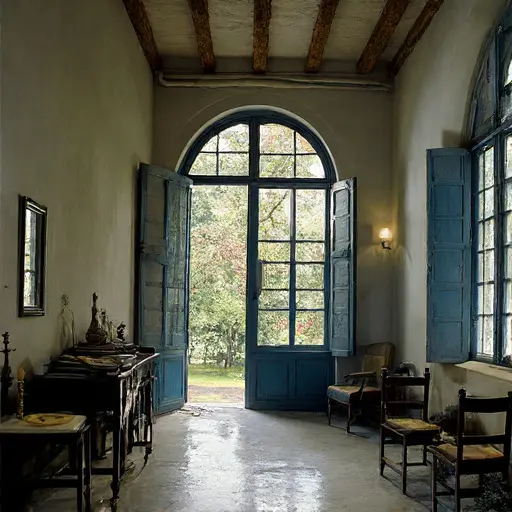
The Beaumont House was constructed in the early twentieth century by a provincial French family whose livelihood depended on small-scale agriculture, vineyard parcels, and seasonal forestry work at the edge of a dense woodland. Designed in a restrained provincial style, the residence prioritized practicality and proportion over ornamentation, resulting in a compact rectangular form with a steep hipped roof and evenly spaced shuttered windows. The household consisted of a single extended family supported by one or two domestic workers who maintained both the interior and the modest formal garden.
Daily life was centered on the ground-floor salon and kitchen, where financial accounts, harvest planning, and correspondence were handled with routine consistency. For many years, the property remained stable, its small garden carefully tended and its rooms consistently occupied despite its modest scale.
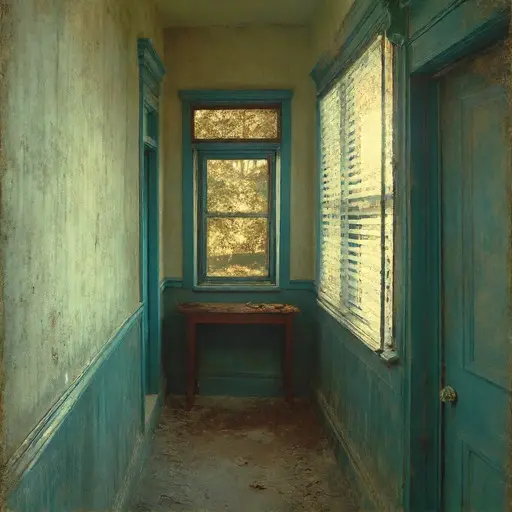
By the late 1920s, the Beaumont House began to experience financial strain as agricultural yields declined and seasonal income became increasingly unreliable. Maintenance tasks were delayed, particularly roof repairs and exterior plaster work, allowing gradual weathering to affect the structure. Parts of the upper floor were used less frequently to conserve heating costs, resulting in a subtle consolidation of daily life into fewer rooms. The garden, once carefully maintained, began to soften at its edges as labor and resources were reduced. Correspondence accumulated without consistent response, while household management shifted from proactive care to reactive maintenance. Over time, the residence slowly transitioned from a fully active home to a partially maintained dwelling marked by quiet neglect.
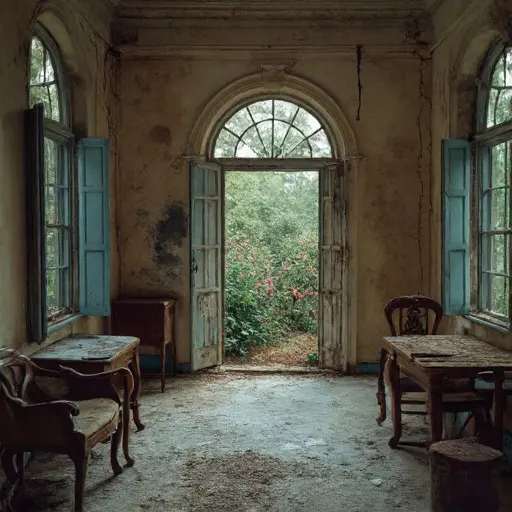
By the early 1940s, following prolonged financial hardship and unresolved inheritance matters, the Beaumont House was fully abandoned. No restoration efforts were undertaken, and the property remained in legal uncertainty that prevented any redevelopment. Vegetation from the surrounding forest gradually encroached upon the garden, while moisture and seasonal weather accelerated structural deterioration. Interior furnishings and personal documents were left in place, preserving the final period of decline in quiet detail. No occupants returned, and the house continues to stand empty at the forest edge, slowly merging back into the landscape while retaining the memory of its former domestic life.