The Basalt and Marble House of the Glacial Valley
In a glacial mountain valley meadow, a Romanesque Revival Victorian house stands in quiet isolation beneath crystal-clear alpine air. The structure is composed of alternating bands of black basalt and white marble, giving it a stark, rhythmic contrast against the pale landscape of moraine stones and distant snow-dusted peaks.
The building’s mass feels heavy and settled into the earth.
Its footprint is subtly asymmetric, as if the ground beneath has shifted over time. This uneven settling is most visible in the arcaded veranda, where the rounded arches dip lower along one side, breaking the otherwise monumental symmetry.
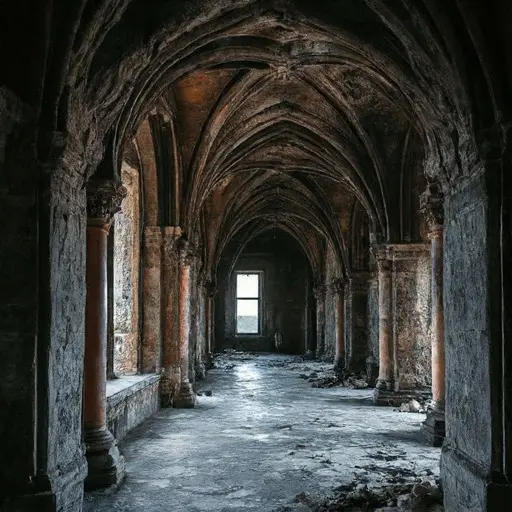
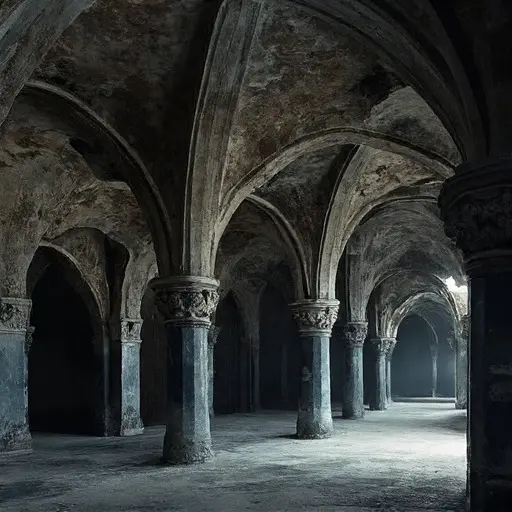
Inside, the house remains entirely unlit. No interior glow exists anywhere, and the rooms sit in deep, silent darkness. Soft overcast daylight enters through arched openings and distant windows, skimming across polished marble and absorbing into rough basalt surfaces.
Outside in the yard, a broken stone sundial lies tilted off-axis, its shadow marker no longer aligned with time. Nearby, a rusted iron bell frame stands partially collapsed, its silhouette stark against the pale meadow grass.
The entire structure feels like a geological extension of the valley itself—less built than revealed—holding its form in a slow dialogue with shifting stone and mountain wind.