The Aurelian Forest Basilica Palace Left in Ceremonial Silence
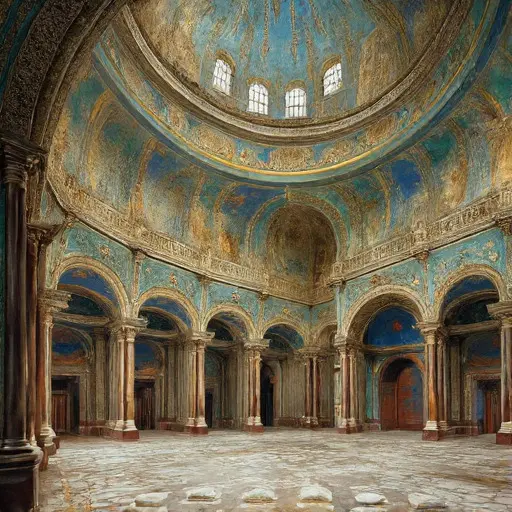
The Aurelian Basilica-Palace was constructed in the early twentieth century at the edge of a dense forest clearing, commissioned as both a private residence and ceremonial civic-religious complex by a wealthy patron with strong ties to cultural preservation movements. The household consisted of an extended family, administrative stewards, and a small clerical staff responsible for maintaining the basilica’s ritual functions and architectural integrity. The central rotunda served as the heart of the complex, hosting formal assemblies, commemorative rites, and seasonal gatherings beneath its vast domed ceiling.
Early life within the structure was defined by strict ceremonial schedules, preservation rituals for the mosaics, and carefully choreographed movement through its arcaded galleries and colonnades. The surrounding forecourt functioned as an extension of the interior order, reinforcing the basilica’s role as a unified symbolic and residential environment.
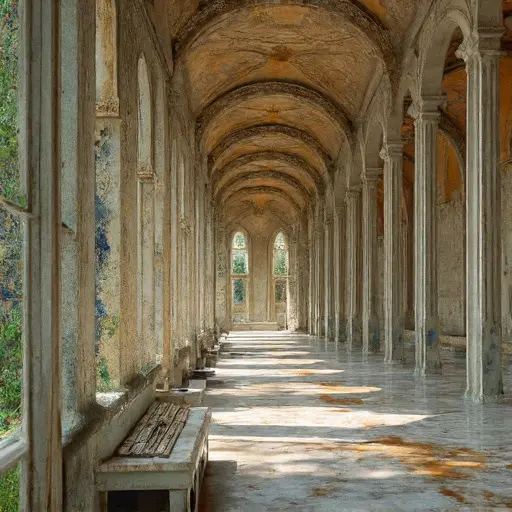
By the late 1920s, the Aurelian complex began to experience financial and organizational instability as its supporting patronage networks declined. Funding for ceremonial upkeep and specialized mosaic restoration diminished, forcing gradual reductions in staff and maintenance schedules. Portions of the arcaded galleries were closed to conserve resources, and certain ceremonial wings were no longer used for regular functions. The once-precisely maintained mosaic surfaces began to accumulate dust, while humidity fluctuations introduced early signs of material fatigue in the marble and tesserae. Administrative correspondence regarding preservation funding and institutional support slowed and eventually ceased, marking a transition from active ceremonial use to partial dormancy and neglect.
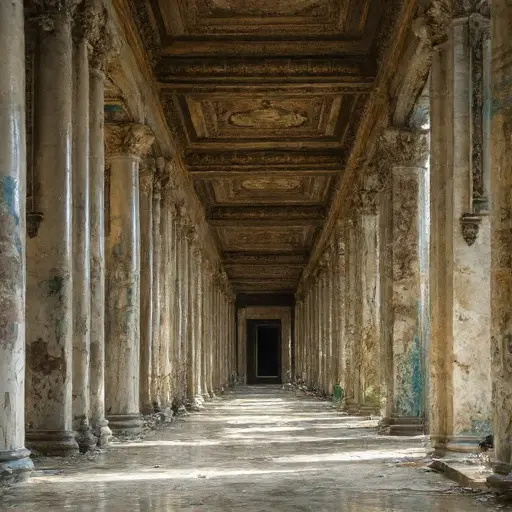
By the early 1940s, after prolonged withdrawal of patronage and the dispersal of its remaining occupants, the Aurelian Basilica-Palace was fully abandoned. No restoration or preservation program was initiated, as the scale and complexity of its mosaic and marble systems required resources no longer available. Ownership records became fragmented, preventing coordinated stewardship. The structure remained at the forest edge, gradually deteriorating under seasonal weathering and vegetation encroachment. Interior spaces were left in their final ceremonial configuration, allowing dust, moisture, and plant life to slowly overtake the basilica’s ordered geometry. The complex persists as an unresolved monument of Byzantine Revival ambition, neither restored nor repurposed, with its domed rotunda still standing as a silent testament to ceremonial decline and abandonment.