The Asterwick Observatory House Left Unattended on the Ridge Terraces
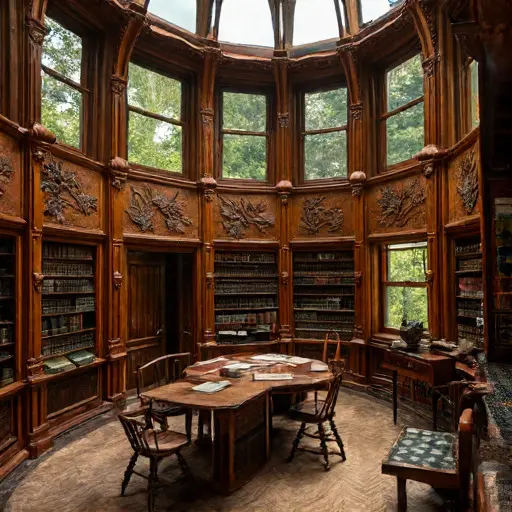
Asterwick Observatory House was constructed between 1887 and 1910 on a terraced forest ridge where cultivated estate grounds gradually transitioned into untamed woodland. Commissioned by the Halverston family—natural philosophers and botanical patrons—the residence was designed as both home and observational instrument. Its architecture was organized around a central axis of stacked octagonal rooms, each subtly rotated from the one below, creating shifting interior perspectives that reflected the evolving study of light, plants, and seasonal change.
The structure was built from warm sandstone and polished cedar beams, with copper roofing that oxidized over time into a deep green patina. Rather than following strict symmetry, the house employed controlled asymmetry: window proportions, room heights, and veranda alignments varied intentionally across construction phases, reflecting experimental architectural philosophy rather than structural inconsistency. The result was a coherent yet dynamic silhouette that appeared to change as one moved around it.
The most distinctive feature was the circular observatory lantern crowning the roof. Unlike traditional astronomical domes, this structure functioned as a sunlit arboretum chamber, filled with carefully selected plant specimens arranged to respond to seasonal solar movement. Below it, wraparound verandas encircled multiple floors, supported by carved columns depicting botanical studies in relief, effectively turning the entire exterior into a sculptural index of plant life and natural forms.
The surrounding estate was carefully managed but never rigidly controlled. Terraced stone walls shaped the forest edge into gentle gradients, supporting ornamental grasses, flowering trees, and sculpted evergreens. Narrow water channels ran between terraces, reflecting fragments of sky and foliage while guiding light toward the house’s lower levels. The interplay of water, vegetation, and architecture created a stable ecological and aesthetic system centered on observation and refinement.
Early institutional decline
By the late 1920s, the Halverston family’s scientific and botanical funding began to diminish as institutional priorities shifted toward centralized research facilities. Maintenance of the estate required specialized horticultural oversight, which became increasingly difficult to sustain. Gradual staff reductions led to less precise control of the terraced landscape, and minor sections of the garden began to grow beyond their original design intent.
Progressive withdrawal from upper observational levels
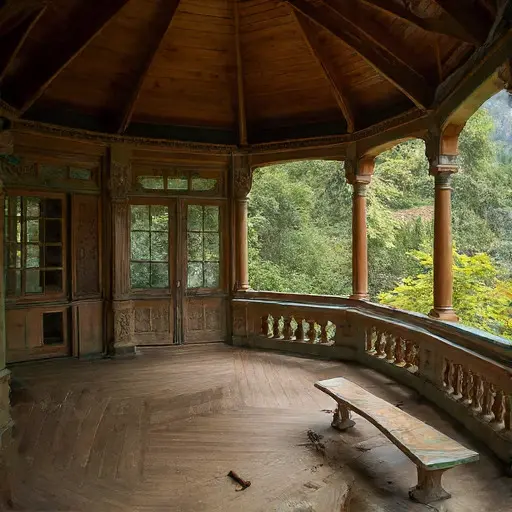
As the 1930s progressed, portions of Asterwick Observatory House were gradually decommissioned. Upper arboretum functions within the observatory lantern were reduced as staffing decreased and specimen maintenance became irregular. Some verandas ceased to be used entirely, particularly those facing steeper sections of the forest ridge where access required constant upkeep.
Despite this decline, the core octagonal structure remained partially occupied. Researchers and remaining family members continued to document botanical cycles and seasonal light variation, though with diminishing precision. The estate’s water channels and terraced gardens began to show subtle signs of natural rewilding, as maintenance shifted from active cultivation to occasional correction.
Final abandonment phase
By the early 1940s, Asterwick Observatory House was no longer continuously inhabited. Administrative support for the estate was withdrawn, and remaining occupants relocated to urban academic institutions. Without regular upkeep, the terraced gardens softened into semi-wild conditions, and the architectural system began to operate independently of human oversight.
The house left in ecological observation
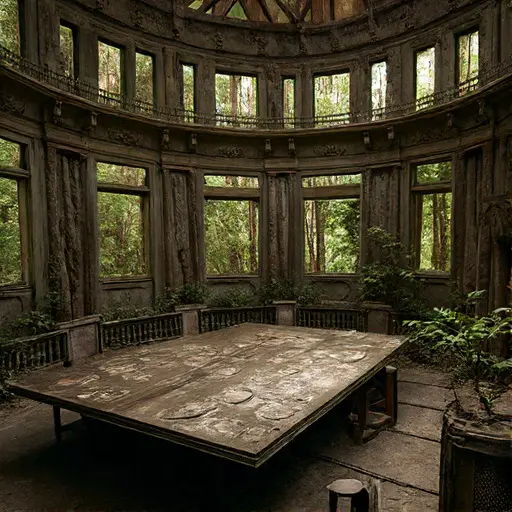
By the late 1940s, no formal ownership or active management of Asterwick Observatory House remained. No restoration was attempted, as the estate was considered too integrated with its ecological system to be easily separated from its environment. The structure remains on the forest ridge today, slowly weathering within its terraced landscape, its octagonal forms and botanical architecture persisting as a quiet, unattended study of light, growth, and time.