The Ashwick House Left Vacant at Riverside End
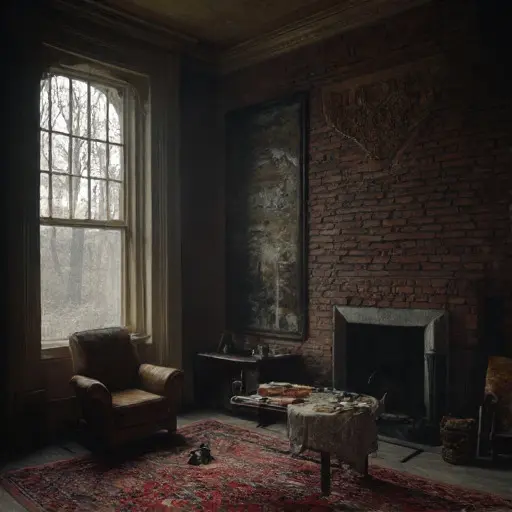
Ashwick House stood at the end of a fractured cobblestone lane in a mist-heavy riverside district, built in the late 1880s for the Merriweather family. Designed as a three-story Victorian residence, it was shaped by asymmetry and layered ornamentation rather than strict architectural balance. Dark red brick formed the structural body of the house, interwoven with carved sandstone trim that once displayed crisp detail but had softened over time into rounded, weather-eroded reliefs.
The house rose in a complex silhouette of intersecting gables and steep slate roofs, its form slightly uneven yet still deliberate in composition.
Decorative bargeboards lined the eaves in intricate wooden patterns, though many had warped under decades of moisture exposure. Iron filigree balconies clung to upper windows, their delicate forms darkened by rust but still intact. The façade’s tall sash windows varied in condition—some panes remained original but clouded, others had been replaced with mismatched glass that distorted reflections of the surrounding riverside growth. A prominent bay window at the front leaned outward slightly, its curvature still structurally sound but visibly stressed.
Inside, the Merriweather family maintained a household shaped by both comfort and increasing uncertainty. Thomas Merriweather managed local trade accounts tied to river transport, while his wife Eleanor oversaw correspondence, domestic planning, and social obligations. The house functioned as both residence and minor administrative center, its rooms filled with documents, ledgers, and records of river commerce. Over time, the expanding family and aging structure created an increasingly fragile balance.
Early financial strain
By the late 1920s, river trade routes shifted as rail infrastructure expanded across the region, reducing dependence on small riverside transport networks. The Merriweather family’s business connections weakened, and income gradually declined. Maintenance of the house became increasingly irregular, with repairs to sandstone trim, roofing, and balconies postponed due to cost constraints. Moisture from persistent river fog accelerated the erosion of exposed brick and wood surfaces.
Gradual decline within the house
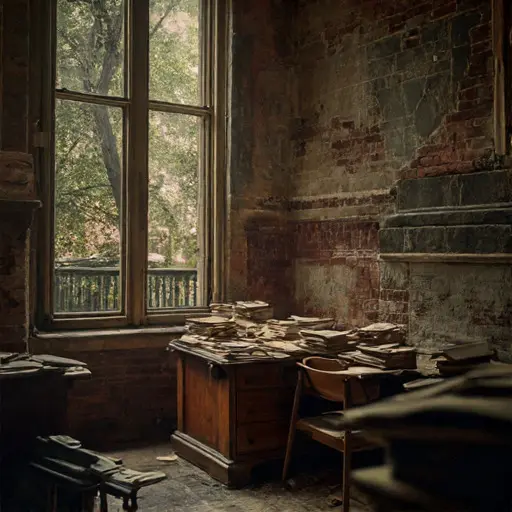
As financial pressure increased, entire rooms of Ashwick House were gradually closed off. Heating was restricted to central living areas, leaving upper floors cold and unused during winter months. Decorative maintenance ceased entirely, allowing carved woodwork and iron fixtures to deteriorate without repair. The surrounding garden, once formally maintained, began to dissolve into uncontrolled vegetation, with ferns and saplings pressing closer to the house walls.
Family presence diminished steadily throughout this period. Younger members left for larger towns seeking employment in expanding industrial and administrative sectors. Their departures were gradual but irreversible, leaving fewer occupants to manage the increasingly burdensome residence. By the early 1940s, only a small portion of the house remained regularly inhabited.
Final abandonment phase
By 1946, Ashwick House was no longer fully occupied. Utility services became unreliable and were eventually discontinued following prolonged arrears. Without maintenance, structural decay accelerated, particularly in moisture-exposed areas facing the river. The bowed bay window worsened slightly but remained intact, while upper balconies became unsafe and fell into disuse. River fog frequently entered the interior spaces, blurring boundaries between inside and outside.
The house left behind

By the late 1940s, no formal ownership or maintenance of Ashwick House remained. Legal notices sent to the last known heirs were repeatedly returned undelivered, and no party assumed responsibility for the property. No restoration was attempted, and no return was made to the residence. The house remains standing at the end of the cobblestone lane, slowly decaying under river mist and encroaching vegetation, its once-formal Victorian presence gradually dissolving into the quiet erosion of the riverside district.