The Ashcroft Corner House Left Vacant After Street Realignment Works
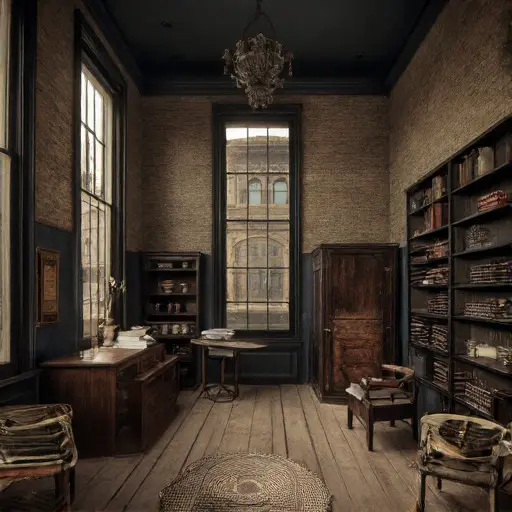
Ashcroft Corner House was constructed in 1883 during a period of dense urban expansion when corner plots were increasingly shaped by irregular street grids rather than planned symmetry. Built for the Harrowgate family, who maintained small administrative roles within the city’s shipping and customs offices, the residence was designed to maximize vertical living within a constrained trapezoidal footprint. Its architecture reflects late Victorian civic discipline: practical, measured, and structurally precise.
The building rises four stories in strict vertical alignment, constructed from brown brick softened by decades of soot accumulation. Horizontal stone banding divides each level into clear visual strata, giving the façade the appearance of measured architectural intervals. Unlike more decorative Victorian residences, ornamentation is minimal and controlled, emphasizing proportion over embellishment.
The defining mansard roof is clad in tightly arranged slate tiles that shift subtly between graphite and muted slate blue. Dormer windows are evenly spaced along the roofline, each framed in simple molded wood trim. A faint iron cresting runs along the ridge, now partially missing or bent from age and wind exposure, but still preserving the roof’s structured silhouette.
Early urban transition pressures
By the early 1920s, the surrounding district began undergoing significant infrastructural change. Street realignments, drainage upgrades, and shifting commercial zones gradually altered residential stability in the area. While Ashcroft Corner House remained structurally sound, its immediate environment became less residential and more transitional in function.
Tenancy within the building began to fluctuate. Rooms on upper floors were occasionally rented or left vacant depending on household needs. The Harrowgate family gradually reduced their occupancy, retaining only portions of the house for long-term residence while other floors were quietly closed off during winter months.
Gradual interior contraction
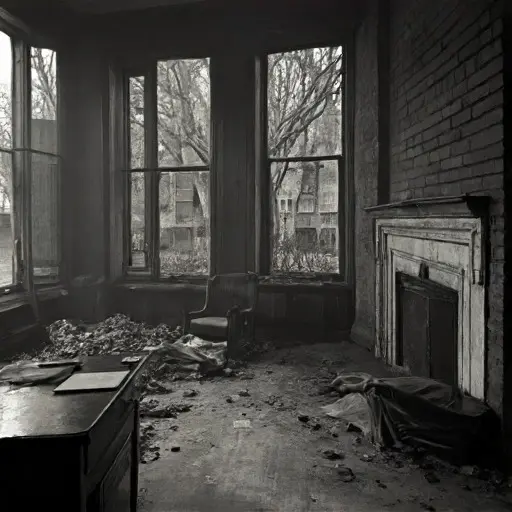
As urban restructuring continued, the building’s relevance as a single-family residence diminished. Portions of the lower floors were repurposed temporarily for clerical storage connected to nearby administrative offices, while upper floors were increasingly left unused. The once-active household began to fragment into isolated rooms of activity rather than a unified domestic space.
By the late 1930s, the surrounding streetscape had changed significantly. Cobblestone roads were partially rerouted, utilities were modernized, and sections of the district transitioned toward light commercial use. The house, once centrally placed in a residential network, became functionally peripheral.
Final abandonment phase
During the 1940s, the Harrowgate family relocated permanently to another district following consolidation of municipal offices and retirement from their administrative positions. Without occupants, Ashcroft Corner House entered a state of quiet vacancy. Ownership records remained stable, but no restoration or redevelopment efforts were initiated.
The house left behind
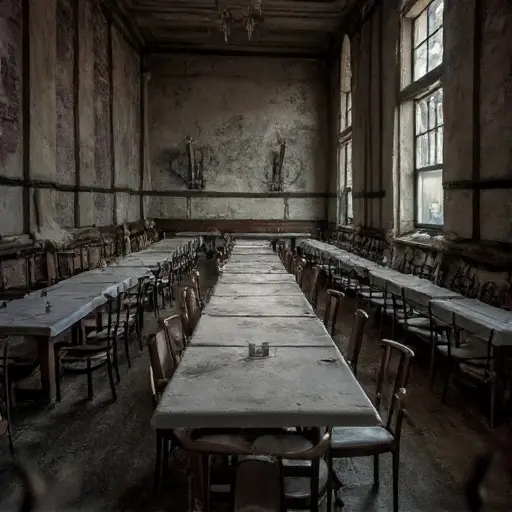
By the early 1950s, Ashcroft Corner House stood entirely vacant. No redevelopment proposals were pursued, and no new occupants took residence. The surrounding streets remained lightly used but structurally intact, leaving the building preserved within its original urban geometry. The townhouse endures as a quiet, grounded example of Victorian city architecture—unaltered, unembellished, and simply left behind as the district evolved around it.