The Ashbourne Gothic Revival Townhouse Beneath the Overgrown Garden
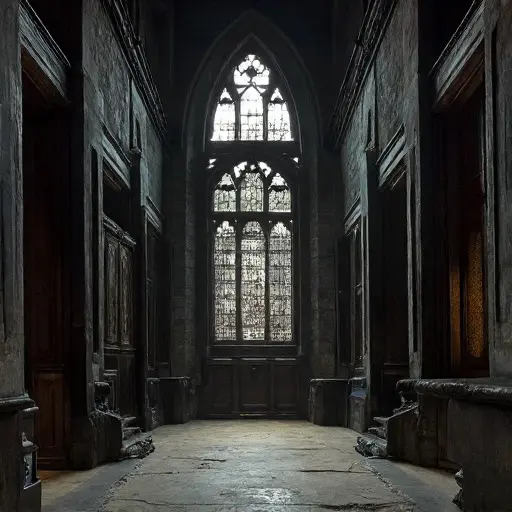
The Ashbourne townhouse was completed in 1885 during a period when Victorian Gothic Revival architecture was widely adopted for urban residences seeking a sense of permanence and moral weight. Commissioned by the Ellery-Hart family, the structure was designed as both a family home and a symbolic statement of lineage and stability. The household included three generations living under one roof, along with domestic staff responsible for maintaining both the interior stonework and the expansive front garden.
Daily life followed strict routines centered on formal dining, correspondence, and religious observance, with the entrance hall serving as the primary transitional space between public and private life. The garden, visible from nearly every front-facing room, was carefully curated to reinforce the house’s vertical grandeur with cultivated floral symmetry.
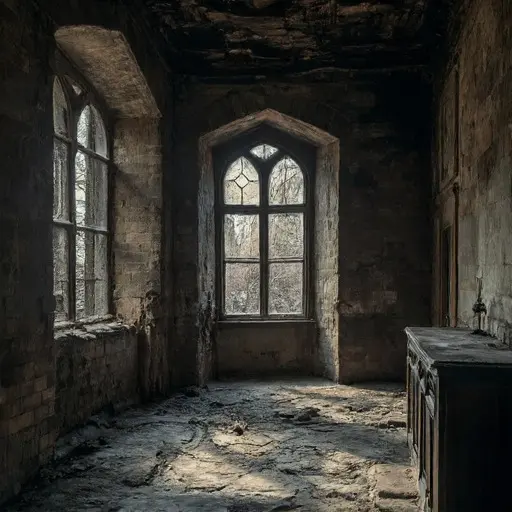
By the early 1930s, the Ellery-Hart household began to decline financially as shifting urban development reduced the value of the surrounding district and increased the cost of maintaining such a structurally complex Gothic residence. Essential repairs to roofing, drainage, and stonework were repeatedly postponed, allowing moisture to spread through upper floors and weaken interior finishes. The front garden, once meticulously arranged, began to lose its strict geometry as foxgloves, delphiniums, and wild roses spread beyond controlled borders. The marble statue in the yard developed visible cracks, while the iron gazebo gradually collapsed under the weight of ivy and dried grapevines. Household movement contracted into fewer rooms, with upper floors becoming increasingly unused as maintenance demands exceeded available resources.
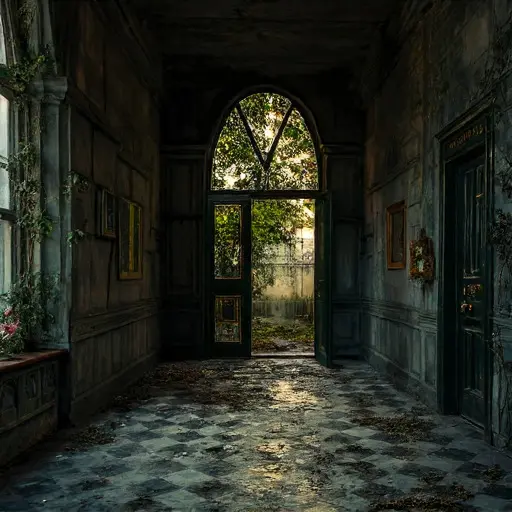
By the mid-1940s, following foreclosure proceedings and the final departure of its remaining occupants, the Ashbourne Gothic Revival Townhouse was permanently abandoned. No restoration efforts were undertaken, and the property remained legally unresolved for decades, preventing redevelopment of the site. The front and side gardens fully merged with the surrounding vegetation, as stone paths disappeared beneath overgrowth and the collapsed gazebo became indistinguishable from the forest edge. The marble statue remained standing but increasingly obscured by ivy and climbing plants. Inside, all belongings were left exactly as they were at the moment of abandonment. The townhouse still stands today under a heavy overcast sky, its Gothic silhouette slowly dissolving into weather, vegetation, and silence.