The Amphitheater Retaining House Left Silent Within the Curved Wall
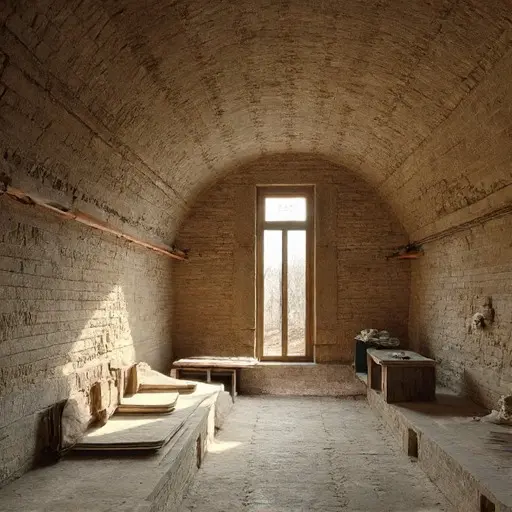
The Amphitheater Retaining House was constructed in 1894 as part of a large-scale stabilization project for a sunken residential district slowly shifting due to underlying geological subsidence. Rather than treating housing and infrastructure as separate systems, the design merged them into a continuous architectural form. The house was partially embedded into the inner curve of a vast retaining amphitheater wall, making it both a residence and a structural reinforcement element within the engineered landscape.
Its exterior is defined by alternating bands of compressed rammed earth and pale vitrified brick, forming a strict horizontal stratification that echoes the layers of the retaining structure itself. Over decades, these materials have softened into subdued tones of ash rose, muted graphite, and pale mineral gray. Subtle differences in density and compaction remain visible under diffuse daylight, reinforcing the building’s identity as both inhabited space and engineered mass.
Instead of a conventional façade, the house presents a repeating sequence of structural bays that follow the curvature of the amphitheater wall. Each bay is framed by reinforced stone ribs that project slightly outward, forming a rhythm of shallow alcoves. Within these recesses, tall narrow windows are deeply embedded, their uneven glass producing soft optical distortions of the curved exterior environment.
The house functioned initially as part of a broader municipal housing initiative designed to stabilize both population and terrain. Early occupants included engineers, civil planners, and their families, all of whom lived within a structure that was simultaneously domestic and infrastructural. Daily life unfolded within a building that also served as a structural component of the city’s retaining system.
Early adaptation and structural dependency
By the 1920s, the surrounding district had largely stabilized, reducing the active engineering oversight once required for maintenance of the amphitheater wall. As institutional attention shifted elsewhere, upkeep of the integrated housing system became increasingly decentralized. While the structural integrity of the retaining wall remained sound, residential maintenance began to decline in parallel with administrative oversight.
Interior modifications were gradually reduced to essential repairs. Some bays were sealed off temporarily during inspection cycles. Drainage systems along the stepped roof terraces required more frequent manual clearing, as automated maintenance systems were phased out.
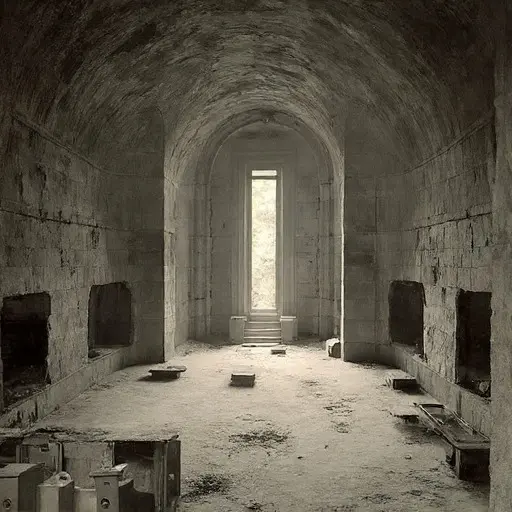
During the 1930s, occupancy became increasingly fragmented. As municipal housing policies changed, residents were gradually relocated to newer developments. Families left first, followed by institutional occupants such as engineers and maintenance staff. Entire sequences of structural bays were vacated in stages, beginning at the upper terraces and progressing downward along the curvature of the wall.
Without consistent residential presence, the building’s hybrid nature began to shift. What had functioned as a living component of infrastructure increasingly became a static architectural shell embedded within the retaining system.
Final withdrawal from the amphitheater structure
By the early 1940s, the last remaining occupants had departed. No replacement housing program was initiated, and the Amphitheater Retaining House was effectively removed from residential use while remaining structurally integrated into the retaining wall itself. Maintenance of internal drainage channels and skylight apertures ceased shortly thereafter.
Despite abandonment, the structure retained its coherence. The stepped roof terraces, drainage channels, and repeating bays continued to express the logic of engineered curvature even in the absence of human activity. The amphitheater wall above and below remained stable, reinforcing the house’s embedded position within the larger civil system.
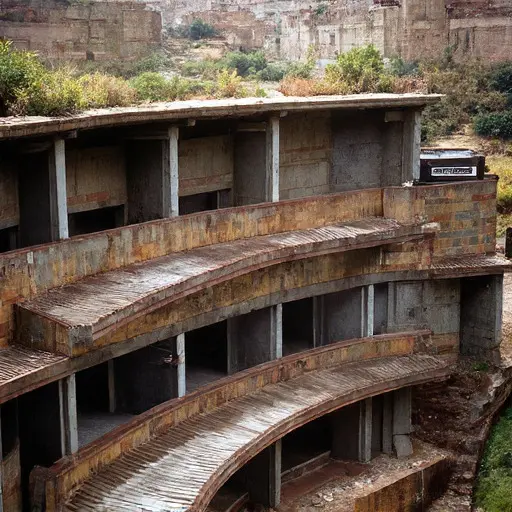
By 1950, the Amphitheater Retaining House stood completely abandoned within the curved retaining system. No demolition or repurposing was undertaken, and no residential reintegration occurred. The structure remains embedded within the amphitheater wall today, its bays, terraces, and stratified materials slowly weathering under time and diffuse light, preserving the quiet memory of a house that was once inseparable from the infrastructure that held the city in place.