The Amber Glass Silence of the Basalt Estate

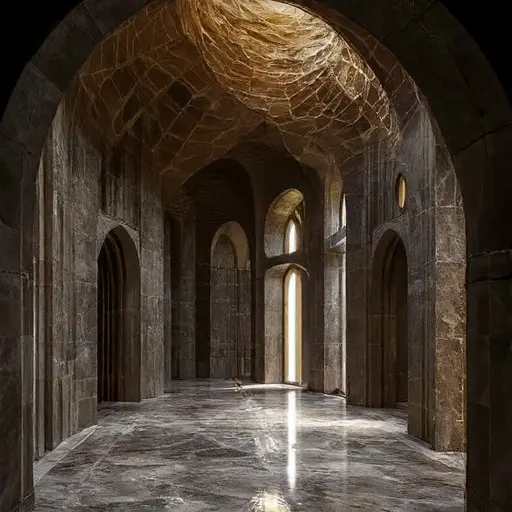
In a quiet forest clearing, a Secession-style Victorian three-story family estate rises as a continuous sculptural mass rather than a segmented building. It is formed from pale basalt stone interwoven with bands of muted amber-glass masonry, which subtly refract daylight across the façade without producing any internal illumination. The result is a surface that feels quietly responsive to light, yet remains entirely inert within.
The structure is composed as a flowing asymmetrical volume. The central mass rises into a soft, slanted roof ridge that avoids sharp peaks, while secondary wings extend outward in opposing gentle arcs. These curved extensions give the estate a sense of carved continuity, as if the entire building were shaped from a single geological formation rather than assembled piece by piece.
A slightly offset tower element emerges from one corner of the estate. It tapers upward with a restrained spiral-like geometry, suggestive of motion but firmly grounded in architectural logic. Rather than standing apart as a focal point, it integrates into the overall flow of the structure, reinforcing the building’s continuous, sculpted identity.
Window composition is varied yet cohesive. Tall rounded arches, elongated vertical slots, and softly angled rectangular panes are distributed across the façade in a non-repetitive rhythm that follows wall curvature rather than imposing strict symmetry. Despite their variation, they maintain visual balance through consistent material framing and spacing logic. Every interior beyond these openings is completely dark and unlit, with no visible glow or artificial light anywhere within the estate.
The surrounding forest remains calm and open, resembling an old estate park. Tall fir and birch trees are spaced widely across a mossy understory, and a gently winding gravel path leads through the clearing toward the entrance. The composition feels deliberately composed by nature and design working in parallel.
At the front approach, a shallow carved stone reflecting pool sits quietly, its surface still and unbroken. A minimal wrought-iron gate marks the transition from forest to architecture without ornament or emphasis. The entire scene settles into a quiet equilibrium—an estate defined by light-reactive stone, amber glass, and complete interior darkness.