The Alderwick Mansion Left Vacant After Riverbend Decline
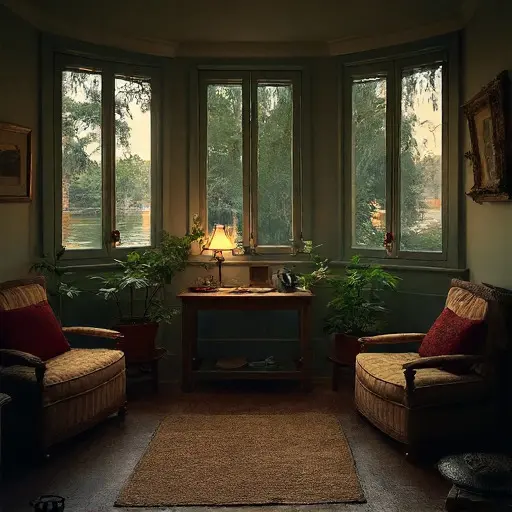
The Alderwick Mansion was established in 1902 by the Montclair family, who managed small-scale trade and agricultural coordination along the riverside bend. Though designed in a Victorian style, the home was modest in scale, intended to function as both residence and local administrative point for river-based commerce. Its aurora-fig exterior and sapphire-copper trim were chosen to harmonize with the shifting tones of willow foliage and reflective water surfaces.
Positioned close to the river’s curve, the structure was intentionally integrated into the landscape, its form shaped to follow the natural flow of the bank rather than impose upon it.
Inside, life followed a steady rhythm tied to river transport schedules and seasonal trade cycles. Henri Montclair oversaw ledger work and shipment coordination, while his wife Elise managed household organization and correspondence with downstream suppliers. The mansion remained orderly and functional, its interior spaces designed for both domestic living and administrative labor. The sound of water moving past the property was constant, forming a subtle backdrop to daily routines.
Early financial strain
By the late 1920s, regional river trade began to decline as rail and road infrastructure replaced smaller water-based routes. The Montclair family’s commercial role diminished, resulting in reduced income and fewer operational responsibilities. Maintenance of both the riverside property and the mansion itself began to slow. Sapphire-copper trim along exterior frames dulled under constant moisture exposure, and repairs to wooden structures were delayed indefinitely. Portions of the house were gradually closed off to conserve heat and reduce upkeep demands.
Gradual decline in the household
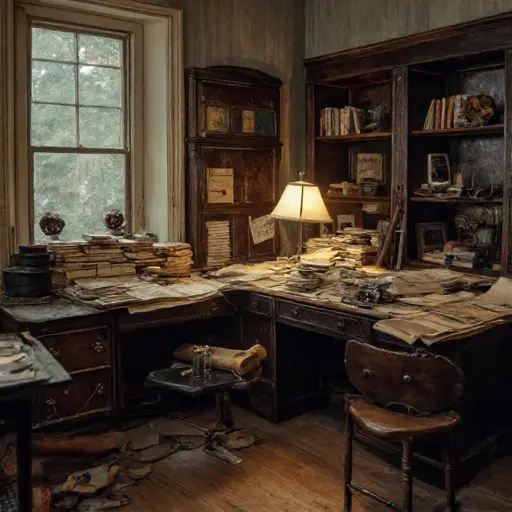
As financial strain increased, river trade operations were gradually scaled back until only minimal oversight remained. The surrounding garden and stepping stones began to merge with the riverbank as grass thickened and willow branches extended further toward the house. Inside, correspondence from suppliers became infrequent, and recordkeeping grew irregular. The household shifted from active coordination to slow contraction, maintaining only essential functions while unused rooms accumulated dust and silence.
Family members gradually relocated to inland towns where employment opportunities had become more stable. Their departure marked a turning point in the mansion’s use, transitioning it from an active commercial residence to a partially maintained structure sustained more by memory than purpose.
Final abandonment phase
By the early 1940s, the Alderwick Mansion was no longer fully inhabited. Utility services were reduced and eventually discontinued following prolonged financial arrears. Without maintenance, river moisture began to penetrate interior materials, accelerating decay in wooden frames and plaster surfaces. Willow seeds drifted indoors through open windows, collecting in corners and across abandoned furniture.
Final deterioration
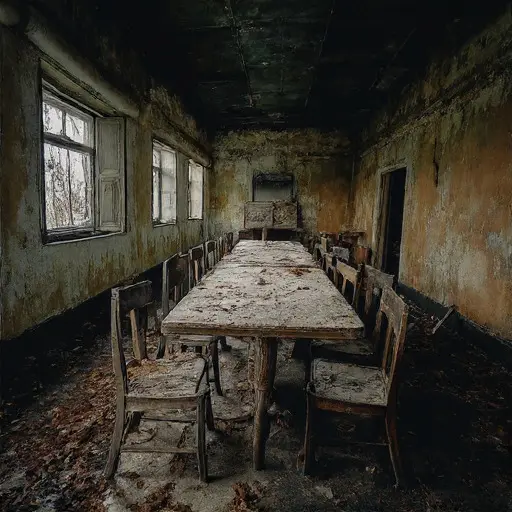
By the mid-1940s, no formal ownership or maintenance of the Alderwick Mansion remained. Legal notices were repeatedly returned undelivered, and no heirs reestablished control of the property. The structure persisted along the riverside willow bend in a state of quiet abandonment, slowly weathering under water, wind, and vegetation. No restoration or reoccupation followed, and the mansion remained an empty remnant of a once-functioning riverside household absorbed back into the flow of the river.