The Al-Sahar Moorish Revival House Left in Desert Stillness
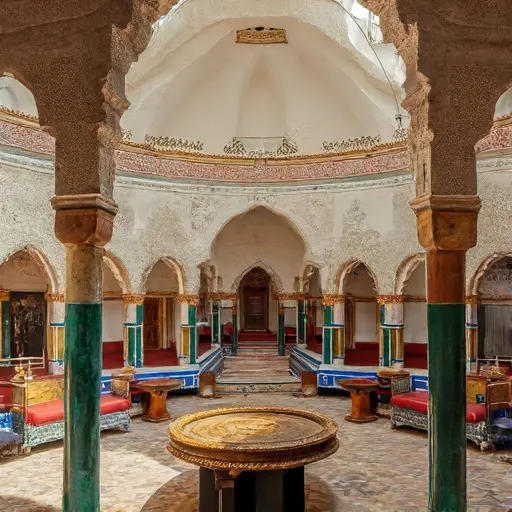
The Al-Sahar House was constructed in the late nineteenth century on a remote desert plain by a family involved in regional water distribution and caravan coordination. Designed in the Moorish Revival style, the structure emphasized climatic adaptation, symmetry, and shaded spatial rhythm, using arcaded walkways and domed volumes to regulate heat and airflow. The household consisted of two generations supported by a small group of workers responsible for maintaining water channels, gardens, and structural cooling systems.
Daily life was shaped by environmental conditions, with water allocation, shade timing, and seasonal winds determining the rhythm of occupation. The circular forecourt functioned as both ceremonial and practical space, collecting water and organizing movement through the residence.
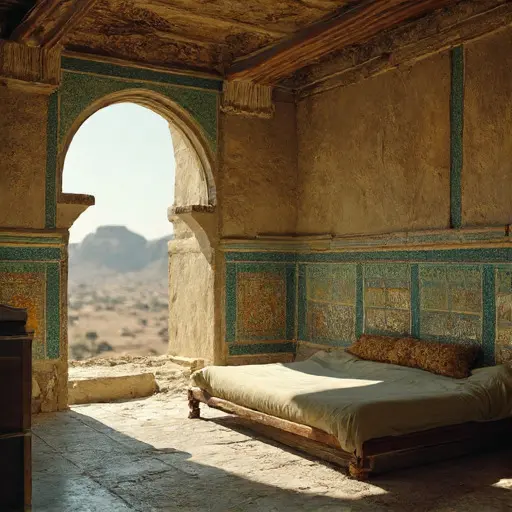
By the late 1920s, the Al-Sahar estate began to experience strain as regional water routes shifted and desert caravan networks declined. Maintaining the plaster surfaces, glazed tilework, and arcaded walkways required constant upkeep due to wind erosion and sand accumulation. Portions of the house were used less frequently during harsher seasonal conditions, and maintenance of the reflecting basin and surrounding forecourt became irregular. Desert plants began to spread more freely around the base of the structure, with grasses and succulents encroaching on previously controlled edges. Water records and correspondence regarding supply agreements accumulated without consistent oversight, reflecting a slow reduction in operational management.
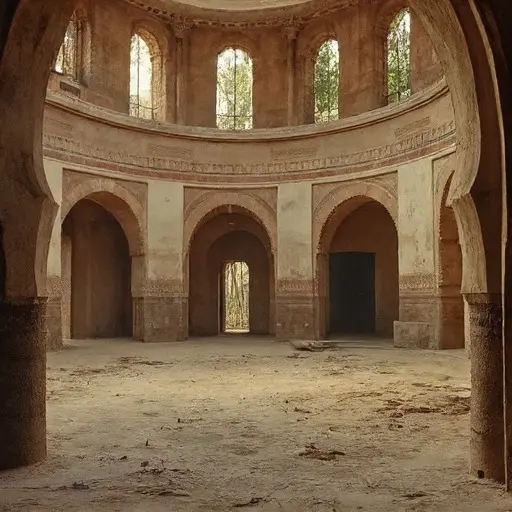
By the early 1940s, following prolonged economic decline and the collapse of regional water distribution routes, the Al-Sahar House was fully abandoned. No restoration efforts were undertaken, and its isolated desert position prevented any practical redevelopment. The structure remained standing on the open plain but deteriorated slowly under wind erosion, sand drift, and extreme temperature shifts. Interior spaces were left in their final state of use, preserving furnishings, water records, and architectural details beneath layers of dust and desert air. The house endures as an unoccupied Moorish Revival residence, quietly embedded in the desert landscape, gradually fading without return, renewal, or resolution.