The Aelthorn Neo-Gothic Manor Left at the Forest Edge
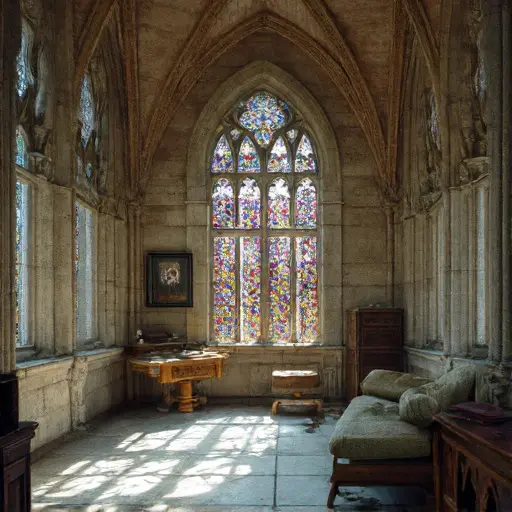
The Aelthorn Manor was constructed in the early twentieth century on a forest-edge rise by an artisan patron-architect who sought to merge Neo-Gothic structural language with domestic scale livability. Unlike monumental ecclesiastical Gothic forms, the design emphasized human proportion, resulting in a compact footprint with clustered steep gables, interlocking roof volumes, and a modest central tower integrated into the residence rather than dominating it. The household consisted of a small family of craftsmen and designers, supported by one or two assistants who maintained both the home and its surrounding garden.
Daily life centered on the main hall and adjoining work-study rooms, where design drawings, material records, and correspondence were managed in a disciplined creative routine. The manor remained stable for years, sustained by commissioned artisan work and careful preservation of its highly specialized materials.
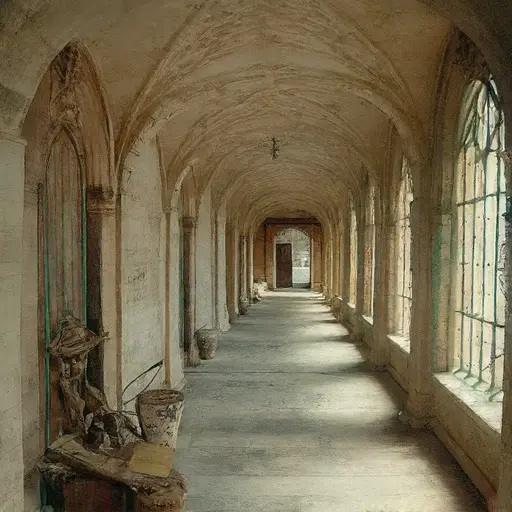
By the late 1920s, the Aelthorn Manor began to experience financial strain as commissioned artisan work declined and maintenance costs for its highly detailed materials increased. The delicate combination of limestone carving, stained glass, and copper ornament required constant skilled attention, which became harder to sustain. Portions of the upper rooms were used less frequently, concentrating daily life into the central hall and ground-level workspaces. Repairs were postponed, particularly to roofing and window tracery, allowing gradual weathering to affect both structure and appearance. Correspondence accumulated without timely response, while creative activity slowed under economic pressure. Over time, the manor transitioned from an active artisan residence into a partially maintained home marked by quiet neglect.
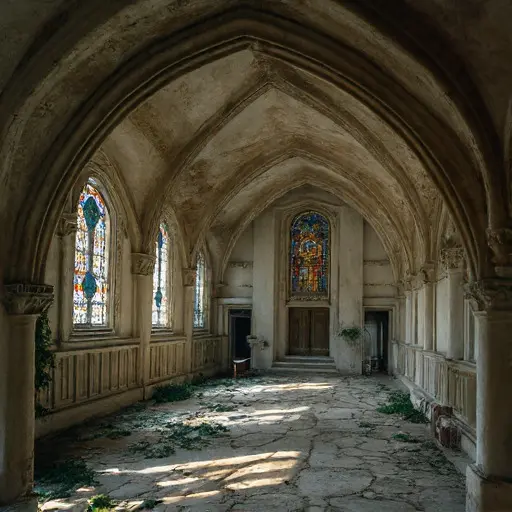
By the early 1940s, following prolonged financial hardship and unresolved inheritance issues, the Aelthorn Neo-Gothic Manor was fully abandoned. No restoration efforts were undertaken, and legal uncertainty prevented any transfer or redevelopment of the property. Vegetation from the surrounding forest gradually encroached upon the winding stone paths and façade edges, while seasonal weather accelerated deterioration of delicate masonry, glass, and copperwork. Interior furnishings and documents were left in place, preserving the final years of decline in quiet detail. No occupants returned, and the manor continues to stand empty at the forest edge, slowly being reclaimed by time while its intricate Gothic silhouette remains faintly visible among the trees.