Tessera-Wane: The Curator’s Missing Exhibit
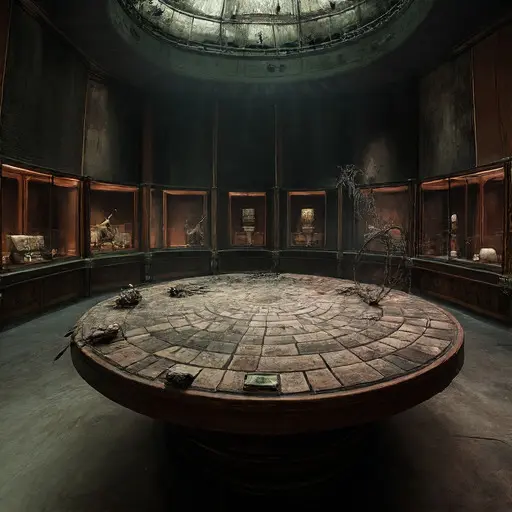
The moment the heavy, bronze-plated door to Tessera-Wane was pushed open, the air rushed out—cold, dry, and heavy with the pervasive, unsettling odor of stale museum air, dry chemicals, and the faint, sweet decay of old taxidermy glue. The name, combining a small, square piece (like a tile or mosaic piece) with the concept of fading or decline, perfectly captured the manor’s function: a place dedicated to collecting and organizing fragments of the past, now itself a crumbling mosaic. This abandoned Victorian house was structured not for domestic warmth, but for clinical, systematic display, its secluded chambers and meticulously temperature-controlled halls designed to preserve items that should have long since vanished.
The final inhabitant was Dr. Aloysius Flinch, a brilliant, but intensely reclusive master curator and cultural historian of the late 19th century. Dr. Flinch’s profession was the acquisition, preservation, and exhibition of historically significant objects, creating narratives from disparate fragments. His singular obsession, however, was the creation of the ‘Zero Collection’—a perfect, flawless museum display that would, through the precise arrangement of its items, reveal the absolute, fundamental truth of human history, free of all interpretation or bias. After a devastating error in dating a major artifact shattered his professional reputation, he retreated to the manor. He dedicated his final years to resolving this single, terrifying goal, believing that the only way to achieve the Zero Collection was to understand the ultimate artifact—the item that represented the beginning and end of human endeavor. His personality was intensely systematic, fearful of narrative error, and utterly consumed by the pursuit of historical finality.
The Restoration Chamber
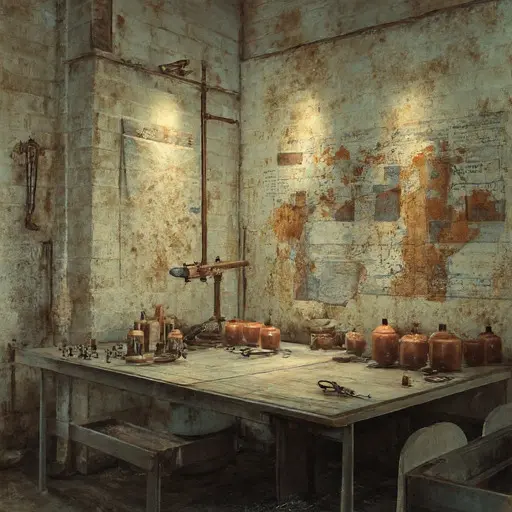
Dr. Flinch’s mania culminated in the Restoration Chamber. This secure, light-controlled room was where he spent his final days, not preserving artifacts, but deconstructing them—pulverizing them into their constituent materials to find the pure, fundamental matter that survived all time. His journals, written in a cramped, clinical script that eventually gave way to dense, chemical formulae and philosophical maxims, were found submerged in a cracked preservation fluid basin. He stopped trying to preserve the past and began trying to synthesize the ultimate artifact, concluding that the only flaw in any exhibit was the inclusion of time-bound objects. “The exhibit must speak no history,” one entry read. “The final piece requires the complete removal of all narrative. The self must become the final, un-dated object.”
The house preserves his scientific methods. Many internal stairwells feature small, low brass railings and hooks, remnants of a pulley system he used for safely transporting fragile, large specimens between the different exhibit levels.
The Final Exhibit in the Abandoned Victorian House
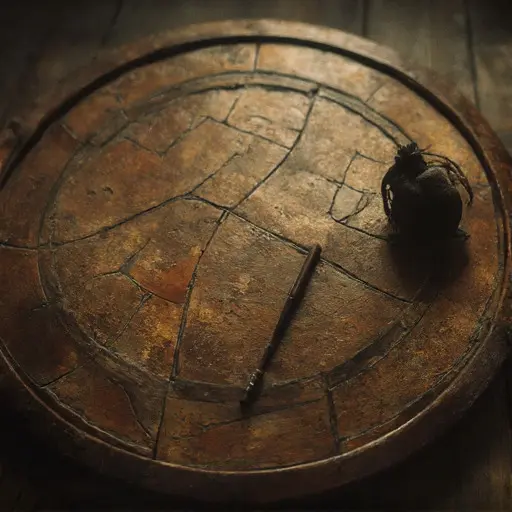
Dr. Aloysius Flinch was last heard working in his workshop, followed by a sudden, intense grinding sound—like metal against wood—and then immediate, profound silence. He did not leave the manor. The next morning, the exhibit hall was cold, the display cases empty, and the man was gone. No body was found, and the only evidence was the singular, physical alteration to his final workspace.
The ultimate chilling clue is the marked tessera. It is the final piece of his collection—the Missing Exhibit achieved, representing the fundamental void at the core of human history. This abandoned Victorian house, with its silent exhibit halls and specialized laboratories, stands as a cold, imposing testament to the master curator who pursued the ultimate, unbiased truth of the past, and who, in the end, may have successfully completed the Zero Collection, vanishing to become the absolute, unrecorded artifact that anchored his final, terrifying display.
