Tactus-Sine: The Tactician’s Final Gambit
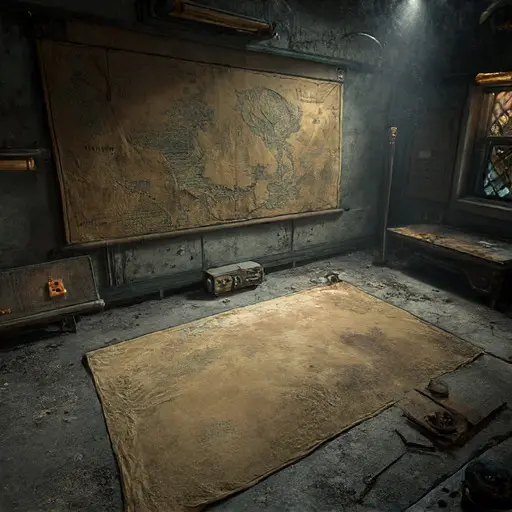
The moment the heavy, bronze-plated door to Tactus-Sine was carefully pushed open, the air rushed out—cold, dense, and heavy with the pervasive, unsettling odor of stale pipe tobacco, dry military canvas, and the sharp scent of mineral spirits. The name, combining the concept of touch or maneuver with “without” or “absence,” perfectly captured the manor’s function: a physical space dedicated to designing action, now embodying its own complete lack of movement. This abandoned Victorian house was structured not for ordinary living, but for unwavering, calculated strategy, its internal layout a bewildering maze of interconnected communication lines, soundproofed chambers, and meticulously angled sightlines designed to maximize intellectual focus.
The final inhabitant was General Maximus Stone (a retired title he insisted on using), a brilliant, but intensely reclusive master tactician and military philosopher of the late 19th century. General Stone’s profession was the planning and execution of complex, large-scale military engagements. His singular obsession, however, was the creation of the ‘Zero-Loss Scenario’—a single, perfect, flawless strategy that would, when executed, yield absolute victory with zero casualties to his own forces, a campaign that was simultaneously a military triumph and a perfect ethical abstraction. After a devastating, personal loss during a flawlessly executed but costly victory, he retreated to the manor. He dedicated his final years to resolving this single, terrifying goal, believing that the only way to achieve perfect war was to understand the ultimate absence of all human cost. His personality was intensely rigorous, fearful of moral failure, and utterly consumed by the pursuit of strategic finality.
The Logistical Chamber
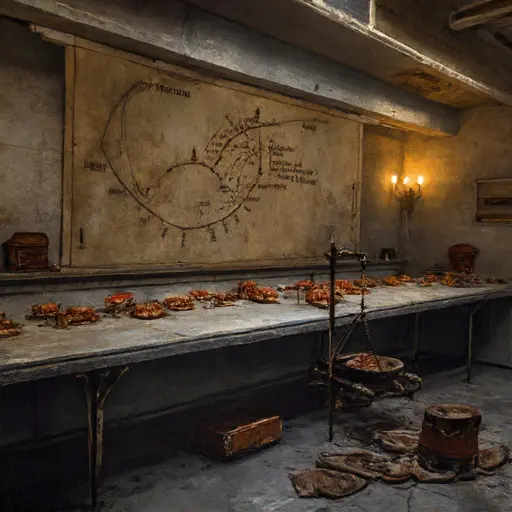
General Stone’s mania culminated in the Logistical Chamber. This secure, sealed room was where he spent his final days, not planning campaigns, but deconstructing the act of conflict itself, attempting to define the perfect military maneuver by isolating the moment before the first blow. His journals, written in a cramped, precise military script that eventually gave way to complex formulae involving vectors and variables, were found sealed inside a hollow metal water bottle. He stopped trying to win battles and began trying to design the un-battle, concluding that the only way to achieve the Zero-Loss Scenario was to eliminate the need for engagement. “The victory is a lie; the deterrent is the truth,” one entry read. “The final strategy requires the complete surrender of all offense. The self must become the final, unmoving object of absolute defense.”
The house preserves his military rigor. Many internal doors are fitted with small, precisely calibrated spring mechanisms that slow the speed at which they can be opened, forcing an unnaturally cautious and deliberate movement through the space.
The Final Move in the Abandoned Victorian House
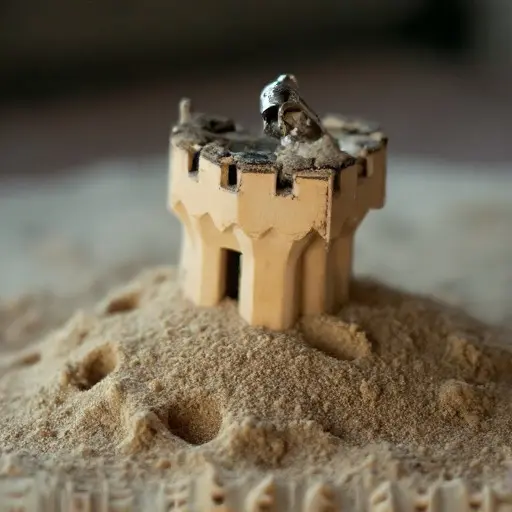
General Maximus Stone was last heard working in his strategy room, followed by a sudden, intense, high-pitched scream of pressurized air (perhaps from a crushing mechanism), and then immediate, profound silence. He did not leave the manor. The next morning, the strategy room was cold, the sand table silent, and the man was gone. No body was found, and the only evidence was the singular, physical alteration to his final strategic board.
The ultimate chilling clue is the crushed whistle resting on the white turret. It is the final command—the Zero-Loss Scenario achieved, representing the cessation of all offensive action and all need for communication. This abandoned Victorian house, with its fortified walls and silent war maps, stands as a cold, imposing testament to the master tactician who pursued the ultimate, casualty-free victory, and who, in the end, may have successfully engineered the Perfect Deterrent, vanishing into the absolute, unmoving defense that he engineered as his final, terrifying statement of peace.
