Switchback Observatory House
Abandoned Victorian house, pale fired-salt sandstone with fine horizontal sediment lines visible under raking light, deep weathered indigo-stained pine timber faded into layered graphite-blue and umber gradients, and forged ironwork in matte black with localized bronze oxidation where rainwater repeatedly pooled over decades. A compact Victorian hillside observatory residence is anchored directly into a spiral mountain switchback road, its architecture following the curvature of elevation rather than resting on a flat foundation. The structure is vertically terraced, stepping with the slope in a controlled sequence of built volumes adapted to gravity, wind, and access rather than symmetry alone.
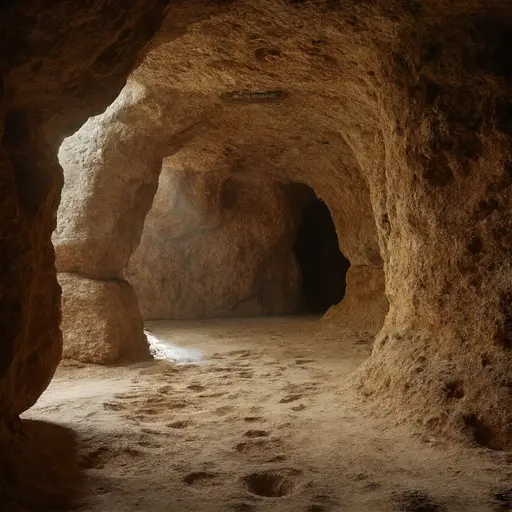
The composition is layered across three primary levels. A lower service level is partially carved into the rock face, functioning as storage and structural anchoring mass.
Above it, a central living level opens onto a narrow panoramic veranda that traces the contour of the hillside, offering continuous visual connection to the surrounding valley and road below. At the top sits a circular observatory room, designed for sky tracking and atmospheric study, its geometry contrasting with the angular sandstone base. The roof combines steep slate planes with a central domed observatory structure. Slate tiles vary from deep charcoal to misted blue-gray, their edges subtly displaced by freeze–thaw cycles and long-term gravitational settling. The dome is clad in aged copper panels, heavily oxidized into green-gray patina with vertical rain streaking that records decades of exposure. Chimneys are integrated into the slope-facing wall, thick and functional, with visibly mismatched brick repairs indicating multiple maintenance periods over time.
The façade is fully exterior and materially honest. Fired sandstone blocks reveal stratified sediment layers and erosion smoothing along exposed corners, while recessed zones preserve sharper granular texture. Timber structural members are load-bearing rather than decorative, showing compression marks, micro-cracking, and uneven moisture absorption patterns that reflect environmental exposure rather than artificial finishing. Iron railings, brackets, and observational mounts are utilitarian and hand-forged, with slight irregularities in spacing and curvature, and corrosion concentrated in joints and water-flow paths.
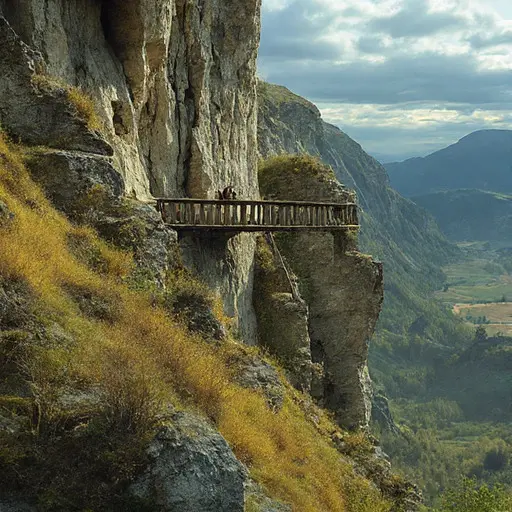
The surrounding environment is a steep alpine switchback system carved into the mountain through both geological uplift and long-term road cutting. The winding road below remains partially intact but increasingly reclaimed by nature—gravel dispersal, moss colonization, and grass intrusion soften its original geometry. The slope alternates between exposed rock strata and thin soil layers where vegetation has established footholds.
Vegetation is sparse and altitude-driven rather than lush. Wind-shaped alpine grasses grow in directional clusters that visually map prevailing airflow across the slope. Small shrubs survive only in rock fissures where moisture accumulates, and scattered wildflowers appear in microclimatic pockets: pale alpine white blossoms near sheltered stone ledges, muted violet mountain flowers in recessed slopes, and occasional desaturated yellow blooms where sun exposure briefly intensifies soil warmth.
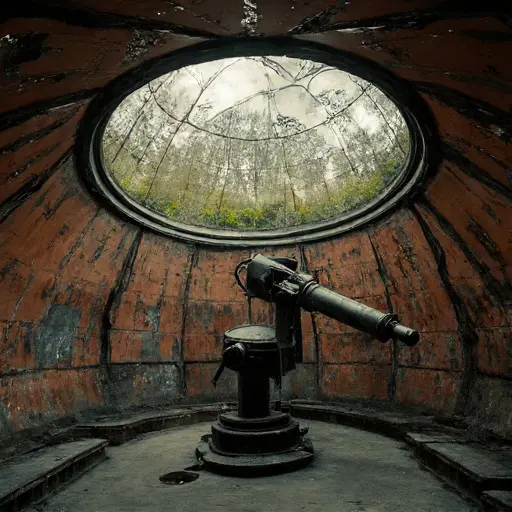
A collapsed wooden astronomical tracking platform once extended from the upper observatory, now broken and partially embedded into the downslope terrain. Its beams remain at irregular angles, displaced by long-term soil movement and gravity creep. Inside the dome, a rusted iron telescope mount remains fixed in position, angled slightly off true alignment, frozen without its optical assembly. Along the switchback road, sections of stone retaining walls show partial collapse, with displaced blocks resting at unstable, rotated angles that record structural fatigue over time.
Window glass in the observatory is uneven and aged, with mineral inclusions and slight warping that distort the mountain horizon into softened, fractured geometry. Lower windows are deeply recessed into thick stone walls, producing strong shadow cavities that emphasize structural mass. Interior visibility is minimal, limited to silhouettes of beams, circular framing, and empty platforms shaped by light rather than detail.
Lighting is high-altitude overcast with thin atmospheric layering, producing soft directional illumination that shifts slowly as cloud cover moves across the ridge. Atmospheric depth is pronounced, with distant peaks fading into haze while foreground materials remain sharply resolved in texture and grain. Moisture in the air slightly diffuses contrast without reducing material clarity.
The entire scene reads like a precise architectural survey photograph of a Victorian mountain observatory residence—geologically integrated, elevation-driven, and shaped by slope mechanics, wind exposure, and long-term structural adaptation rather than ornament or narrative embellishment. A place defined by altitude, observation, and environmental pressure accumulated over time.