Stillwater Boathouse Residence
Abandoned Victorian boathouse-residence resting along the edge of a still inland forest lake under flat overcast daylight, where the sky forms a uniform pale gray dome and the entire scene is rendered in soft, diffuse clarity. The lighting is even and neutral, flattening harsh contrast and emphasizing material texture—wet timber, pale paint, and quiet stone—without any dramatic shadowing or atmospheric distortion.
The structure is fully intact and carefully preserved, built from pale painted timber panels reinforced by low stone pilings embedded in damp shoreline soil. The main residence sits partially over the water, extending outward on a stable grid of wooden supports that descend into the lake’s mirror-like surface. Reflections of the house and surrounding trees remain undisturbed, broken only by faint ripples near the dock supports.
The architectural form is modestly Victorian, with a compact upper residence featuring evenly spaced sash windows framed in simple white trim. The façade is symmetrical at first glance, though subtle irregularities appear along the lakeside elevation where window spacing tightens slightly toward the rear extension. These distortions remain structurally coherent, suggesting adaptation to shoreline constraints rather than design error.
A long covered dock extends from the main structure into the lake, functioning as both walkway and service pier. It is straight and well-maintained, yet the rhythm of its planks subtly shifts midway, as if two construction phases merged without alignment. The dock terminates in a small, empty mooring platform, its edges softened by moisture but free of damage or collapse.
The roof is simple and dark slate, tightly fitted and clean, with a single ridge line running the length of the upper structure. One small chimney rises near the rear section, perfectly vertical and intact. Moisture staining is faint but present, giving the roof a slightly desaturated tone without implying decay.
Lake-facing windows are clear and reflective, mirroring the still water and distant tree line with glassy precision. Forest-facing windows are slightly dulled by interior dust, their curtains hanging motionless and unevenly drawn. One upper window remains slightly ajar, introducing a quiet asymmetry in an otherwise orderly façade.
The surrounding environment is calm and minimally intrusive. Low shoreline grass and sparse reeds trace the edge of the water without overgrowth or encroachment. The forest begins a respectful distance away, composed of evenly spaced trunks that frame the lake rather than overwhelm it. Everything feels naturally contained, as though the clearing was maintained long ago and then simply left alone.
Inside, the boathouse rooms are compact and functional, with painted wooden floors, simple wall paneling, and narrow interior corridors aligned parallel to the lake.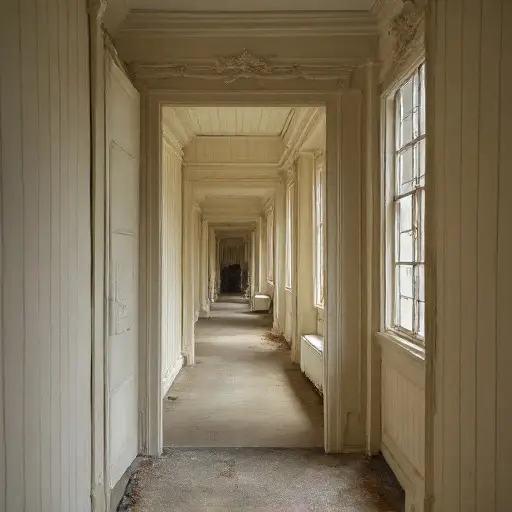
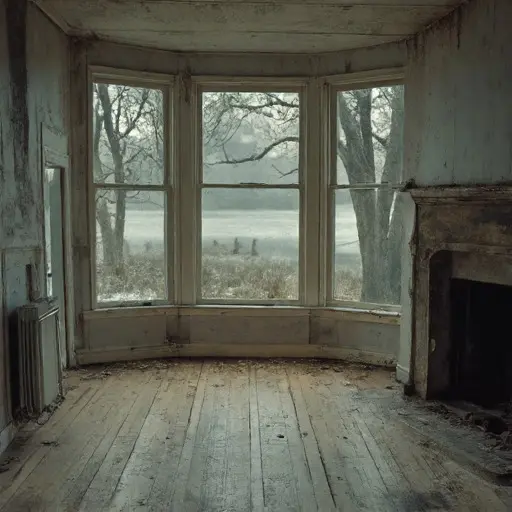
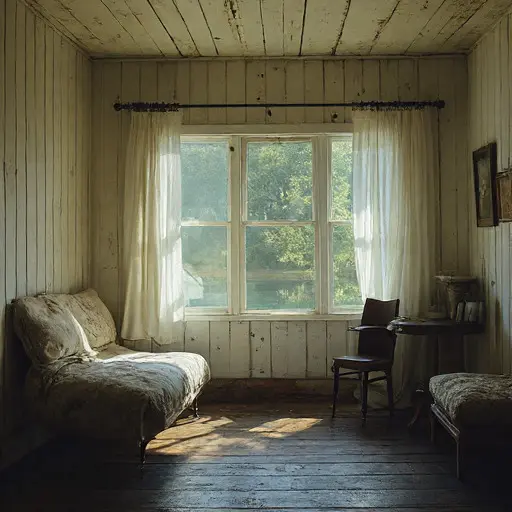
The interior spatial logic remains straightforward, though lakeside rooms feel subtly elongated compared to exterior proportions, especially along the water-facing axis, reinforcing the quiet architectural adaptation to shoreline geometry.
No decay, no collapse, no supernatural presence. The house feels like an abandoned caretaker residence for a forgotten lakeside operation—preserved, still, and quietly reflecting itself in the motionless water under a gray sky. Cinematic realism, exploration-game environment aesthetic, grounded materials, and subtle spatial distortion driven by waterfront design.