Still Convergence in the House of the Coral Memory Sculptor
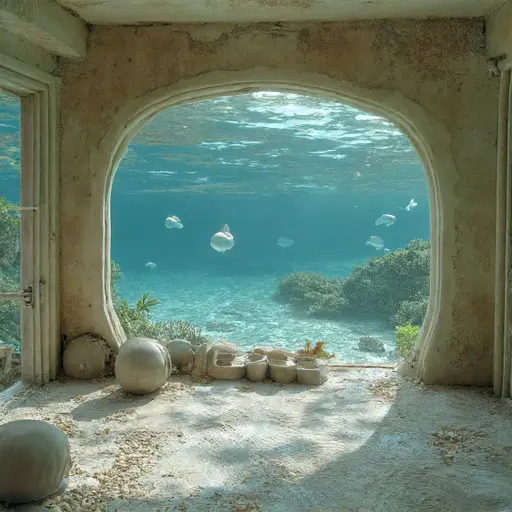
The coral forms are still drying in mineral frames.
Some have begun to pale slightly where seawater evaporation once left salt deposits along their edges.
Each piece was labeled by growth cycle, reef origin, and biological resonance pattern.
This house belonged to Nara.
She worked as a coral memory sculptor, preserving and reconstructing reef growth patterns into physical models used for marine conservation mapping and ecological restoration planning.
The studio was partially submerged during high tide cycles, allowing direct environmental integration.
Carving tables stood on raised stone platforms. Reef samples were suspended in salt-stabilized tanks. Mineral binders and sculpting tools were arranged beside translucent frames shaped like branching coral memory structures.
The house was built to preserve living geometry.
At the Reef Reconstruction Workbench
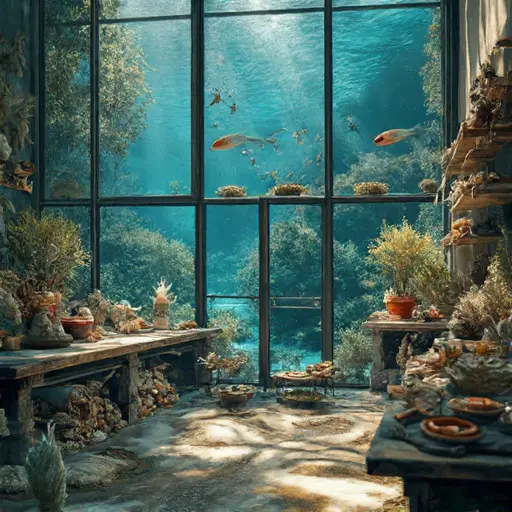
Nara worked most often at the Reef Reconstruction Workbench.
The wide stone-and-glass surface was where she translated reef growth data into physical coral memory structures used by marine biologists to track ecosystem recovery after bleaching events.
Her partner died during an earlier offshore restoration expedition when a sudden reef collapse trapped field divers inside an unstable coral shelf system.
After that, she stopped joining ocean field missions and worked entirely from the coastal studio house.
For years, the profession remained vital.
Marine conservation networks relied on coral memory sculptors to reconstruct damaged reef systems, model ecological regrowth pathways, and preserve biological formation records before they degraded beyond recognition.
Then synthetic reef modeling replaced physical reconstruction.
Computer-generated reef simulation systems and engineered coral substrates reduced the need for manual sculptural preservation of reef memory structures.
Nara continued anyway.
Even without commissions.
Even without ecological assignments.
But the decline was not only technological.
The ocean itself changed.
Warming currents and acidification events destabilized coral growth cycles, making natural reef regeneration increasingly unpredictable and breaking long-term biological modeling accuracy.
Then access collapsed.
A regional marine protection mandate closed large reef zones to human contact after accelerated ecosystem fragility made physical intervention too disruptive for recovery.
Nara stayed inside the house through extended tidal isolation periods, continuing to document coral formation behavior from preserved samples even after field access was fully restricted.
During a final bleaching convergence event, multiple reef systems collapsed simultaneously across the coastal basin, producing large-scale structural coral failure that erased decades of growth patterns in a single season.
She attempted to finalize a complete reef memory reconstruction set at the Reef Reconstruction Workbench during a prolonged environmental monitoring blackout caused by satellite sensor failure.
She died before the final coral structure could be completed.
No marine authority retrieved the studio’s preserved reef models.
The ocean continued shifting without reconstruction.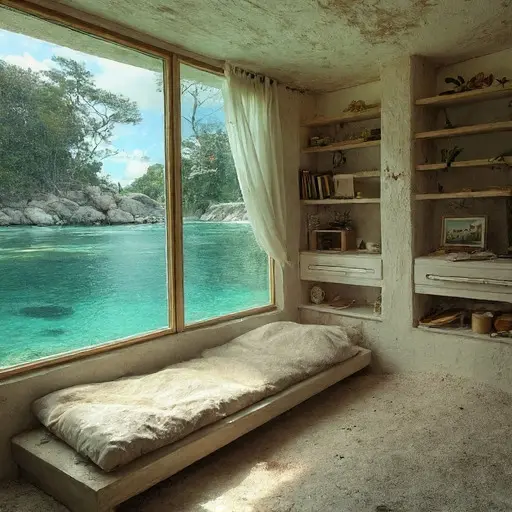
The coral memory structures remain half-formed in their frames.
The reef diagrams stay open beside mineral tools.
And at the Reef Reconstruction Workbench, Nara’s unfinished coral memory continues waiting in silence—holding the last living geometry no one returned to rebuild.