Spiral House of the Mooring Winds
Abandoned Victorian woodland house situated on a high coastal moor where the land folds into long wind-carved ridges and the sea presses close in shifting curtains of mist, the structure designed as a low but radically spiraled Victorian residence embedded into a natural knuckle of bedrock, as if the building has been slowly wound into the landscape over generations rather than constructed in a single act.
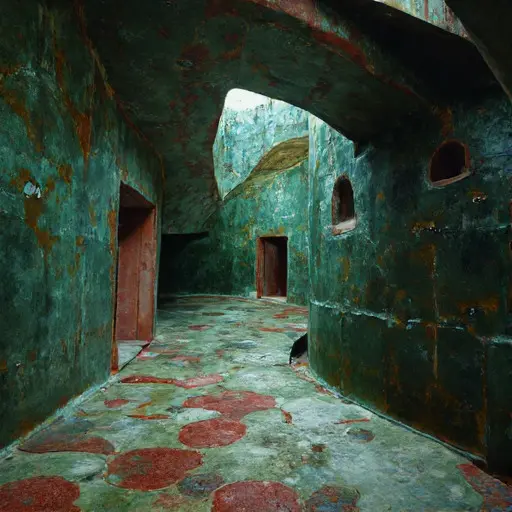
The exterior is composed of interleaved bands of storm-worn granite, glazed ceramic masonry, and reinforced timber ribs, all organized in a helical wrapping that reinforces the sense of continuous rotation. The granite base appears in cold slate gray, iron black, and pale salt-specked silver, roughened by coastal abrasion. Above it, ceramic masonry introduces deep tonal spirals of oxidized teal, weathered garnet, and muted cobalt, each band subtly shifting hue as moisture and light change across the façade. Timber ribs arc between these layers in softened vertical sweeps, stained in aged driftwood brown, moss green, and faded indigo, binding the spiral together visually and structurally.
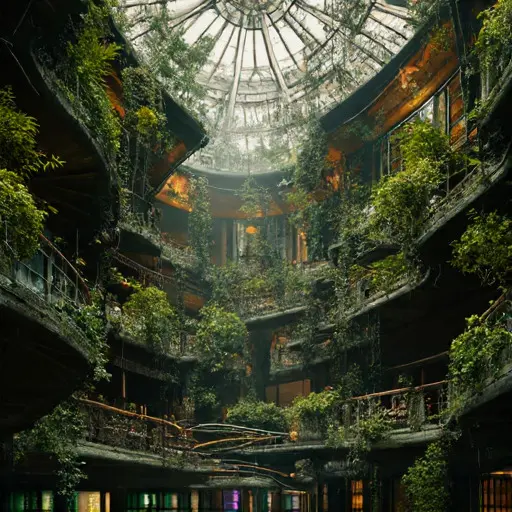
The architecture is organized around a central void-like atrium that twists upward through the entire structure, with each floor slightly offset to follow a continuous rotational logic. Instead of stacking levels, the house coils around this core, producing shifting corridors, curved thresholds, and wedge-shaped rooms that open and close depending on position within the spiral. The result is a sense of controlled motion, as though the building is frozen mid-rotation.
The roof is not a single crown but a fragmented spiral canopy composed of overlapping curved slate plates and glazed ceramic ridges. Slate surfaces range from deep graphite and blue-black to faint green mineral bloom where coastal air has weathered the stone. Copper reinforcements trace the spiral path like luminous veins, oxidized into turquoise-green and sea-bronze streaks that emphasize the rotational geometry from above.
The façade is defined by vertical continuity broken into spiraling segments: tall slit windows curve with the walls, while larger glazed panels appear intermittently at the outer bends of the structure, revealing glimpses into the twisting interior. Window frames are finished in matte iron black and dull nickel gray, allowing the shifting colors of stone and ceramic to dominate the visual rhythm.
The main entrance is carved into the lowest turn of the spiral, set within a recessed stone aperture that curves inward like a pulled thread in fabric. The door is a heavy, rotating timber slab reinforced with radial iron struts, its surface darkened to near-black with hints of deep green where salt air has settled into the grain.
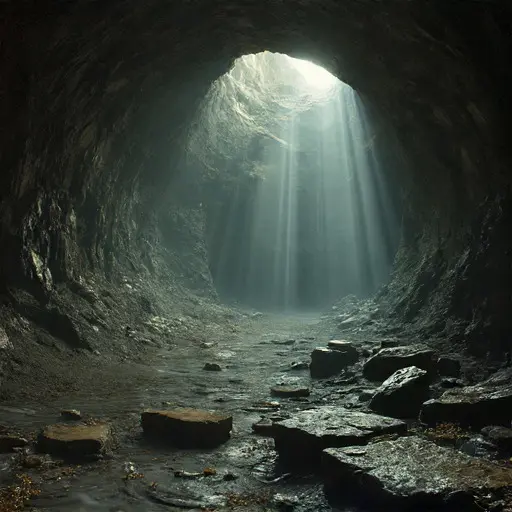
Inside the atrium, the space rises in a continuous helix of light and vegetation, with suspended walkways and iron lattices spiraling upward alongside climbing coastal plants. At the top, a broken oculus opens directly to the sky, allowing mist, rain, and shifting coastal light to fall through the entire vertical volume in slow, changing columns.
The surrounding moorland is open and wind-driven, with grasses bending in long synchronized waves across rolling terrain. Sea mist moves inland in slow, unpredictable sheets, often wrapping around the house so that its spiral form appears and disappears in phases, as if the structure itself is breathing with the weather.
The atmosphere is kinetic yet restrained, defined by rotation, vertical pull, and shifting coastal light. The result is a grounded Victorian woodland moor house that feels continuously turning, materially layered, and deeply embedded in wind, stone, and salt air without repeating prior architectural systems, spatial logics, or material palettes.