Silent Voronin Stencil-Room and the Pattern That Slipped

A muted hush fills Voronin House, gathering heaviest in the stencil-room, where artisanship once shaped walls for neighboring estates. Here Oleg Viktorovich Voronin refined decorative borders, repeating rhythms drawn from northern folklore. Now one slipping pattern marks the moment when certainty faltered and the house drifted out of step.
A Shear in the Decorator’s Practice
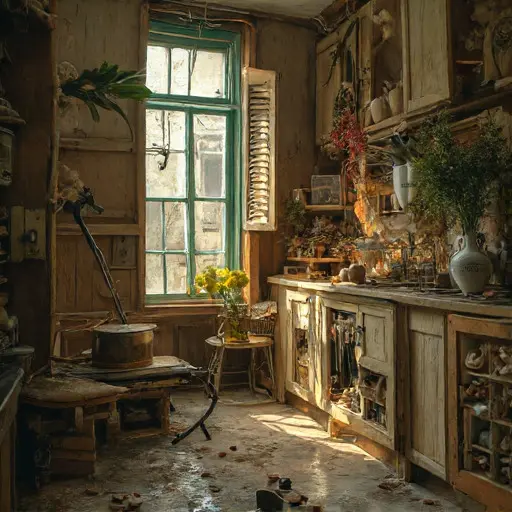
Oleg, decorative stenciler, born 1876 in Novgorod, inherited folk motifs from his grandmother Sofiya Voronina, whose embroidered cloth remains draped across a pigment chest. Each day he mixed colors at dawn, cut paper forms by afternoon, and brushed walls by lamplight. Evidence of his steady method lingers—cleared palettes in tiered racks, knife blades stored by width, rollers wrapped in linen to preserve grain. His meticulous nature reads clearly in every aligned brush and squared sheet.
When His Borders Lost Their Line
Rumors stirred that Oleg misaligned an estate’s grand frieze, causing tension with a patron known for his exacting standards. In the supply loft, tins of primer stand unevenly, one lid popped askew. A stencil roll lies crushed, its pattern distorted. Sofiya’s cloth shows a fresh crease where it was clutched too tightly. A brush used for fine edgings is bent at the ferrule, its bristles splayed. None of these explain why his once-unbroken confidence wavered, though each sign edges close to a strain he would not voice.

Only the slipped stencil remains, its shear line catching shadow along the lacquered board. Whatever turned Oleg from his work lingers in the room’s tempered hush.
Voronin House remains abandoned still.
