Silent Marlow Pipe-Room and the Draft That Faltered
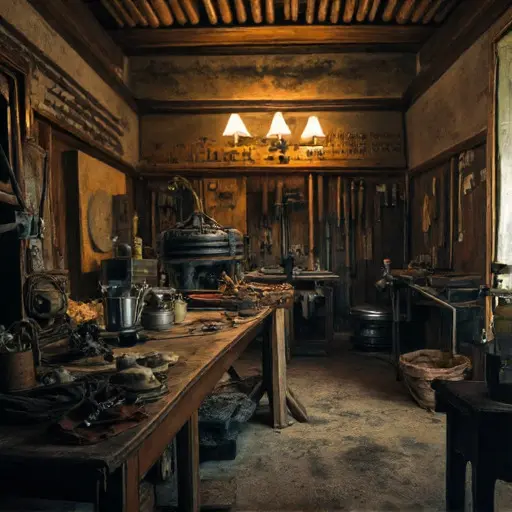
A muted stillness gathers inside Marlow House, thickest in the pipe-room, where warm brass once sang under the hand of Agatha Rose Marlow. She crafted wind-instrument tubing for small music halls—quiet work requiring calm, heat, and a feel for resonance. Now the faint ripple on a cooling sheet catches the lantern’s glow, a suggestion of a gesture she never finished.
Even the rafters seem to lean closer, waiting for a note that never rose.
A Ripple in the Instrument-Maker’s Patience
Agatha, born 1878 in Norfolk, apprenticed under her cousin Thomas Marlow, whose old tuning fork lies wrapped in felt upon a shelf. Her days traced a careful path: heating brass at dawn, curving pipes around hand-wheels by noon, burnishing valves after dusk settled into floorboards. Evidence of her diligence remains everywhere—tubing sorted by bore size, cloths folded in squared stacks, soldering rods aligned like quiet intentions. She moved with thoughtful certainty, shaping airflow into the bones of music.

When Her Precision Lost Its Tone
Word spread that Agatha’s latest commission—a replacement horn pipe for a seaside band—sounded muted, even breathless. In the side cupboard, a cloth roll of valve springs lies partly unfurled, coils spilling in uneven lines. A small hammer bears a new dent along its handle, not matching any normal task. Thomas’s tuning fork shows a smudge across one tine. A curvature template rests beneath a stack of brass sheets, its outline skewed a shade off-coaxial. Each detail murmurs of a craftsman caught between resolve and strain, though none declare the cause outright.
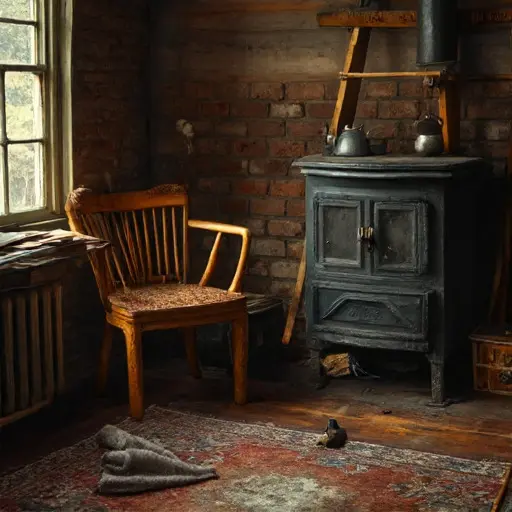
In the end it is the rippled brass sheet, barely warped, that captures the stillness: a draft broken mid-arc, a breath stopped short. Whatever pressed upon Agatha’s final night remains locked in these small displacements, fragile as the sound she once coaxed from hollow metal.
Marlow House remains abandoned still.
