Silent Dominion in the House the Bone Illustrator Never Signed
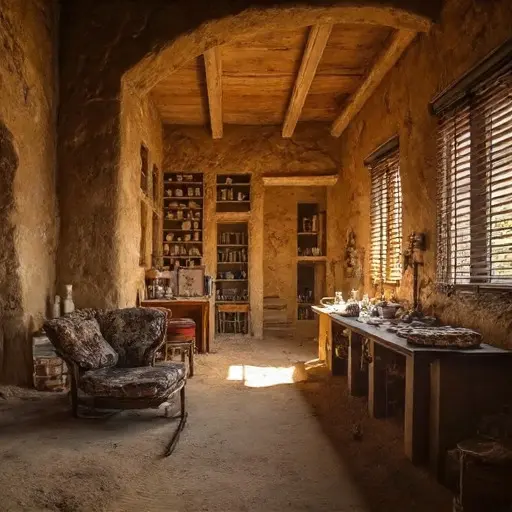
The bones are still arranged in sequence.
Not scattered.
Not forgotten.
Placed with deliberate care along a long wooden drafting table where dust has settled like a second layer of anatomy.
This house belonged to Idris.
He worked as a skeletal anatomist illustrator, producing precise bone structure drawings for medical schools, field hospitals, and archaeological teams working across desert excavation zones.
The studio was carved into the back of the house to protect fragile specimens from heat and wind.
Ink pots lined stone shelves. Fine brushes rested in ceramic cups. Bone fragments were labeled in faded script and arranged according to study sequence rather than discovery order.
Nothing here was random.
Everything was observation made permanent.
Beneath the Desert Alignment Frame
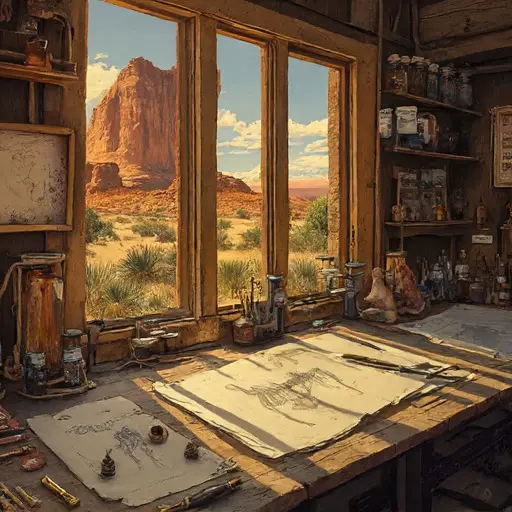
Idris worked most often beneath the Desert Alignment Frame.
The wide drafting window allowed him to align skeletal proportions against natural light for accurate comparative anatomy sketches used by medical students and excavation researchers.
His wife passed away during his early career.
After that, he stopped traveling with excavation teams and worked entirely from home.
For years, the profession remained respected.
Archaeologists depended on accurate skeletal reconstruction to identify ancient populations uncovered in shifting desert dig sites. Medical institutions used his diagrams for training field surgeons in remote conditions.
Then digital modeling replaced hand illustration.
3D scanning, automated reconstruction software, and centralized anatomical databases replaced independent illustrators who once worked from direct observation and manual reconstruction.
Idris continued anyway.
Even without commissions.
Even without requests.
But the decline extended beyond technology.
The desert itself changed.
Excavation sites became unstable due to shifting wind erosion patterns and unexpected subterranean collapses that forced many archaeological projects to shut down or relocate. Bone recovery slowed. Field access became restricted.
Then the health of Idris declined.
Years of inhaling fine desert dust during excavation visits and specimen handling led to chronic respiratory failure that steadily reduced his ability to work for long hours at the studio.
One final excavation shipment arrived during a severe sandstorm season.
He attempted to complete a comparative skeletal plate set from fragmented remains brought in before the site was closed permanently.
The storm cut power intermittently across the region, and supply routes never reopened in time for assistance.
Idris died at the drafting table before the final illustration was signed.
No institution reclaimed his workspace.
The house remained sealed by desert silence.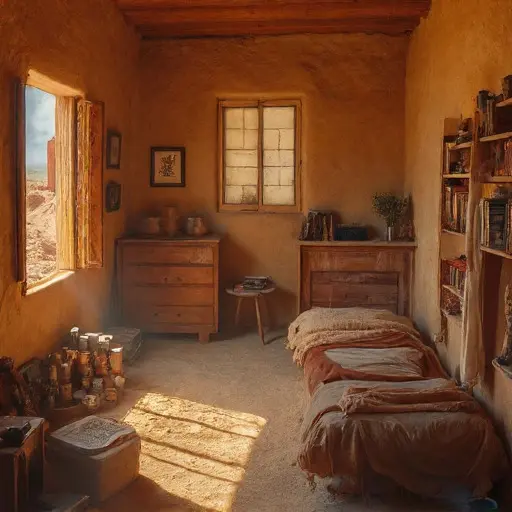
The bone fragments remain aligned.
The ink has dried in unfinished strokes.
And beneath the Desert Alignment Frame, Idris’s final illustration continues waiting in silence—holding the last anatomy he never returned to sign into completion.