Shrouded Kowalski and the Pantry That Guarded His Ferments
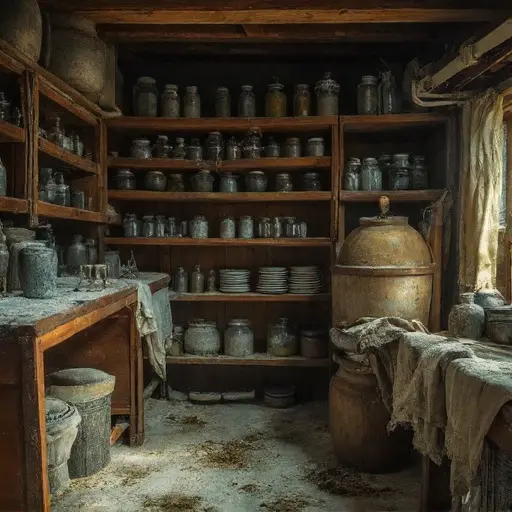
A dim hush rests inside Kowalski House, thickest in the abandoned pantry, where fermentation once hummed gently beneath domestic routine. Here Jan Krzysztof Kowalski, a Polish pickler and food preserver of uncommon precision, tested brines and cultures beside everyday provisions. Now the faint pulse in that unsettled jar hints toward a moment when his certainty thinned.
A Pulse in the Preserver’s Patient Methods
Jan, born 1876 in Kraków, learned careful salting from his mother Agnieszka Kowalska, whose wooden mixing spoon—darkened by beet brine—lies across a chipped bowl. He shaped his days with discipline: morning inspections of jars for clarity, afternoon tasting of trial mixtures, evening notes written at the kitchen table while the pantry cooled around him. Traces of his order remain—labels in neat Polish cursive, jars arranged by harvest season, cloth wraps folded into squares. Even the worn patch of floor near the counter keeps the contour of his habitual stance, weight tipped slightly forward as he checked each slow-developing batch.
When His Craft Slipped from Its Line
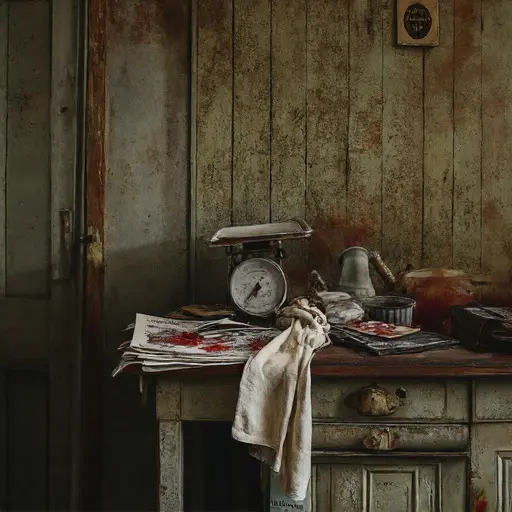
Whispers suggested Jan supplied a spoiled batch of preserved cabbage to a neighbor who fell ill, though no one proved the fault. In the rear hallway, a crate of cucumbers has collapsed, scattering shriveled skins along the boards. Agnieszka’s mixing spoon bears a fresh splinter. A ledger of measurements sits wedged beneath a shoe, its last entry scratched out. A broken wax seal lies crushed near the wall, flakes forming a small crimson arc. These clues do not speak plainly, yet they lean toward a pressure he kept quietly to himself.
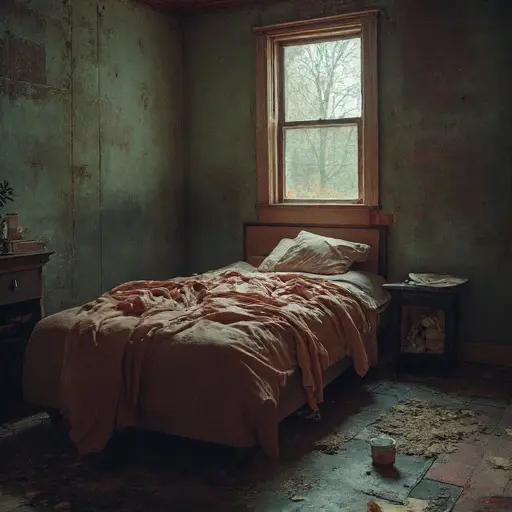
Only the unsettled pulse inside the skewed-lid jar remains—an unfinished test, suspended between craft and doubt. Whatever unsettled Jan’s final mixture lingers in these abandoned rooms.
Kowalski House remains abandoned still.
