river-aligned house in the willow delta
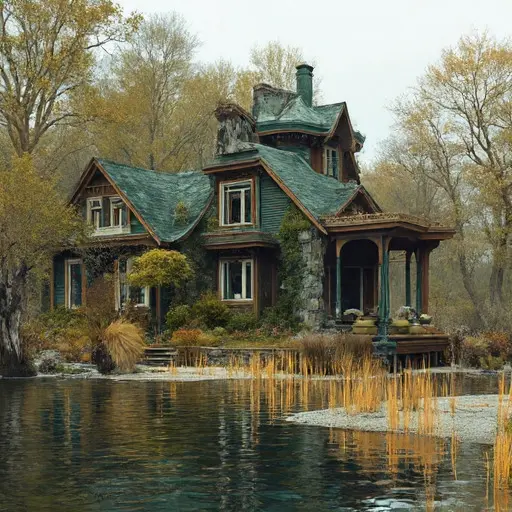
Abandoned Victorian woodland house located in a wide river delta where multiple slow channels weave through dense reeds, gravel bars, and scattered willow stands, the structure built as a low, elongated residence that follows the curvature of the main waterway rather than standing perpendicular to it. The entire composition feels as if it has been gently pulled into alignment with the river’s motion, producing a flowing, horizontal architecture that mirrors the braided geometry of the delta itself.
The exterior is constructed from pale fired brick at the base, its surface softened into chalky beige, muted rose-gray, and weathered sand tones by constant humidity and sediment-laden air. Above this grounded foundation, the upper levels are finished in continuous horizontal timber siding painted in a layered triad of weathered ultramarine, soft saffron cream, and desaturated moss green. These colors have not remained distinct; instead, they have merged over time into long atmospheric gradients where sun, river mist, and seasonal dampness have subtly blended edges into one another across the length of the façade.
The roof is a continuous shallow hipped form that gently bends at points where the building follows the river’s curvature. Slate tiles vary from deep slate-gray to muted steel blue, with occasional pale green mineral staining concentrated near the water-facing edges. Wide overhanging eaves extend well beyond the walls, supported by a rhythmic series of darkened wooden brackets that have aged into deep brown-black tones, emphasizing the building’s horizontal drift across the landscape.
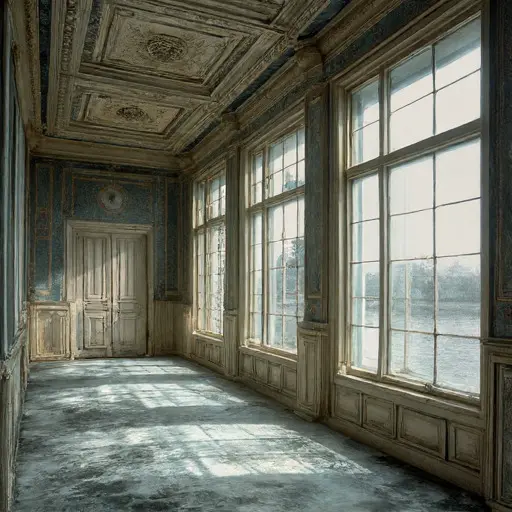
The façade is organized through a long, continuous rhythm of windows rather than segmented architectural breaks. Tall sash windows dominate the central living areas, while narrower paired windows appear toward the ends of the structure, subtly tapering the visual weight of the building. Frames are painted in alternating subdued tones—fog white, faded apricot, and muted teal—creating a restrained but intentional chromatic sequence that repeats gently along the length of the house.
The main entrance sits near the midpoint of the structure, recessed beneath a shallow gabled porch painted in softened cream with dark green timber accents. The heavy wooden door is finished in deep matte navy blue, its surface polished smooth along the handle path and softened at the edges by years of wind, moisture, and repeated contact.
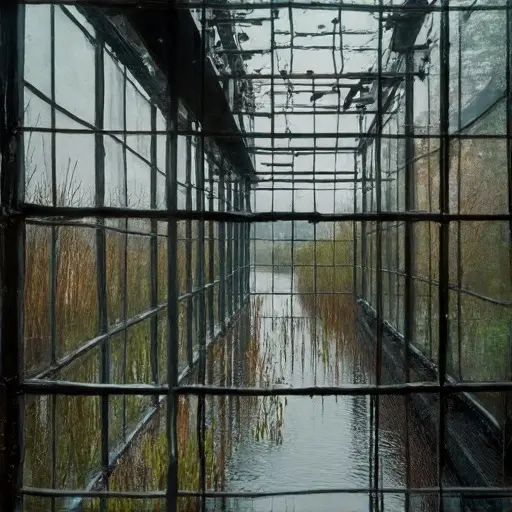
On the river-facing side, a continuous glazed gallery stretches almost the entire length of the house. Built from thin black iron framing and slightly uneven glass panes, it acts as a long reflective membrane between interior and delta. The glazing captures the braided channels in fragmented horizontal bands of green, silver, and dark brown, constantly shifting as wind ripples the water and reeds bend with current.
The surrounding environment is expansive and fluid, shaped by braided waterways that divide and rejoin across gravel bars and reed islands. Willows lean toward the channels, their reflections stretching and breaking across moving water into abstract streaks of pale green and shadow. The entire delta behaves like a slow-moving mosaic of land and water, constantly rearranging its own geometry.
The atmosphere is humid, quiet, and softly luminous, with diffuse daylight filtered through thin cloud layers and reflected across water surfaces in long, layered gradients. The house feels less like a fixed object and more like a linear continuation of the river system itself, integrated into the delta’s motion and reshaped by its constant flow.