Redwood Amphitheater House of the Sunken Ring
Abandoned Victorian woodland house located within a vast circular redwood forest where colossal trunks rise like natural cathedral columns and the forest floor is layered in thick fern mats and compressed needle carpets, the structure designed as a perfectly radial Victorian residence organized around a sunken central courtyard that behaves like a carved stone amphitheater open directly to the sky.
The exterior is composed of alternating structural bands of carved pale sandstone, vitrified Victorian brickwork, and interleaved oxidized metal cladding. The sandstone elements appear in warm ivory, soft honey gold, and pale chalk cream, intricately carved with faded botanical reliefs and geometric Victorian motifs that have eroded into abstract topographic textures. The vitrified brick bands introduce deep saturated chromatic blocks—ruby crimson, forest emerald, and midnight indigo—glazed surfaces that still catch fragments of filtered redwood light. Between these, oxidized metal cladding acts as connective tissue between radial volumes, shifting between brushed steel silver, tarnished copper, and muted gunmetal, creating a subtle industrial undertone beneath the ornate Victorian layering.
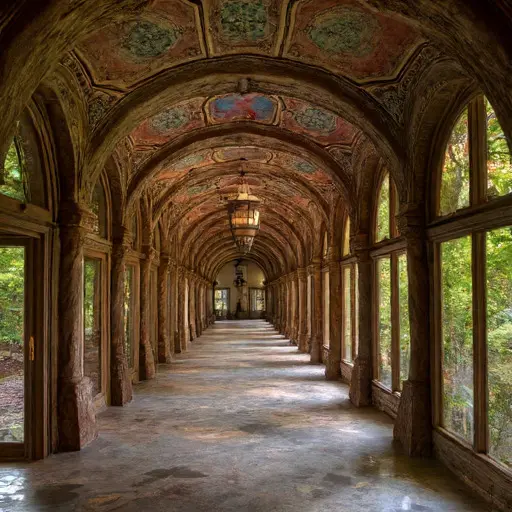
The architecture is organized with strict radial discipline: eight curved wings extend outward from the central sunken courtyard like structural spokes, each wing differentiated by height, window rhythm, and material emphasis. Some wings rise vertically with stacked arched fenestration, while others stretch low and horizontal with continuous forest-facing glazing. Narrow fissures between wings allow redwood roots, moss, and understory ferns to infiltrate the edges of the architecture, softening the boundary between built and natural systems.
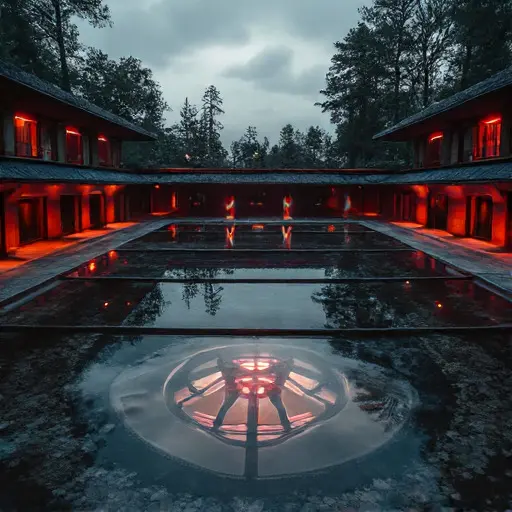
The roofscape forms a segmented circular crown made of overlapping curved slate shells, each aligned precisely with the radial geometry of the building. Slate tones shift from deep graphite and blue-black to occasional streaks of oxidized green where moisture and forest air have altered the mineral surface. At the center, a large circular oculus roof opens above the sunken courtyard, fitted with segmented glass panes that scatter daylight into rotating, concentric patterns across the interior.
The façade is defined by rotational repetition rather than linear symmetry: each wing maintains its own internal window cadence while remaining aligned toward the central courtyard. Window frames alternate between soft bone white, desaturated teal, and muted burgundy, producing a subtle chromatic pulse when experienced in sequence around the ring. Deep recesses in the sandstone emphasize shadowed thresholds, while glazed brick sections reflect fragmented vertical slices of the surrounding redwood trunks.
The main entrance is positioned asymmetrically on the forest-facing side of one radial wing, set within a tall arched sandstone portal that slightly interrupts the perfect circular logic. The door is a heavy ebony-stained timber slab reinforced with radial brass inlays that converge toward a central point, echoing the geometry of the courtyard itself.
Inside the courtyard, the architecture opens into a sunken circular garden chamber. Stone pathways spiral gently through moss, low ferns, and shallow water channels that reflect shifting fragments of sky and structure. At the center lies a still reflecting pool that mirrors both the redwood canopy and the radial house in broken concentric distortions.
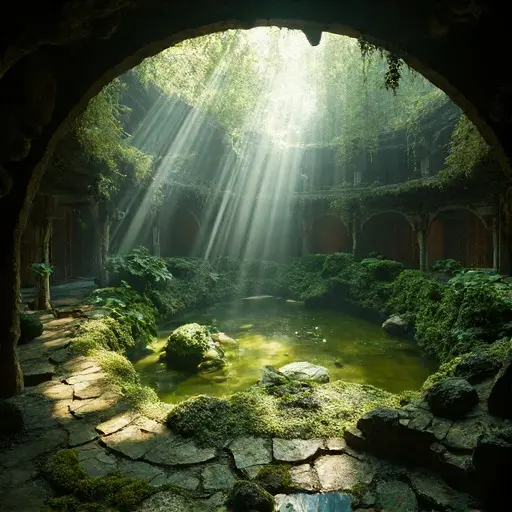
The surrounding redwood forest rises in immense vertical repetition, forming a living colonnade that filters sunlight into narrow rotating shafts throughout the day. Shadows drift slowly across the radial architecture, reinforcing the sense of circular time and spatial rotation.
The atmosphere is hushed, monumental, and rhythmically luminous, with light moving in circular sweeps across stone, brick, and oxidized metal. The result is a grounded Victorian woodland radial amphitheater house that feels structurally absolute, geometrically disciplined, and fully embedded within a redwood cathedral landscape without repeating prior architectural systems, spatial logics, or material compositions.