Ravenspan Bridge House
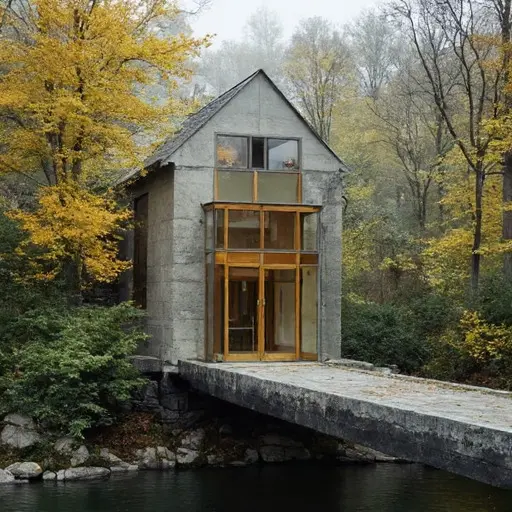
Abandoned Victorian bridge-house spanning a narrow forest ravine under soft overcast daylight, where evenly diffused light flattens harsh contrast and reveals the structure in quiet, readable detail. Pale stone supports rise from the ravine floor, holding a long suspended residential span of white timber and slate above slow-moving water. The atmosphere is still and balanced, with no wind-driven motion in the trees and only faint ripples below the bridge.
The structure is fully intact and precisely engineered, functioning simultaneously as a residence and a crossing point between two rocky forest edges. Massive stone piers anchor the house into the ravine walls, supporting a continuous horizontal building that extends in a straight line across the gap.
The engineering reads as deliberate and confident, with no visible stress fractures or signs of failure despite the unusual span.
The main residence is organized as a strict linear sequence of rooms arranged side-by-side along the bridge’s length. Each room opens to tall sash windows on both sides of the structure, offering symmetrical views into the surrounding forest. This creates a continuous lateral exposure to the landscape, reinforcing the sense of movement through space even in stillness.
A subtle structural irregularity appears beneath the house where one cluster of stone supports sits fractionally closer together than the rest. Above this section, the interior compresses almost imperceptibly, with slightly tighter room spacing and marginally reduced corridor width, though all proportions remain structurally coherent and stable.
The roof is a clean, uninterrupted span of dark slate, running the full length of the bridge-house in a disciplined line. Chimneys are evenly spaced along this ridge, each aligned with distinct interior rooms below. All chimney stacks are upright, functional in appearance, and evenly weathered, reinforcing the sense of engineered continuity.
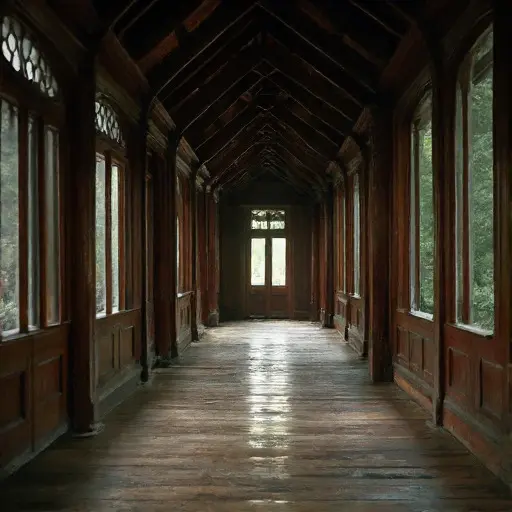
On one side of the structure, a narrow enclosed corridor runs the entire length of the bridge, fully glazed with tall windows overlooking the ravine. The glass is intact but softened by age, diffusing reflections of trees and sky into gentle distortions. The opposite side features smaller, regularly spaced windows facing deeper into the forest, creating a dual-aspect architecture that balances openness and enclosure.
The ravine below is shallow and calm, with slow water movement around scattered stones and exposed riverbed. Light vegetation grows along the edges but does not encroach upon the structure. The elevation of the house keeps it entirely free from overgrowth, reinforcing its identity as a suspended human passage through the landscape.
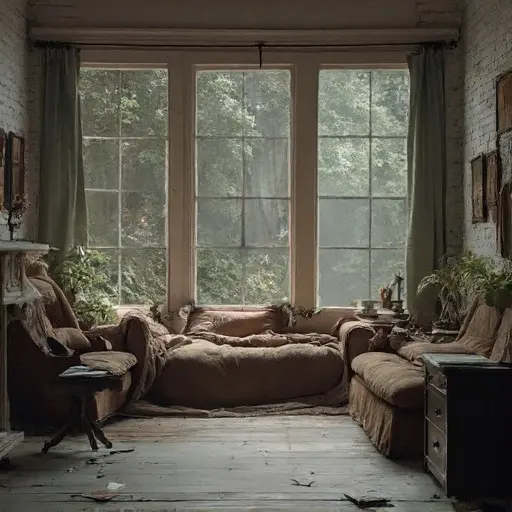
Interior rooms are simple, functional, and Victorian in restraint, with wooden floors and minimal decorative detailing. Doors align in a strict linear sequence, creating an uninterrupted path from one end of the bridge to the other. Some rooms feel slightly elongated relative to their window spacing, but remain within plausible architectural limits shaped by the bridge’s structural rhythm.
No decay, no collapse, no supernatural elements. The house feels like a forgotten transit residence integrated into infrastructure—quietly suspended above a ravine, preserving domestic life within a bridge that was never meant to be just a crossing. Cinematic realism, exploration-game environment aesthetic, grounded materials, and subtle spatial compression driven entirely by structural engineering.