Ravenholt Manor Left Vacant After Wartime Decline
The Occupied Years
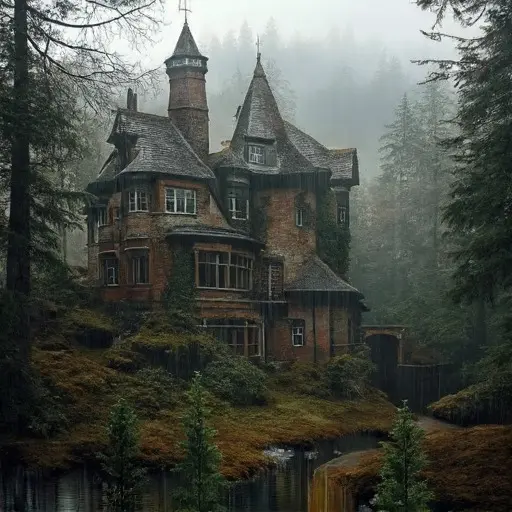
Ravenholt Manor was established in the final decades of the nineteenth century as a remote country residence for the Halverson industrial family, who used it intermittently while maintaining business interests in coastal manufacturing towns. By 1906 the manor was occupied more consistently by Edward Halverson, his wife Clara, and a small household staff who managed both domestic operations and the surrounding woodland estate. Life within Ravenholt was structured and formal, though increasingly shaped by the building’s peculiar geometry.
Corridors stretched longer than expected between wings, and certain rooms appeared duplicated in layout despite no official architectural record explaining their repetition. These inconsistencies were noted in maintenance logs but attributed to incremental expansion over decades rather than any deeper flaw in design.
Daily routines remained stable. Letters were drafted in the east study, meals were served in the long dining hall beneath stained glass windows, and repairs were recorded with meticulous precision. Yet even in these early years, the structure exhibited subtle shifts. Doorframes required seasonal adjustment, and exterior timberwork absorbed moisture at uneven rates depending on exposure to the forest basin’s persistent dampness. The household adapted to these irregularities without question, maintaining function despite a growing sense that the building was not entirely fixed in its arrangement.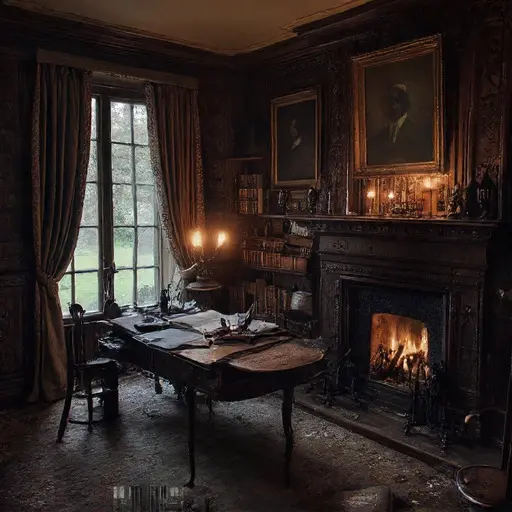
Early Decline
By the 1920s, the Halverson family’s financial position weakened as industrial markets shifted and overseas competition reduced profitability. Ravenholt Manor, expensive to maintain due to its size and environmental exposure, became increasingly difficult to support. Staff numbers were reduced, and entire wings of the house were sealed to limit heating costs. The forest basin’s constant moisture accelerated deterioration, particularly where overlapping rooflines and intersecting wings created weak drainage points. Rainwater began to collect in hidden channels within the slate roof, seeping into upper floors and producing slow, uneven decay in interior plaster and timber.
Repair efforts grew more complex as the manor’s geometry complicated standard restoration methods. Contractors reported that replacement materials rarely fit without modification, as walls and floors no longer aligned consistently across different sections of the house. Some corridors required angled adjustments to accommodate shifting structural lines, and certain staircases had to be reinforced after subtle changes in load distribution became apparent. Administrative records from the period show increasing concern over maintenance costs, though no single catastrophic failure was identified. Instead, the building deteriorated through accumulation: small distortions, repeated moisture damage, and gradual abandonment of space that had become too expensive to sustain.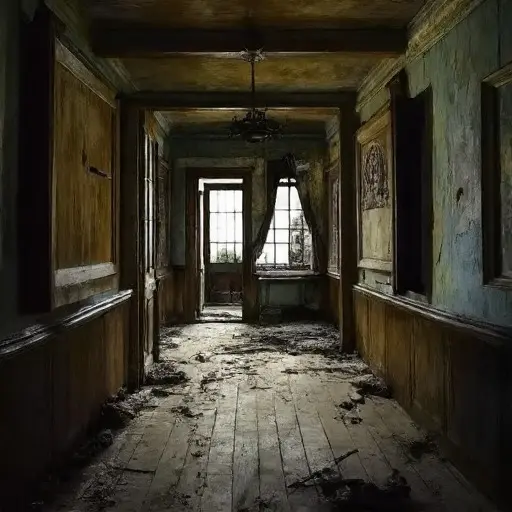
Final Abandonment
The final occupation of Ravenholt Manor ended during the early 1940s, as wartime disruptions and economic instability forced the remaining Halverson descendants to relocate permanently. The estate, already costly and structurally compromised, was left under temporary administrative oversight that failed within a short period due to resource shortages and legal uncertainty. By 1943 the manor was effectively uninhabited. Subsequent inspections recorded advanced water damage, worsening alignment shifts in multiple wings, and partial collapse of internal supports in less-used sections of the house.
Ownership disputes over inheritance and property taxation prevented any coordinated sale or restoration effort. The manor remained legally unresolved, neither fully abandoned nor actively maintained. Doors were sealed, though many deteriorated naturally over time, allowing forest growth to penetrate interior spaces. Ivy spread through broken windows and reappeared in upper corridors where light and moisture allowed slow vegetation growth. Lower paths vanished beneath moss and leaf litter, merging the structure into the surrounding basin.
Ravenholt Manor remained standing but empty, its internal layout still intact yet increasingly compromised by time, moisture, and neglect. No restoration was undertaken, no returning occupants were recorded, and the property remained in a prolonged state of vacancy. The house continued to deteriorate in silence, its shifting geometry preserved only in decay, with ownership unresolved and the estate left indefinitely abandoned.