Radiant rotunda pavilion
Abandoned Victorian mansion, citrus-amethyst, coral-azure, jade-sunburst
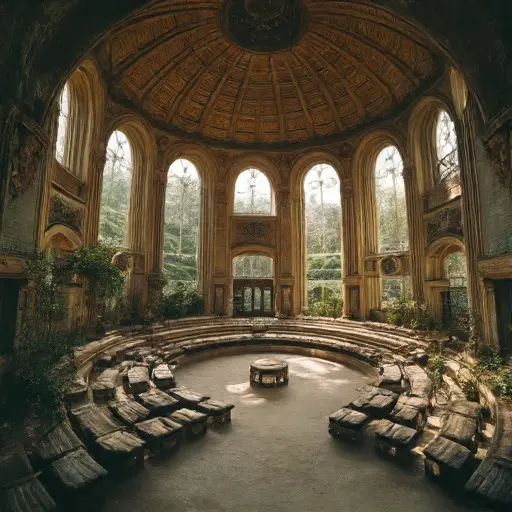
A compact park-facing pavilion manor designed as a low circular rotunda set at the center of a gently reclaimed civic garden, where the architecture functions less as a private residence and more as a sculptural public ornament embedded in landscape geometry. The silhouette is perfectly balanced and rotational, with a central rounded volume anchoring two subtle curving wings that extend outward like restrained gestures guiding circulation through the surrounding park.
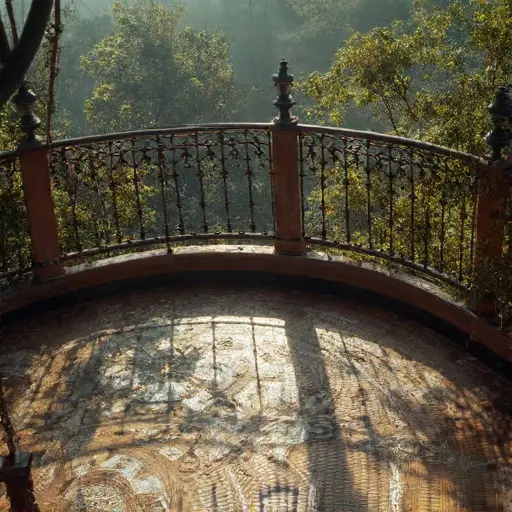
Rooflines are softly domed and segmented, composed of curved slate shells, fine copper ribbing, and narrow lantern vents arranged in a crown-like ring that emphasizes the building’s radial symmetry. The façade is fully exterior and highly refined: citrus-amethyst plaster walls with smooth mineral finish, coral-azure carved stone pilasters marking structural rhythm along the curve, and jade-sunburst wrought iron filigree wrapping continuously around circular windows and veranda edges like ornamental circuitry.
The sky hangs in a warm, clear cerulean overcast, naturally lit and evenly bright, producing clean color separation and soft architectural shadows without haze or dramatic contrast.
The estate sits in a public garden biome where pathways trace circular flows around the pavilion and grass grows in gentle spiraling patterns that mirror the building’s geometry, slowly blurring the line between designed landscape and natural regrowth.
At the garden perimeter rests a broken marble fountain ring, fractured but still aligned with its original circular basin, its surface smoothed by time and weather, once forming part of the pavilion’s leisure water system.
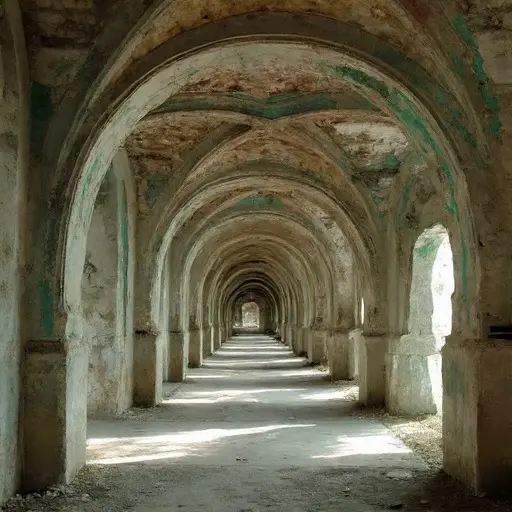
Inside, the pavilion remains abandoned yet preserved, with light and symmetry still defining its interior atmosphere.