Rabid Silence Drifted Through the Villa Where Cosimo Preserved the Shadows of Vines
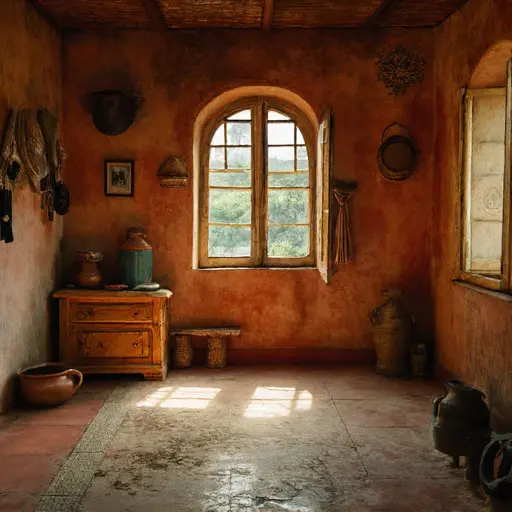
The walls darken before sunset.
Not from age.
From memory.
Across the projection room, faded silhouettes still stain the plaster—leaf shapes, lattice shadows, and twisted patterns resembling vines long removed from the property.
Cosimo preserved them deliberately.
The villa belonged to him.
He lived there alone and practiced a profession almost impossible to explain without sounding superstitious.
Cosimo was a vineyard shadow conservator.
His work involved recording and preserving the seasonal shadow patterns cast by vine canopies onto walls, courtyards, and working spaces. Certain growers and estates once believed these moving silhouettes carried environmental information about pruning, sunlight balance, and vineyard health.
He archived absence through light.
The projection room still carries his obsession.
Pigment trays remain beside tracing rods. Shadow sheets hang from brass clips. Seasonal ledgers rest near shelves carrying panels labeled by trellis style, harvest year, and sun angle.
The room feels suspended between farming and theatre.
Beside the Hollow Trellis Chamber
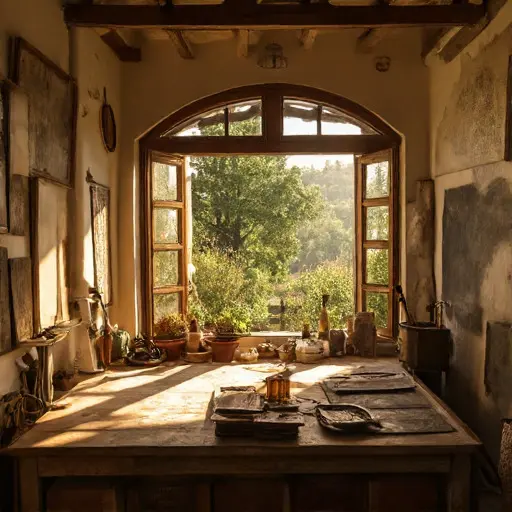
Cosimo worked beside the Hollow Trellis Chamber.
The narrow side room faced southwest and received the cleanest projection lines during late afternoon when vine shadows reached maximum detail.
One unfinished preservation still rests there.
The silhouette traced.
The seasonal annotation missing.
Cosimo inherited the villa but learned the profession from vineyard laborers who treated shadow not as decoration but as agricultural witness.
People remembered him watching walls more than grapes.
For decades the work survived.
Historic vineyards and family estates still valued seasonal shadow archives tied to canopy management and environmental memory.
Then cultivation industrialized.
Mechanical pruning, standardized vineyard systems, and high-efficiency trellis design steadily erased the irregular canopy forms shadow conservators relied upon. Walls no longer carried the same complexity.
Cosimo disliked perfect rows.
He said symmetry made vines forget themselves.
Still, he continued preserving shadows and tracing seasonal variation long after patrons disappeared.
Then the hail arrived.
Repeated extreme hail seasons shattered traditional canopy cycles and forced widespread replacement with protective netting that altered sunlight and shadow behavior across surrounding vineyards.
The grapes survived.
Their silhouettes changed.
Already living with advanced cataracts and chronic balance problems, Cosimo spent longer afternoons inside the chamber preserving fading wall projections.
One violent storm season he remained working during unstable weather while trying to document a rare surviving shadow pattern.
A section of weakened ceiling collapsed after heavy rain saturated the old masonry.
He died beneath the chamber he refused to abandon unfinished.
The funeral gathered growers, cellar workers, and aging vineyard families who still remembered Cosimo tracing walls with charcoal-black fingers.
The villa remained afterward.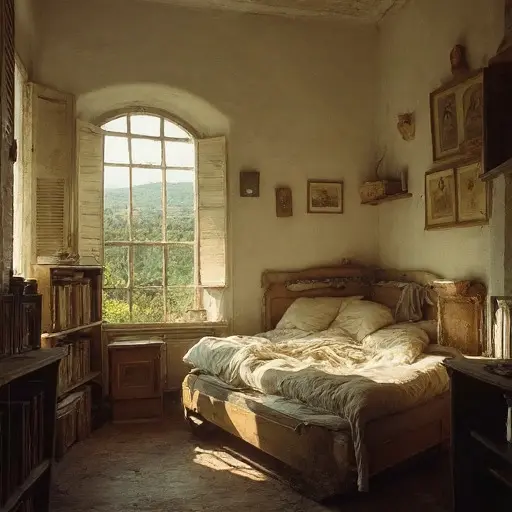
The tracing rods remain beside the trays.
The shadow sheets still hang from their clips.
And beside the Hollow Trellis Chamber, Cosimo’s unfinished vine shadow continues waiting in silence—holding a season of light he never returned to preserve.