Phos-Umbra: The Astronomer’s Lightless Star
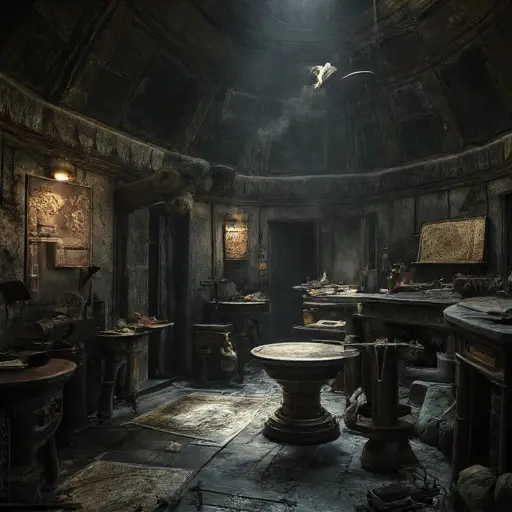
The moment the heavy, bronze-plated door to Phos-Umbra was finally breached, the air rushed out—cold, dry, and heavy with the pervasive, unsettling odor of stale ether, cold metal, and the fine dust of pulverized graphite. The name, combining light with shadow, perfectly captured the manor’s function: a place dedicated to revealing the farthest sources of illumination, now trapped in perpetual night. This abandoned Victorian house was structured not for ordinary living, but for unwavering, precise observation, its massive walls and specialized rotating dome designed to eliminate all external light and stabilize the delicate instruments.
The final inhabitant was Dr. Cassian Stroud, a brilliant, but intensely reclusive astronomer and astrophysicist of the late 19th century. Dr. Stroud’s profession was the mapping and spectral analysis of distant stars and nebulae. His singular obsession, however, was the creation of the ‘Final Star Catalogue’—a complete record of every luminous object in the visible universe, believing that the arrangement of these celestial bodies held the ultimate, perfect geometric truth of existence. After a lifetime of observations, he realized his catalogue was endlessly growing, leading him to a terrifying hypothesis: the universe was infinite, and his task, futile. He retreated to the manor. He dedicated his final years to resolving this single, terrifying goal, believing that the only way to complete the catalogue was to find the single, non-luminous object that anchored the cosmos. His personality was intensely logical, detached from earthly concerns, and utterly consumed by the pursuit of cosmic finality.
The Spectrograph Chamber
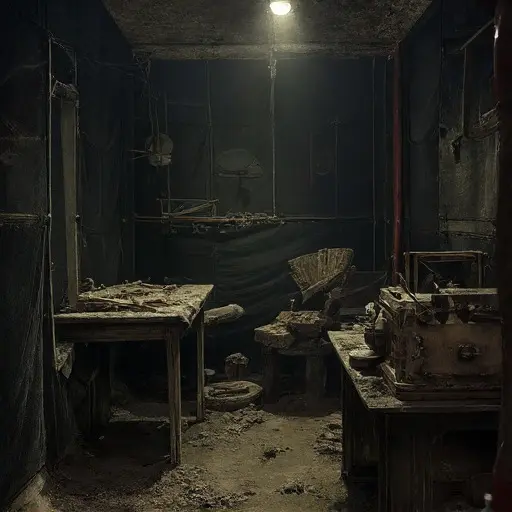
Dr. Stroud’s mania culminated in the Spectrograph Chamber. This secure, windowless room was where he spent his final days, not analyzing light, but charting the absence of light. His journals, written in a cramped hand that eventually gave way to dense, complex equations involving zero and negative values, were found pinned beneath the telescope’s eyepiece. He stopped trying to catalogue stars and began trying to map the void, concluding that the only way to define the cosmos was by charting the ultimate object: a body with zero light, or the ‘Shadow Anchor.’ “The truth is not in the fire, but in the ultimate cold,” one entry read. “To measure the universe, I must observe the object that emits nothing, and anchor the infinite chaos.”
The house preserves his scientific methods. Many internal walls are subtly painted with faint, phosphorescent dots and arcs, remnants of his tests to gauge the human eye’s adaptation to total darkness within the manor.
The Final Focus in the Abandoned Victorian House
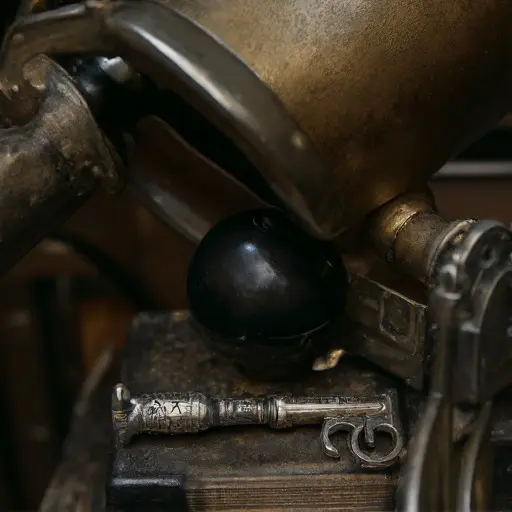
Dr. Cassian Stroud was last heard working in the observatory, followed by a loud, complex crushing sound of brass and glass, and then immediate, profound silence. He did not leave the manor. The next morning, the dome was sealed shut, the Spectrograph Chamber locked, and the man was gone. No body was found, and the only evidence was the singular, physical alteration to his final instrument.
The ultimate chilling clue is the obsidian sphere. It sits where the eyepiece should be, a single, perfect symbol of ultimate non-luminosity. This abandoned Victorian house, with its cold, dark dome and complex, silent instruments, stands as a cold, imposing testament to the master astronomer who pursued the infinite light, and who, in the end, may have successfully found his Shadow Anchor, removing himself entirely from the visible universe and vanishing into the unyielding, silent darkness.
