Orchard valley quiet house
An abandoned Victorian family house rests within a sheltered orchard valley where long-established rows of apple and pear trees spread across gently rolling ground, forming an uneven agricultural geometry softened by decades of natural growth. The trees are mature and slightly irregular, their branches arching outward in layered silhouettes that filter warm daylight into shifting patches of gold and green across long grass and fallen fruit. The air is still, open, and gently luminous, with no harsh shadows—only soft continuity between land, tree, and structure.
The house is a compact two-story Victorian residence built from hand-fired red brick that has aged into a muted spectrum of russet, clay, and weather-softened terracotta. Subtle variations in brick tone reveal different building phases, yet the structure reads as unified and deliberate, shaped by practical rural life rather than decorative ambition.
Its proportions are modest and slightly elongated, with a central living core and a small rear utility extension that once served domestic agricultural needs.
The façade is organized around a centered entrance framed in simple stonework. The front door is heavy timber painted in a faded deep green, worn at the edges to reveal raw wood grain beneath. Above it sits a small transom window that softens the entry with diffuse interior light. Tall, narrow sash windows are arranged with practical regularity across both floors, their cream-painted frames now subdued and slightly uneven in tone from long exposure to weather. The glass reflects the orchard canopy in softened, fragmented patterns, occasionally revealing faint interior silhouettes behind aged lace curtains.
The roof is moderately pitched and covered in weathered clay tiles, their coloration shifting between faded red, brown, and soft gray depending on moisture and age. Two chimney stacks rise at opposite ends of the ridge, subtly asymmetrical in wear but structurally sound, suggesting separate hearths that once warmed different parts of the home. The roofline remains clean and continuous, reinforcing the house’s grounded rural stability.
A narrow brick path extends from the front steps into the orchard, though it is partially reclaimed by grass and scattered fruit. Its original geometry is still readable beneath nature’s gradual overlay, guiding movement between tree rows without imposing strict control over the landscape.
Inside, the atmosphere is quietly preserved, as if the house paused rather than declined.
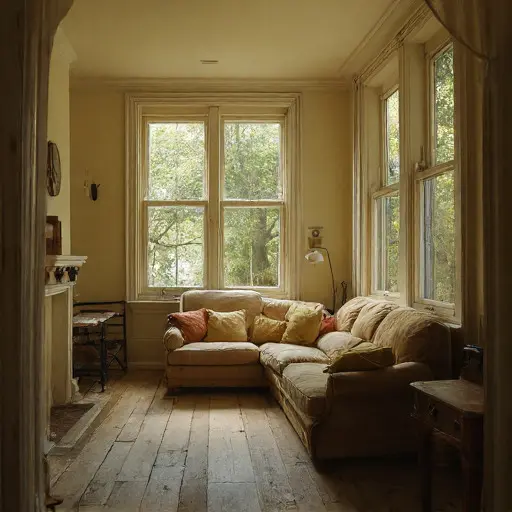
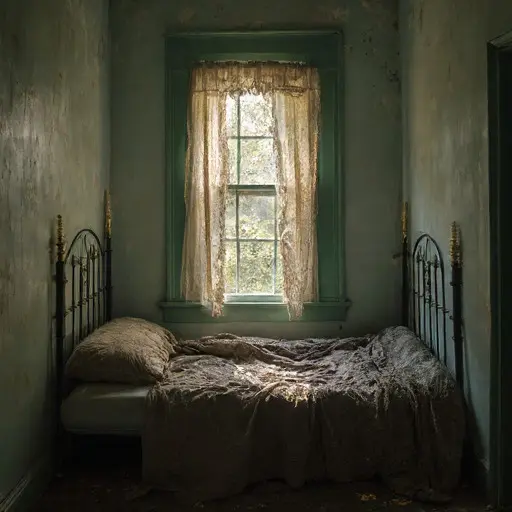
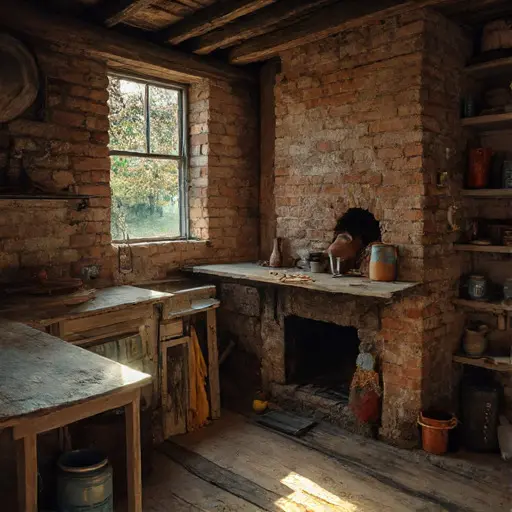
The surrounding orchard remains quietly active even in abandonment, with fallen fruit gathering beneath trees, grasses weaving through old planting lines, and seasonal growth slowly reclaiming the spacing between trunks. No fences remain, only the memory of order expressed through natural rhythm and spacing.
The atmosphere is calm, warm, and enduring—an abandoned Victorian family house resting within an orchard valley, shaped by agricultural life and gently absorbed back into the land without losing its structure or identity.