Orchard House of the Forgotten Rows
Abandoned Victorian orchard house resting in a wide forest clearing under soft overcast daylight, where evenly diffused illumination flattens harsh contrast and reveals a muted, natural palette across stone, timber, and regrown grass. The atmosphere is calm and agricultural in memory, as if the land still remembers its original grid beneath the soft reclamation of nature.
The structure is compact and horizontally composed, built from pale stone on the lower level with white-painted timber framing above. It sits precisely within the faint geometry of a former orchard, where the original planting grid remains visible as subtle lines of stone markers embedded in the soil. Most of the orchard has returned to grass and scattered saplings, but the underlying structure of rows and spacing is still legible across the clearing.
At first glance, the house appears symmetrical, with a centered entrance and evenly spaced sash windows across both floors. On closer inspection, the upper floor extends slightly wider than the lower level, creating a restrained overhang supported by concealed internal beams. This creates a layered architectural profile that feels intentional and stable rather than distorted.
The roof is simple dark slate, clean and intact, with a steady ridge line running the length of the structure. Two small chimneys sit closer together than typical Victorian spacing would suggest, subtly compressing the roof’s rhythm. The slate tiles remain mostly aligned, though minor inconsistencies appear along the edges, suggesting localized repairs over long periods of seasonal use.
A long glass-sided conservatory runs along one side of the house, once used for orchard-related cultivation and seasonal propagation. The glass panels remain intact but slightly clouded with age, diffusing the soft gray daylight into a gentle internal glow. Inside, rows of empty wooden benches are still arranged in disciplined lines, echoing the orchard’s external grid outside the walls.
Windows across the façade are clear but lightly dusted from within. Curtains hang still and minimal, with some rooms fully exposed and others softly obscured by fabric. The interiors appear orderly and domestic, composed of simple rectangular rooms with consistent floor levels and quiet, functional proportions.
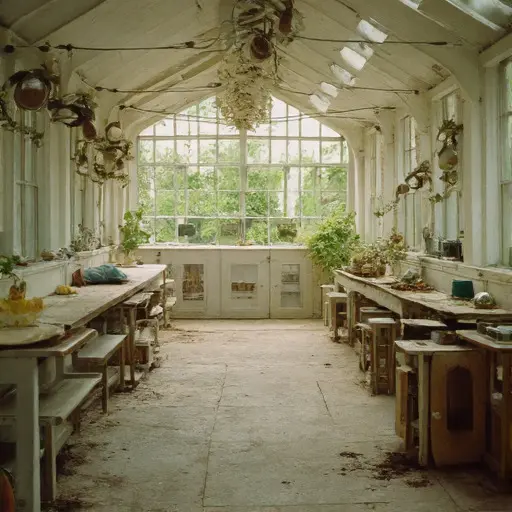
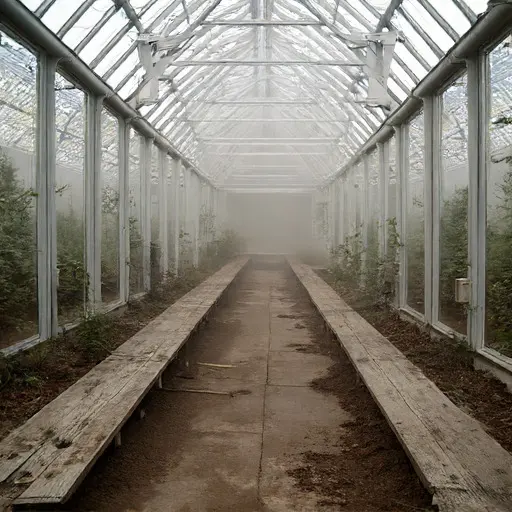
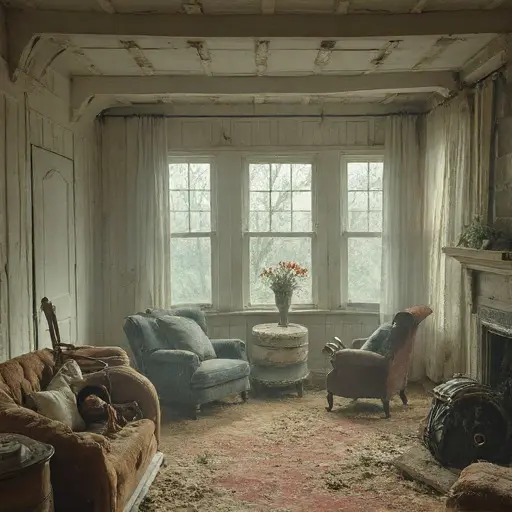
The surrounding grounds remain open and breathable, with low grass covering most of the former orchard. Faint stone borders still trace the original planting rows, forming a subtle agricultural map beneath the natural regrowth. The forest edge stands at a respectful distance, framing the clearing without encroachment.
No decay, no collapse, no supernatural elements. The house feels like a seasonal estate left after harvest duties ended—preserved in quiet domestic suspension, aligned with the forgotten agricultural geometry that once organized the land. Cinematic realism, exploration-game environment aesthetic, grounded materials, and subtle environmental patterning driven by orchard structure rather than architectural distortion.