Orchard Bluff Terrace House
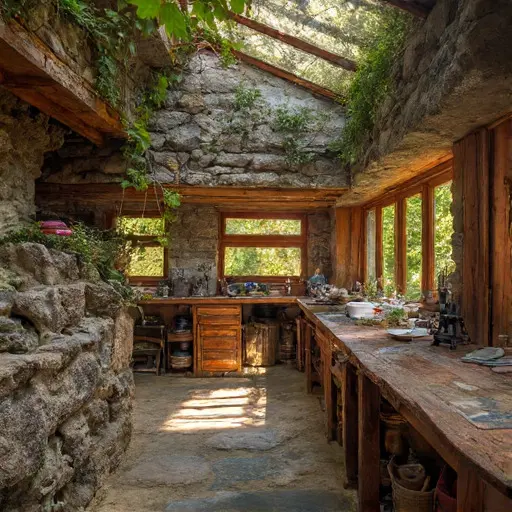
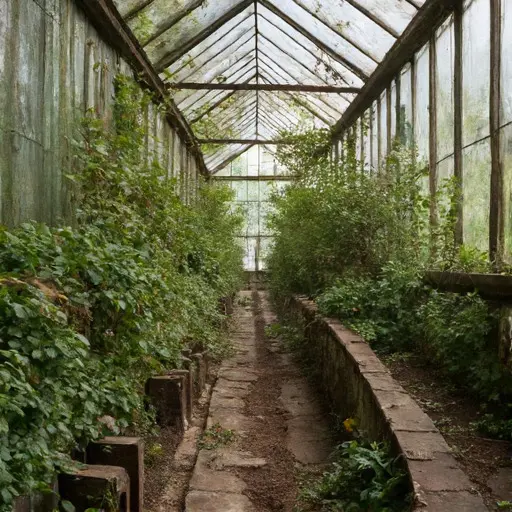
Abandoned Victorian house, sapphire-terracotta shingle, jade-powder stucco, amber-graphite cast iron, a compact Victorian cliff orchard cottage built as a small stepped residence carved into a terraced fruit garden descending toward a coastal bluff, where the house follows the rhythm of agricultural terraces rather than street alignment. The silhouette is layered and grounded, with a modest two-story core, a staggered lower kitchen level partially embedded into the slope, and a narrow greenhouse corridor that runs along the terrace edge like a functional spine connecting rooms to the orchard. Rooflines are broken and tiered, formed from overlapping slate-and-shingle sections, copper drip edges, and small wind-baffled chimneys positioned according to terrace geometry rather than symmetry.
The façade is fully exterior and agriculturally weathered: sapphire-terracotta shingle cladding softened by salt wind and orchard moisture, jade-powder stucco reinforcing terrace-facing walls with lime-stained aging, and amber-graphite cast iron used in irrigation gates, balcony braces, and orchard trellis anchors, all darkened by soil contact and coastal air. Trim contrast appears in forged iron clamps, stone utility markers embedded in retaining walls, and aged wooden beam joints exposed by long-term repair cycles.
The sky is a soft coastal orchard overcast, pale blue-gray with diffused natural light, producing honest tonal rendering across stone, wood, and foliage without stylization.
The house sits in a terraced orchard biome where rows of apple and pear trees descend in ordered lines toward the cliff edge, their roots held by stone retaining walls covered in moss and lichen. Grass grows thick between orchard rows and spills over terrace edges, mixing with wild herbs and seasonal wildflowers. A broken orchard pulley system lies tangled near the lowest terrace, its iron wheel rusted and partially buried in soil, while a collapsed wooden fruit crate ramp rests against a retaining wall, warped and softened by rain. A shallow irrigation channel runs along each terrace, carrying rainwater between levels in thin reflective streams. Every surface feels exterior, agricultural, and physically grounded, like a real Victorian orchard residence designed to manage land, water, and harvest rather than serve ornament. The entire scene reads like a documentary architectural photograph of a forgotten hillside farming home, naturally reclaimed, structurally honest, and deeply integrated with cultivated terrain.