Nodus-Ember: The Cartographer’s Final Point
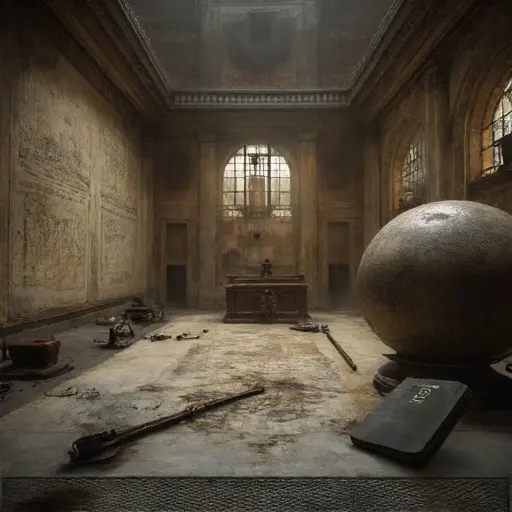
The moment the heavy, bronze-plated door to Nodus-Ember was carefully pushed open, the air rushed out—cold, dense, and heavy with the pervasive, unsettling odor of dry drafting paper, mineral pigments, and the faint, sweet decay of old horsehair padding. The name, combining a knot or central point with a dying coal, perfectly captured the manor’s function: a physical space dedicated to defining the planet’s surface, now embodying its own absolute geographic nullity. This abandoned Victorian house was structured not for ordinary living, but for unwavering, geometric precision, its internal layout a bewildering maze of unusual angles, sudden shifts in elevation, and meticulously aligned windows designed to aid in triangulating local survey points.
The final inhabitant was Mr. Tobias Zenith, a brilliant, but intensely reclusive master cartographer and geodesic surveyor of the late 19th century. Mr. Zenith’s profession was the creation of highly accurate, large-scale maps, correcting the errors of past geographers. His singular obsession, however, was the creation of the ‘Zero Map’—a single, perfect, flawless projection that would, through the absolute synthesis of all known geographic data, reveal the ultimate, objective truth of the planet’s surface, free of all distortion or error. After realizing the impossibility of accurately representing a spherical world on a flat plane (the inherent error of projection), he retreated to the manor. He dedicated his final years to resolving this single, terrifying goal, believing that the only way to achieve the Zero Map was to understand the ultimate absence of all spatial dimension. His personality was intensely systematic, fearful of dimensional inaccuracy, and utterly consumed by the pursuit of spatial finality.
The Triangulation Chamber
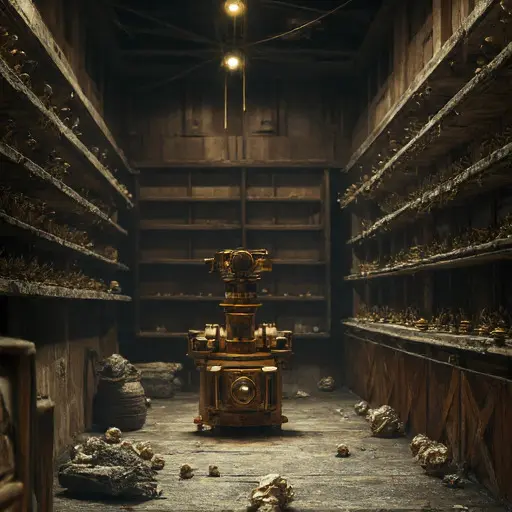
Mr. Zenith’s mania culminated in the Triangulation Chamber. This secure, sealed room was where he spent his final days, not charting land, but deconstructing the act of measurement itself, attempting to define the ultimate point that had no size or extension. His journals, written in a cramped, precise hand that eventually gave way to complex formulae involving infinitesimal calculations and non-Euclidean geometry, were found sealed inside the hollow core of the terrestrial globe. He stopped trying to map the world and began trying to map the void, concluding that the only way to achieve the Zero Map was to eliminate the need for any dimension whatsoever. “The line is a lie; the surface is a deception,” one entry read. “The final map requires the complete surrender of all extension. The truth must be a single, self-evident, unstated conclusion, contained in a singular point.”
The house preserves his systematic anxiety structurally. Many internal door frames and archways are lightly carved with small, repeating reference lines and cross-hairs, his attempts to create a universal grid of perfect alignment within the manor.
The Final Point in the Abandoned Victorian House
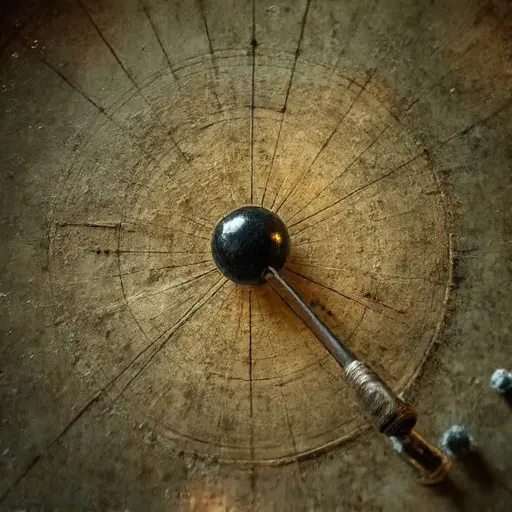
Mr. Tobias Zenith was last heard working in his map room, followed by a sudden, intense sound of rapidly spinning gears that abruptly seized, and then immediate, profound silence. He did not leave the manor. The next morning, the map room was cold, the globe sealed, and the man was gone. No body was found, and the only evidence was the singular, physical alteration to his final, most prized object.
The ultimate chilling clue is the obsidian bead embedded in the North Pole. It is the final measurement—the Zero Map achieved, containing no lines, no landmasses, and only a single, perfectly defined point of origin. The broken awl and seized instruments ensure no further attempt could be made to chart the imperfect surface of the world. This abandoned Victorian house, with its silent map room and geometric precision, stands as a cold, imposing testament to the master cartographer who pursued the ultimate, pure geographic truth, and who, in the end, may have successfully defined the Perfect Point, vanishing into the un-extended, objective singularity that he engineered as his final, terrifying statement of space.
