Merciless Silence Settled Over the Chalet Where Lucien Preserved the Shape of Wind
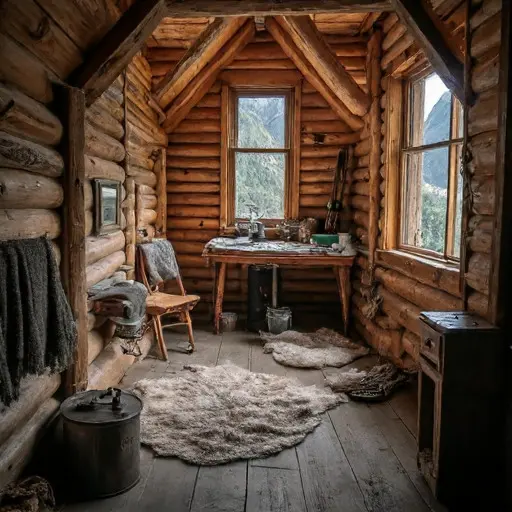
The ribbons never touched the floor.
Even now.
Thin strips of treated fabric remain suspended from rafters and poles throughout the loft, drifting faintly whenever the house settles or distant weather presses against the roof.
Lucien hated still air.
He believed motion revealed truth faster than speech.
The chalet belonged to him for nearly thirty years.
He lived there alone and practiced a profession so temporary most people mistook it for eccentricity.
Lucien was a wind contour sculptor.
His work involved recording and shaping airflow behavior through suspended fabrics and weighted forms used by alpine rescue stations, glider communities, and mountain observatories. Before digital atmospheric tools became dominant, specialists like Lucien modeled wind corridors visually to understand turbulence and thermal movement.
He sculpted invisible terrain.
The loft still reflects his obsession.
Weighted silk bands hang beside cedar poles. Draft charts remain pinned beneath horn clips. Hand-carved airflow markers rest near long benches stained by years of weather testing and graphite notation.
The room feels unfinished by design.
As though waiting for weather to answer.
Across the Gale Thread Balcony
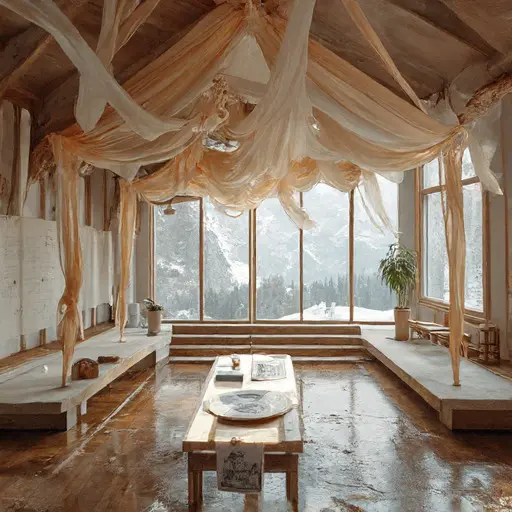
Lucien worked closest to the Gale Thread Balcony.
The narrow loft extension overlooked the valley and allowed him to compare interior fabric behavior against live mountain currents.
One unfinished contour still hangs there.
The upper thermals mapped.
The descending sweep unresolved.
Lucien inherited the chalet after years spent assisting glider instructors and weather guides across highland routes.
People remembered him watching clouds longer than conversations.
For decades his work survived.
Rescue crews, pilots, and mountain operators still valued locally modeled wind knowledge shaped through observation and experience.
Then navigation automated.
Advanced atmospheric software, drone surveying, and real-time predictive systems steadily displaced visual contour work. Wind became data rather than witnessed behavior.
Lucien respected precision.
He mourned detachment.
Still, he continued modeling valley currents long after commissions faded.
Then the ice withdrew.
Accelerated glacier retreat and destabilized alpine terrain altered thermal systems and mountain wind patterns that had guided his craft for decades. Familiar contours became erratic and increasingly difficult to compare against historical records.
The mountains remained.
Their breathing changed.
Already living with degenerative spinal illness and recurring vertigo, Lucien continued climbing onto the balcony to adjust suspended studies.
One late summer storm arrived faster than forecast.
While securing fabric models against violent gusts, he lost balance near the outer railing and fell into the ravine below.
The funeral gathered glider pilots, former rescue workers, and villagers who still remembered ribbons moving from his windows before storms.
The chalet remained untouched.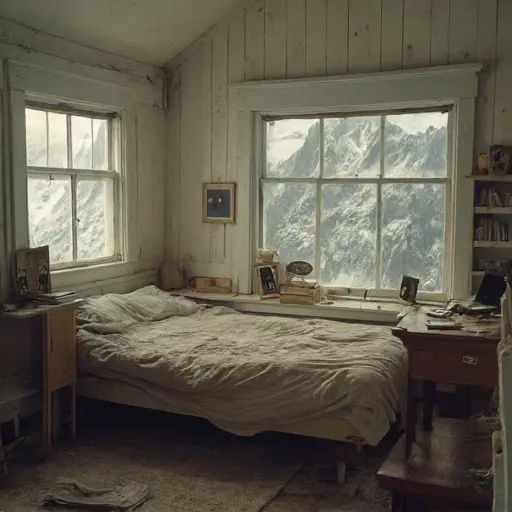
The silk bands remain hanging from the rafters.
The draft charts still cling beneath their clips.
And across the Gale Thread Balcony, Lucien’s unfinished wind contour continues drifting softly—studying a current he never returned to shape.