Lumenwood Lighthouse House
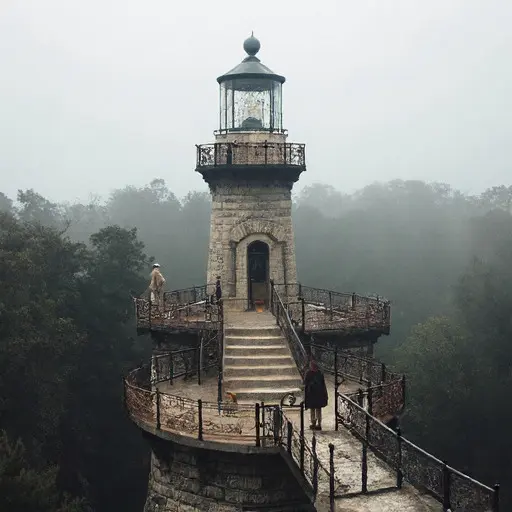
Abandoned Victorian lighthouse-house resting in a dense inland forest clearing under soft overcast daylight, where evenly diffused illumination removes harsh shadows and renders every surface in muted, coherent detail. Pale stone at the base transitions into white-painted timber residential structures wrapped around a central cylindrical tower. The atmosphere is quiet and geometrically focused, as if the forest has arranged itself around a functional architectural signal point that no longer broadcasts.
The structure is fully intact and carefully preserved, combining a traditional lighthouse tower with a Victorian domestic residence integrated around its lower half. The central tower rises cleanly from the core of the building, slightly tapered and perfectly stable, with narrow vertical slit windows spiraling upward in a consistent rhythm.
The masonry is smooth and unbroken, showing only mild weathering consistent with long-term exposure rather than decay.
Encircling the tower’s base is a compact circular residence forming a continuous ring-shaped floor plan. From the exterior, the building reads as symmetrical and unified, but internally the rooms subtly adjust in width as they follow the curvature of the structure. This creates a gentle spatial flow where walls bend naturally around the tower, maintaining structural logic without visual distortion.
The roof system consists of segmented slate panels that wrap smoothly around the circular base. Each segment is tightly fitted and well-preserved, forming a cohesive ring of dark gray surfaces that contrast with the pale stone beneath. A single chimney emerges slightly off-axis from the tower’s tangent point, remaining upright and functional in appearance without any signs of structural stress.
Windows are evenly spaced along the curved exterior walls, all intact and lightly dusted from inactivity. Some curtains remain drawn back while others hang motionless, revealing curved interior rooms where sightlines bend gently around the central tower. Light travels consistently through the circular geometry, reinforcing the building’s rotational logic.
A narrow exterior walkway encircles the tower at mid-height, supported by iron brackets embedded into the masonry. The walkway is stable and continuous, but its railing pattern exhibits a subtle shift halfway around the circumference, where a decorative motif repeats in a slightly compressed interval while maintaining full structural continuity.
The surrounding forest forms a natural circular clearing around the building, as if shaped by the lighthouse’s presence. Grass remains short and evenly distributed, with minimal wild growth near the foundation stones. Trees stand at a respectful distance, creating a quiet perimeter that emphasizes the building’s centrality without encroachment.
Inside the residence, spaces are calm and functional, with curved wooden floors, pale wall paneling, and Victorian detailing adapted to the circular geometry.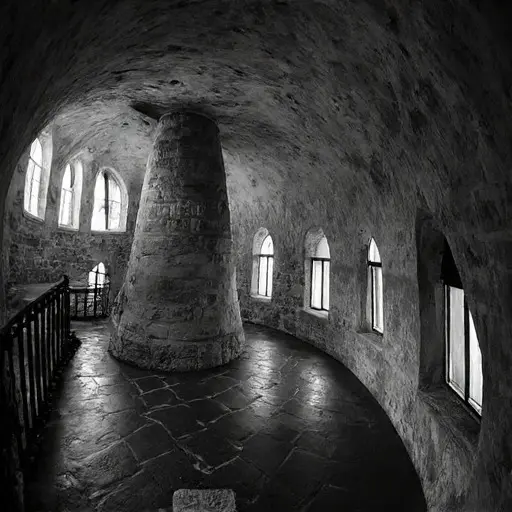
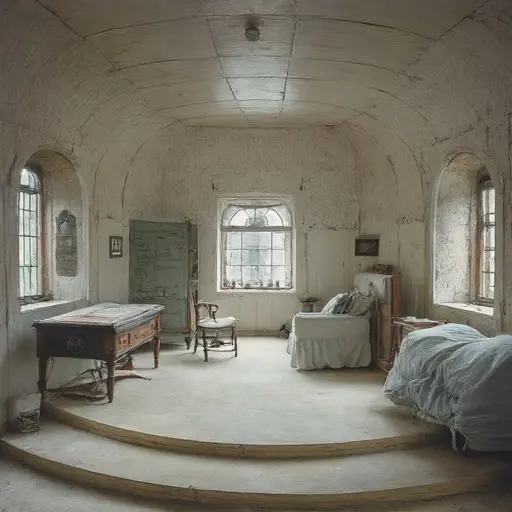
No decay, no collapse, no supernatural elements. The house feels like an inland navigation lighthouse repurposed as a residence—quietly preserving its circular logic in isolation, guiding nothing but remaining perfectly aligned with itself under a gray forest sky. Cinematic realism, exploration-game environment aesthetic, grounded materials, and subtle circular spatial organization driven by lighthouse architecture rather than distortion or ruin.