Lumen-Veil: The Illusionist’s Final Trick
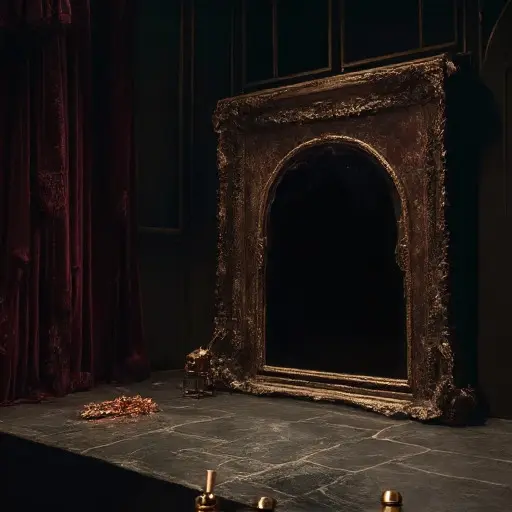
The moment the heavy, bronze-plated door to Lumen-Veil was carefully pushed open, the air rushed out—cold, dense, and heavy with the pervasive, unsettling odor of dry rosin dust, magnesium flash powder, and the sharp scent of mineral oil. The name, combining light with a covering or mask, perfectly captured the manor’s function: a physical space dedicated to creating visual deceptions, now embodying its own absolute, bare truth. This abandoned Victorian house was structured not for ordinary living, but for unwavering, controlled visual effects, its internal layout a bewildering maze of hidden passages, counterweighted platforms, and meticulously angled corridors designed to facilitate complex disappearances and reappearances.
The final inhabitant was The Great Zantus (his stage name, legally Mr. Silas Pye), a brilliant, but intensely reclusive master illusionist and optical physicist of the late 19th century. Zantus’s profession was the creation and staging of monumental, seemingly impossible acts of magic, always rooted in a profound understanding of physics and human perception. His singular obsession, however, was the creation of the ‘Zero Illusion’—a single, perfect, flawless trick that would, through the absolute synthesis of all known optical and mechanical principles, deliver the ultimate, objective truth of perception: making an object vanish by removing the idea of the object itself. After a close call where a trick nearly resulted in a fatality, he retreated to the manor. He dedicated his final years to resolving this single, terrifying goal, believing that the only way to achieve the Zero Illusion was to understand the ultimate absence of all appearance. His personality was intensely secretive, fearful of exposing his methods, and utterly consumed by the pursuit of perceptual finality.
The Scrim Chamber
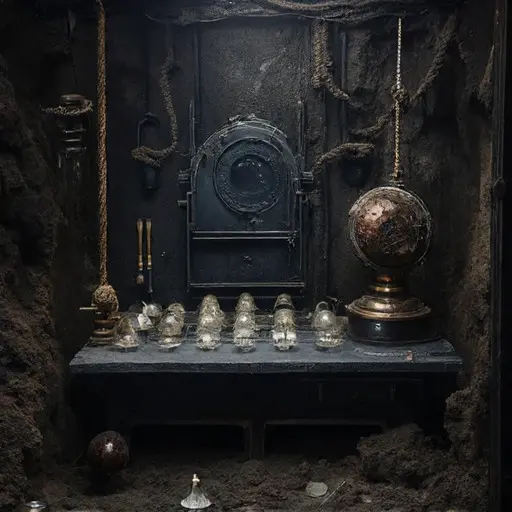
Zantus’s mania culminated in the Scrim Chamber. This secure, sealed room was where he spent his final days, not practicing illusions, but deconstructing the act of seeing itself, attempting to define the ultimate perception by isolating the moment before the audience’s mind filled in the blanks. His journals, written in a cramped, cryptic shorthand that eventually gave way to complex equations concerning refraction and human psychology, were found pinned beneath a broken stage lamp. He stopped trying to make things disappear and began trying to design the un-appearance, concluding that the only way to achieve the Zero Illusion was to eliminate the need for an audience. “The trick is a lie; the method is a crutch,” one entry read. “The final vanishing act requires the complete surrender of the performer. I must seal the stage and become the ultimate, unperceivable object.”
The house preserves his theatrical anxiety structurally. Many internal passages are fitted with small, strategically placed peep-holes and viewing slits, designed to allow him to constantly watch the surrounding areas, a permanent, self-imposed audience.
The Final Vanish in the Abandoned Victorian House
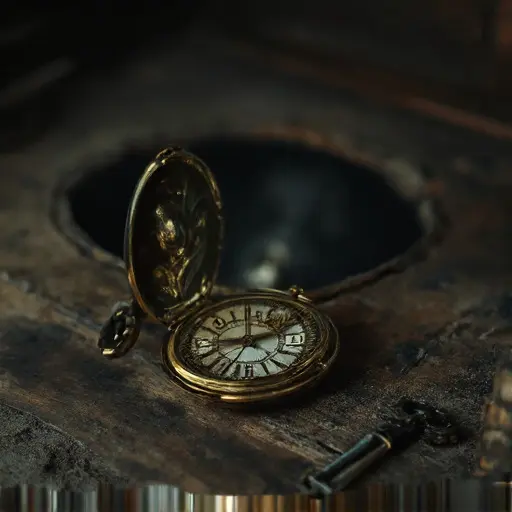
The Great Zantus was last heard working on his stage, followed by a sudden, intense sound of heavy gears grinding to a halt and a soft, rhythmic thump, and then immediate, profound silence. He did not leave the manor. The next morning, the stage was cold, the curtain drawn, and the man was gone. No body was found, and the only evidence was the singular, physical alteration to his final stage setup.
The ultimate chilling clue is the open trapdoor and the stopped watch. The watch marks the moment just before a change, a moment frozen in anticipation of a transition that never completed. The open trapdoor, his final mechanical secret, leads only to empty space. This abandoned Victorian house, with its silent stage and hidden mechanisms, stands as a cold, imposing testament to the master illusionist who pursued the ultimate act of deception, and who, in the end, may have successfully performed the Zero Illusion, vanishing entirely from the realm of perception, leaving behind only the unmistakable, objective truth that he was, quite simply, no longer there.
