Lost to the Vines: Aegisthorne Hall
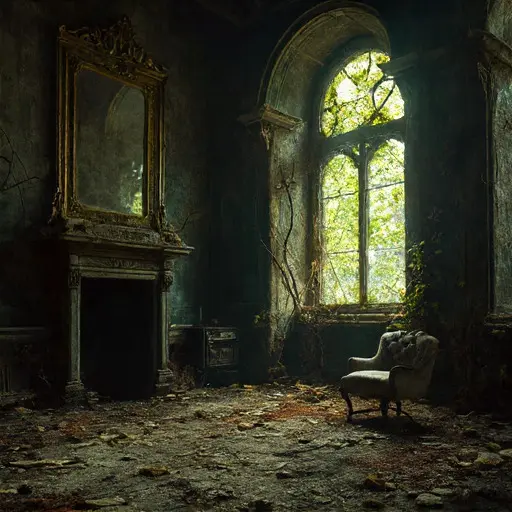
The stillness inside Aegisthorne Hall was the sound of a century holding its breath. Crossing the wrecked parquet floor of the Main Entry, the air was heavy with the mineral scent of powdered stone and the dry, decaying spice of old cedar. This mansion had been left to the quiet mercies of time and the slow, relentless invasion of the outside world.
Every forgotten object remaining within its dark, heavy rooms served as a mute witness to a domestic life that had been severed with traumatic speed, leaving no room for gradual decline.
Silas Hawthorne: The Master of Illusion
The history of Aegisthorne Hall is inextricably linked to Silas Hawthorne, a Victorian stage illusionist and theatrical impresario whose fame peaked in the 1880s. His profession was built on creating perfect illusions, but his temperament was deeply secretive and obsessive about protecting his methods and, more importantly, his personal life from public view. He had a deep, pathological fear of being truly known. He married Eleanor, a former dancer from his troupe, primarily to give the illusion of domestic stability, but their marriage was a carefully choreographed performance. They had no children.
Silas’s true character is best preserved in his Private Workshop, a custom-built room hidden behind a false wall in the Library. The room is still full of his tools of the trade: sawn-off mirrors, rolls of thin copper wire, and heavy, detailed blueprints for his stage apparatus. His desk, covered in a fine layer of dust, holds a small, black velvet-lined box containing dozens of intricately carved wooden keys—keys to every lock, safe, and trick device he owned. His entire world was built on locks and secrets.
Eleanor’s Locked Cage
Eleanor Hawthorne lived in the vast, cold space of Aegisthorne Hall as a glamorous prop. Her former vibrant life as a performer was extinguished by Silas’s paranoia, which forbade her from having public friends or activities that were not strictly approved. Her only private space, and the location of her turning point, was the Music Parlor, though she rarely played the room’s grand piano.
The Music Parlor is filled with the elegant detritus of her imposed leisure. On a small, round table, beneath a pile of mold-fused, romantic novels, lies her Embroidery Hoop, the fabric torn and stained. Tucked into the velvet lining of the hoop’s wooden frame is a small, folded playbill from a rival performance hall, dated 1895. Scrawled on the back is a name, Arthur D., and a clandestine meeting location. This was her final, desperate attempt to reconnect with her former life and escape her emotional cage.
The major turning point for the house came in 1897. Silas discovered Eleanor’s attempt to escape and, in a fit of controlling rage, locked her out of their shared Master Bedroom, banishing her to the Guest Suite for weeks. The strain and public silence of the event broke Eleanor’s spirit.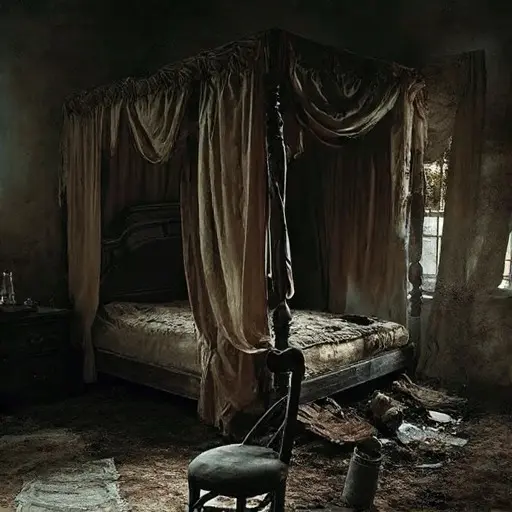
The Illusionist’s Final Act
Eleanor finally found her means of escape not through confrontation, but through a terrifying silence. She slipped away in the dead of winter in 1898, leaving behind only her wedding ring, which she placed conspicuously on Silas’s desk in the Master Bedroom.
Silas Hawthorne, publicly disgraced by his wife’s flight and terrified of the resulting scandal and the exposure of his meticulously guarded secrets, suffered a catastrophic collapse. The final, brutal turning point is concealed in his Secret Workshop. There, amidst the intricate blueprints for a new vanishing act, is a small, brass-bound journal—his Method Book. The final entry is not a stage instruction, but a short, shaky confession: “The only thing I ever truly made disappear was happiness.” The entry stops mid-sentence.
Silas walked out of Aegisthorne Hall the day after Eleanor’s departure, not bothering to lock the front door. He abandoned everything—his secrets, his props, his life—vanished entirely from public life, disappearing into the obscurity he had always both feared and craved. Aegisthorne Hall was left to the creditors and the relentless vines, its interiors standing as a perfectly preserved, forgotten monument to the terrifying price of illusion and control.
