Lexi-Fracture: The Poet’s Final Verse
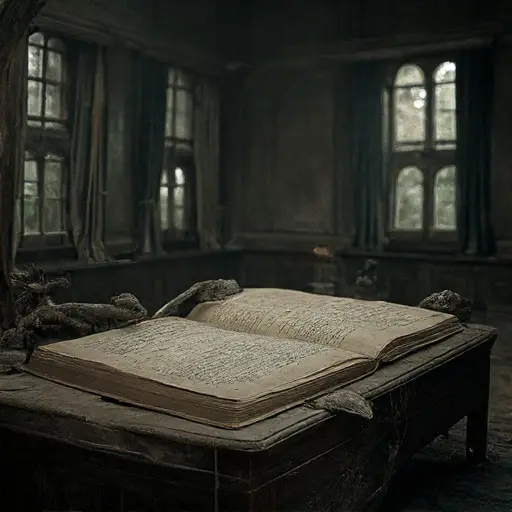
The moment the heavy, bronze-studded door to Lexi-Fracture was pushed open, the air rushed out—cold, dry, and heavy with the pervasive, unsettling odor of aged parchment, dry flowers, and the faint, sweet decay of old laudanum. The name, combining a word with a break or split, perfectly captured the manor’s function: a place dedicated to assembling language, now eternally fractured. This abandoned Victorian house was structured not for domestic warmth, but for deep, agonizing introspection, its secluded chambers designed to isolate the resident from all external distractions.
The final inhabitant was Lord Byron Thorne, a brilliant, but intensely reclusive and emotionally volatile poet laureate of the late 19th century. Lord Thorne’s profession was the creation of complex, emotionally charged verse, often exploring themes of existential dread and romantic decay. His singular obsession, however, was the creation of the ‘Ultimate Poem’—a single, perfect, flawless arrangement of words that would capture the absolute, comprehensive meaning of the entire human experience in one concise piece. After a profound crisis of self-doubt concerning the futility of human expression, he retreated to the manor. He dedicated his final years to resolving this single, terrifying goal, believing that the truth of existence lay in the perfect fusion of form and meaning. His personality was intensely dramatic, self-critical, and utterly consumed by the pursuit of linguistic finality.
The Metaphor Vault
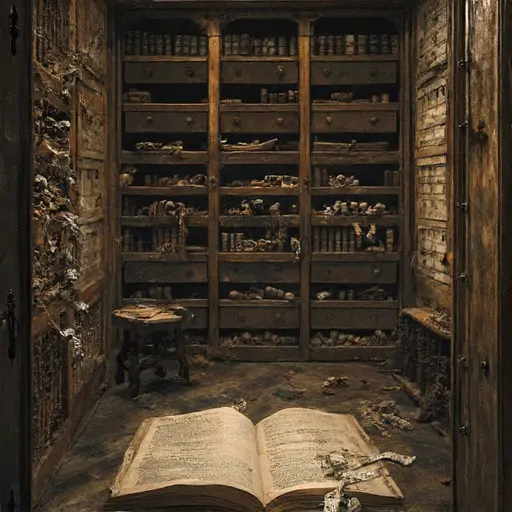
Lord Thorne’s mania culminated in the Metaphor Vault. This secure, light-tight room was where he stored every analogy, simile, and poetic device he had ever considered and then deemed flawed. His journals, written in a dramatic, shifting script and found sealed inside a hollow plaster bust of Shakespeare, detailed his terrifying conclusion: the only way to achieve the Ultimate Poem’s absolute meaning was to eliminate all intermediaries of language. He decided that the final, critical verse must be composed of pure, unadorned meaning, stripped of all metaphor, rhythm, or human artifice. “The word is a lie; the form is a distraction,” one entry read. “The final truth requires the complete surrender of all art. The verse must be silence, but a silence that sings.”
The house preserves his fastidiousness. Many internal walls are subtly marked with pencil-thin scoring where he used a straight edge to align his handwritten verses, practicing the rigid, physical structure of his intended final piece.
The Final Line in the Abandoned Victorian House
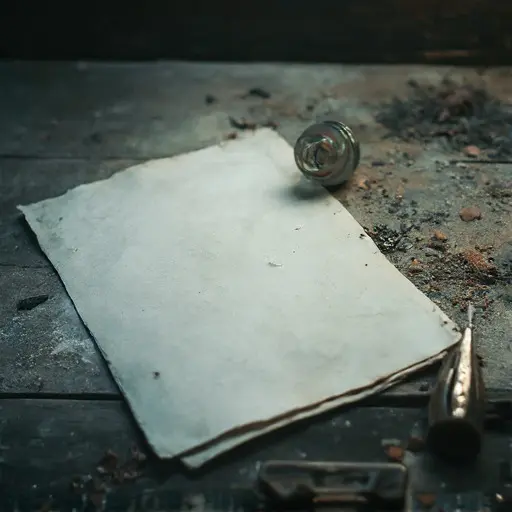
Lord Byron Thorne was last heard working in his salon, followed by a sudden, loud smash of glass, and then immediate, profound silence. He did not leave the manor. The next morning, the salon was cold, the paper scattered, and the man was gone. No body was found, and the only evidence was the singular, physical state of his final piece of paper.
The ultimate chilling clue is the blank sheet of paper. It is the final page of his work—the Ultimate Poem achieved, containing no words, no punctuation, and no language. This abandoned Victorian house, with its silent chambers and vaulted literary spaces, stands as a cold, imposing testament to the master poet who pursued the final, perfect expression, and who, in the end, may have successfully composed the poem that demanded absolute silence, vanishing into the unwritten, ultimate truth that he engineered as his final, terrifying artistic statement.
