Latchwell Sanatorium House
Latchwell Sanatorium House sits deep within a fog-choked forest where the trees grow in tightly packed, near-parallel columns, as if the entire landscape has been repeatedly compressed into alignment. The air is dense and still, with moisture hanging between trunks like suspended breath. At first glance, the structure reads as a coherent late-Victorian institutional residence—part private estate, part medical retreat—constructed from pale yellow brick, soot-darkened limestone, and long bands of iron-reinforced plaster fractured into fine branching stress lines.
The most immediate disorientation comes not from ornamentation, but from repetition. Circling the building reveals that it is composed of multiple façades that appear to be the same design executed several times with slight variation.
Window spacing shifts by inches, cornices rise or fall imperceptibly, and entire wall sections appear duplicated with delayed offsets, as if successive construction attempts were never removed and instead stabilized in parallel existence. The result is not symmetry or asymmetry, but repeated near-sameness that never fully resolves into a single version.
The foundation is unnaturally level against the sloped forest terrain. The house does not conform to the ground; instead, it enforces a rigid horizontal plane that cuts through the landscape. Soil and roots accumulate against this boundary like they are being pushed aside by an invisible structural rule. Drainage grates are embedded along the base, but many terminate into sealed brick cavities that show no continuation beyond their visible depth.
Windows are tall, institutional sash frames with thick, slightly fogged glass. While uniform in shape, their placement subtly contradicts internal partitions. In several instances, exterior windows align with what should be interior walls, yet from inside, those same openings reveal entirely different rooms. This creates the impression that interior layouts shift depending on observational position, without any visible mechanical explanation.
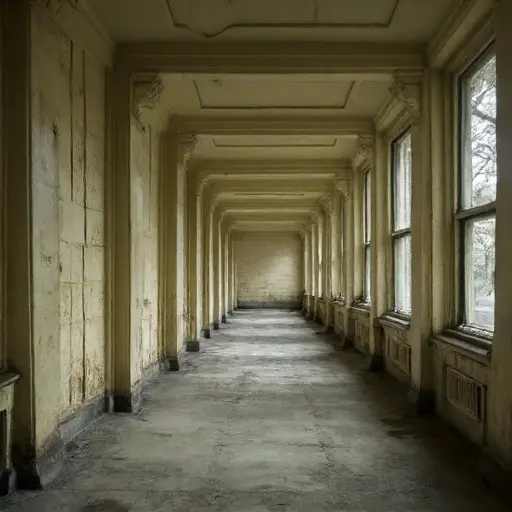
A long central corridor runs through the building’s core. From outside references, it appears straight and consistent, but once inside, it behaves differently: the corridor gently expands and contracts in slow, barely perceptible cycles that only become noticeable after extended movement. Doorways along this passage are evenly spaced, but their thresholds vary slightly in height, producing a subtle rhythm of ascent and descent that never resolves into a staircase or ramp.
The roof is steep and heavily layered, formed from overlapping slate planes that intersect without clear seams. Dormer windows are arranged in positions that suggest internal collision points, yet each corresponds to a separate attic volume. The roof does not contain a single attic, but multiple overlapping roof-spaces that do not share a unified interior map.
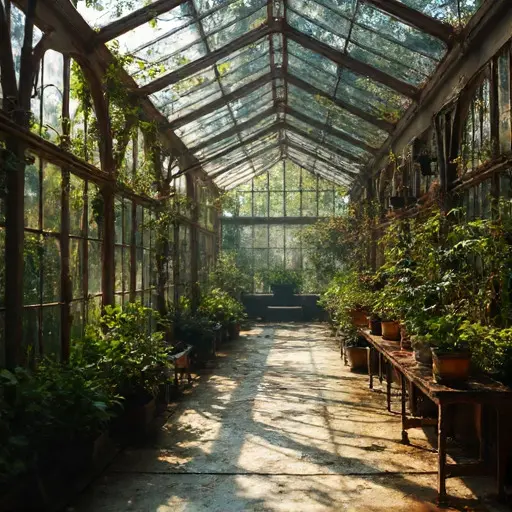
A glass conservatory extends from the rear of the structure, framed in rust-darkened iron. While geometrically simple from the outside, its internal proportions contradict its footprint: walking through it produces a shorter experience than its exterior length suggests, while looking through its ends reveals deeper space than physically traversable distance allows.
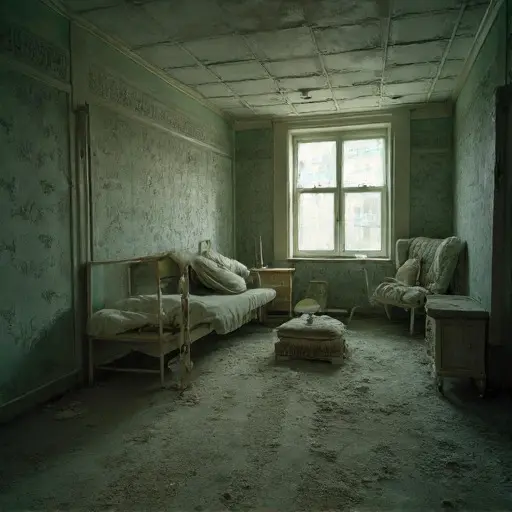
Inside, the atmosphere is still and slightly colder than the fog-damp exterior. Wallpaper peels in controlled vertical strips, often revealing identical layers beneath, as if the surface has been replaced with itself rather than renewed. Furniture is absent, but faint depressions in dust suggest repeated arrangements that no longer persist in physical form.
Outside, the forest maintains an unusual restraint. Vegetation stops abruptly at a narrow perimeter surrounding the house, forming a silent boundary that is neither fence nor wall. Beyond this line, trees grow densely and vertically, untouched by encroachment, as though acknowledging an exclusion zone that has no visible enforcement.
Latchwell Sanatorium House does not present as damaged or decayed. It presents as unresolved. It is an architectural record containing multiple finalized versions of itself, each occupying the same physical space without ever agreeing on which configuration is definitive.