Last Equilibrium in the House of the Glacier Sound Technician
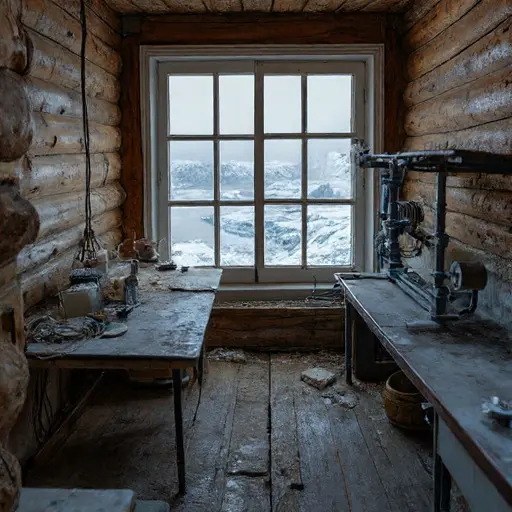
The recordings are still looping.
Soft, low-frequency hums trapped in analog reels that were never powered down properly.
Each tape carries the sound of ice shifting deep within the glacier walls outside.
This house belonged to Einar.
He worked as a glacier sound technician, recording and analyzing sub-ice acoustic patterns to monitor structural stability in glacial formations used for climate research and coastal safety systems.
The acoustic lab was built into the lowest reinforced part of the house to isolate vibrations from wind and shifting ice.
Hydrophones were suspended in sealed liquid chambers. Vibration plates lined the floor. Recording reels rotated slowly, capturing deep tonal shifts from within the glacier mass.
The house was not designed for silence.
It was designed to listen to frozen movement.
At the Sub-Ice Signal Console
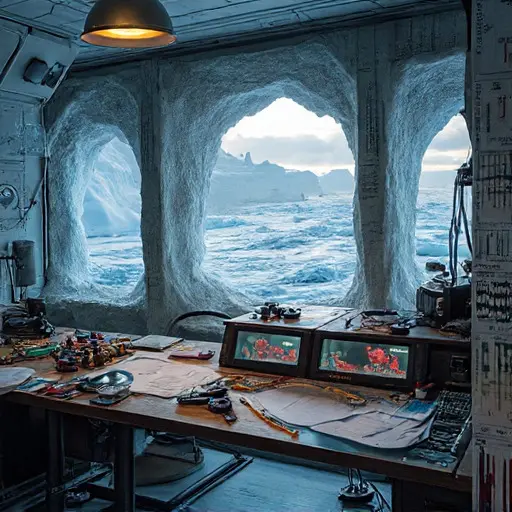
Einar worked most often at the Sub-Ice Signal Console.
The reinforced steel desk was where he translated glacier vibration data into structural stability reports used by coastal engineering teams and climate research stations.
His partner died during a field expedition when an ice shelf fracture collapsed unexpectedly beneath a monitoring platform.
After that, Einar stopped joining field deployments and remained stationed at the house year-round.
For years, the profession remained essential.
Climate scientists depended on glacier acoustic readings to detect internal fractures, predict ice shelf calving events, and model long-term polar stability.
Then satellite interferometry replaced acoustic field monitoring.
Remote sensing systems began mapping ice movement from orbit, reducing the need for embedded sound technicians working inside polar structures.
Einar continued anyway.
Even after the research station was officially decommissioned.
Even after data submissions stopped being accepted.
But the decline was not only technological.
The glacier itself began accelerating.
Rapid warming cycles caused unpredictable internal cracking patterns, making acoustic interpretation increasingly unstable and difficult to validate against historical records.
Then access collapsed.
A series of structural ice failures made the surrounding glacier field unsafe, and all monitoring stations in the region were formally evacuated and sealed due to risk of large-scale calving events.
Einar stayed inside the house through prolonged polar isolation, continuing to record glacier sound even after external systems went offline completely.
During a final acoustic surge event, multiple deep ice fractures occurred simultaneously, producing overlapping low-frequency signals that overwhelmed all remaining recording equipment.
He attempted to stabilize the Sub-Ice Signal Console during a power fluctuation caused by regional grid failure and frozen line rupture.
He died before the final acoustic log could be finalized.
No climate institute retrieved the recordings.
The glacier continued shifting without observation.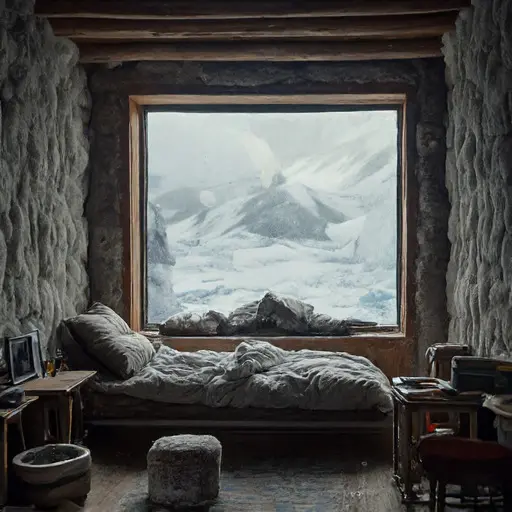
The hydrophones remain submerged in sealed chambers.
The reels still turn faintly when the wind outside is strong enough.
And at the Sub-Ice Signal Console, Einar’s unfinished glacier recordings continue waiting in silence—holding the last sound the ice ever gave before no one was left to listen.