Jade-Flare Cloister Manor
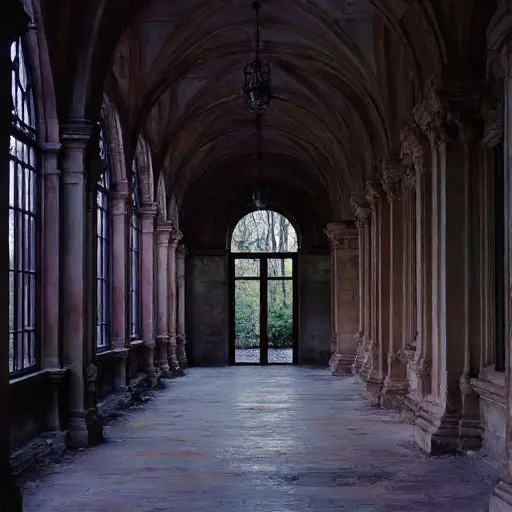
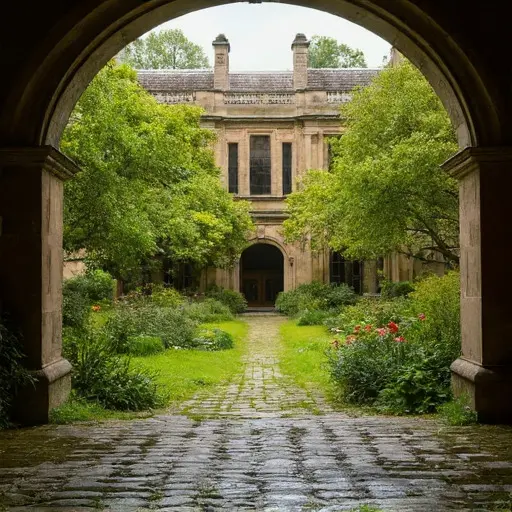
Abandoned Victorian mansion, jade-flare, orchid-steel, ember-aqua, a compact cloister-style Victorian manor organized as a strict square perimeter arcade enclosing a small open-air courtyard garden, prioritizing enclosed geometric symmetry over vertical expression or sprawling massing. The silhouette is grounded and rectilinear, with four connected wings forming a continuous architectural loop, where arched walkways define the entire identity of the structure as an exterior-facing enclosure rather than a conventional residence.
Rooflines remain low, disciplined, and continuous, composed of layered slate mansard planes and thin iron crest rails that trace the square perimeter with precise Victorian restraint. The geometry reads as architectural containment rather than expansion, with every edge reinforcing the idea of a self-enclosed civic-like domestic frame built around open air.
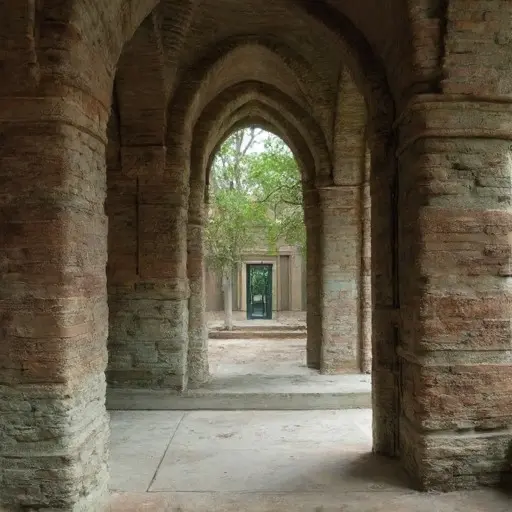
The façade is fully exterior and rhythmically structured: jade-flare masonry panels form the primary wall surfaces, orchid-steel column trims articulate vertical rhythm along the arcade, and ember-aqua cast-iron archwork repeats in measured intervals across all four sides.
Each arch is identical in proportion yet subtly weathered differently, producing a cadence of controlled imperfection typical of long-abandoned Victorian craftsmanship.
The sky hangs in a soft dusk-lavender overcast, naturally lit and matte, distributing even ambient illumination across stone, iron, and plaster. There are no dramatic shadows or highlights—only a stable, diffused light that emphasizes material texture: chipped masonry edges, oxidized iron joints, and softened plaster wear along arch recesses.
The estate sits in a quiet orchard-garden biome where wild grass grows through cobblestone seams in the central courtyard and spreads outward toward overgrown rows of fruit trees surrounding the cloister perimeter. The courtyard functions as an open-air void at the center of architectural control, where nature slowly reclaims the strict geometry without disrupting its underlying order.
At one corner of the arcade rests a broken stone carriage arch fragment, collapsed inward toward the courtyard edge, marking the former ceremonial entrance path now overtaken by grass and scattered orchard debris.